

Critics call living wage a strong-arming by unions
A lid was clamped on living wage supporters who showed up at a chamber-sponsored lunch Tuesday which had been billed as a “forum” on the issue.
Chamber of commerce officials later said the event was designed only to air the chamber’s opposition to the living wage.
The living wage ordinance is the most hotly contested issue on the fall ballot. At one point, chamber officials were over-heard telling one supporter who’d just been verbally attacked that it wasn’t “the appropriate time” to respond.
Conversation at the $25-a-plate lunch of broiled salmon — served by workers at the Four Points by Sheraton Hotel who would supposedly benefit if the living wage ordinance is approved by voters in November — largely focused on the negative aspects of the ordinance and how it could potentially harm local businesses.
The living wage law would raise the minimum wage for low-income workers at coastal Santa Monica businesses that earn more than $5 million a year in revenue to $10.50 with health benefits, or $12.25 without benefits. The wage for workers without benefits would increase to $13 after one year.
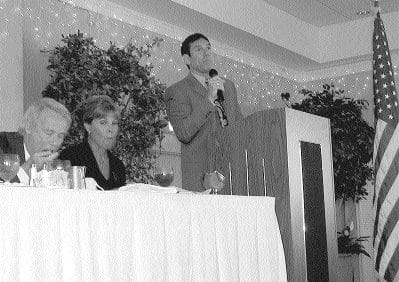
About 160 people, some representatives of unions and supporters of the living wage ordinance, sat quietly while KABC radio talk show host Al Rantel moderated the discussion between the two guest speakers and the audience. Those who attended were invited to write questions on pieces of paper placed at their tables.
The questions were picked up by chamber workers and processed by local property rights attorney Tom Larmore, a leader in the anti-living wage movement. Larmore passed along a few of the questions.
The chamber, which has strongly opposed the living wage ordinance for the past two years, hired former Michigan University Economics Professor David Neumark for $1,000 plus traveling expenses, to speak Tuesday about how living wage ordinances have a negative impact on low-income workers as a group, according to Larmore.
The second speaker was paid an undisclosed amount for a past study by living wage opponents. Richard Sander, a UCLA professor, wrote a report in 2000 for a coalition of local luxury hotels and the Santa Monica chamber that found the city’s proposed living wage ordinance would do more harm than good. During his talk Tuesday, he accused union-sympathizers and the city council of “fixing” the debate about the ordinance. He was not paid for his appearance.
Sander said Madeline Janis-Aparicio, executive director of the Los Angeles Alliance for a New Economy, or LAANE, told him not to bother applying with the City of Santa Monica to review its living wage proposal. He claimed at the luncheon that Janis-Aparicio told him that the city and LAANE had already hand-picked University of Massachusetts, Amherst Economics Professor Robert Pollin, to review the proposal so it would favor the living wage.
Janis-Aparicio wasn’t allowed to respond to the claims, despite her repeated attempts to approach the podium and address the crowd. Chamber officials quietly, but within earshot of the audience, told her it wasn’t “the appropriate time” to hear her.
“His claims are completely unfounded,” Janis-Aparicio said. “I met with him as a friend to discourage him from taking money from the hotels, nothing more.”
After the two professors spoke, living wage supporters dropped their forks and headed to the back of the penthouse conference room to hold their own press conference.
Vivian Rothstein, director of Santa Monicans Allied for Responsible Tourism, a coalition of union organizers and living wage supporters, said the professors misled the audience.
“There’s much more to this story than what was presented,” she said. “Don’t take what you heard at the luncheon as truth.”
Chamber officials said the luncheon was not meant to be a debate. They maintained it was positioned as an event for the chamber to present its views regarding the living wage ordinance.
“This wasn’t meant to be a sharing of views,” said Kathy Dodson, the chamber’s executive director. “This was meant to be more of an educational event.”
“educate” — The chamber insisted the event was designed to its members
Dodson had told the Daily Press on Monday that the chamber would be open to community debate on the issue during the luncheon.
One chamber member said she thought it was a disservice by the chamber’s leadership not to include the other side of the debate.
“Why weren’t there opposing points of view for their membership to hear?” asked Sonya Fox Sultan, a local estate attorney. “This was a skewed hearing, a totally skewed hearing.”
Jeff King, owner of Ocean Avenue Seafood, said his operation would be affected by the wage increase. He called the ordinance “insanity.” He added that minimum wage jobs are entry level positions meant as a starting point, not a career.
“Nobody stays a dishwasher all their lives,” he said. “It’s a stepping stone to a better job.”
King, who said he owns restaurants from San Diego to Calabasas, said people from around the state couldn’t believe Santa Monica would consider “almost doubling” its minimum wage.
“People out there ask can this really happen?” King said. “Well I say, ‘did people think Hitler could happen in 1928?’”
His remark drew a gasp from the audience, which otherwise clapped politely and remained fairly quiet during the luncheon.
Neumark said living wage laws generally cause unemployment for low-skilled workers because employers are forced to pay higher wages.
“If you raise the cost of something you are going to discourage its consumption,” he said.
Neumark, the economist, compared the living wage to a tax on cigarettes intended to reduced consumption.
“The more you raise the prices the more you discourage smoking,” he said. “Same premise here.”
But he also compared the living wage law to environmental regulations that may result in the loss of jobs but result in a cleaner habitat.
Sander accused the city council of trying to settle a unionization battle being waged between the local Hotel Employees & Restaurant Employees Union and several hotels near the beach.
“The easiest way to escape the living wage is unionization,” he said. “It becomes a local policy to promote unionization at that point.”
“The easiest way to escape the living wage is unionization. It becomes a local policy to promote unionization at that point.” — — RICHARD SANDER UCLA professor
Rothstein, who heads up the group supporting the living wage and is paid a salary by the hotel union, said SMART was supporting the ordinance for unselfish reasons.
“We feel this is a tool to bring workers and their families out of poverty,” she said.
Originally published in the Santa Monica Daily Press print edition on August 28, 2002. Read the original PDF.