

Latest advertising trend points shoppers to goods
By EMILY SKEHAN Special to the Daily Press
DOWNTOWN Michael Thomas’ scuffed brown Converse slide along the sidewalk on the corner of Ocean Avenue and Colorado Avenue as he flings himself onto his back hand, legs parallel to the cement. Tourists heading to the pier stop to watch, smiling and pointing. Children hang out of car windows with their mouths agape. The driver of a black Hummer honks and waves.
Thomas spins a large yellow arrow over his head while dancing back onto his feet, stopping to point at passersby and flash a cheesy grin.
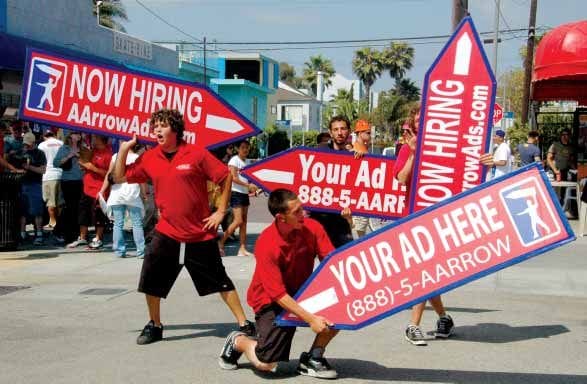
It’s just another Sunday at the office for the professional sign twirler, who spends five to six hours a day at street corners all across Los Angeles, performing acrobatic stunts with a cardboard sign to advertise a myriad of businesses.
By flipping, dancing, posing and twirling, sign spinners — or “human directionals” as they are known in advertising circles — are beginning to attract a lot of attention, both in Santa Monica and beyond.
“You see sign spinners everywhere nowadays,” said Mike Kenny, chief operations officer of Aarrow Advertising, a company he started five years ago along with partner Max Durovic. “The public just loves it. That’s the reason it’s gotten so big.”
The pair started Aarrow in their hometown of San Diego, where the then-high schoolers worked as sign holders themselves.
“We used to stand there and be those guys on the corner — just standing there with a sign,” Kenny said. “After 10 minutes, that’s the most boring job in the world.”
The pair began making up tricks to do with their signs as a means of passing the time, and soon realized the marketing potential in performance-based sign-spinning. Aarrow has since grown into a company of more than 400 human directionals across the country. The company has eight offices across the nation, including one in Los Angeles.
“We turned what used to be a boring and looked-down upon job into an extreme sport of the advertising world,” Kenny said.
Other companies that specialize in human directionals include San Diego-based MJAD Directionals and Lake Forest’s Eventz Extraordinaire. Almost all of the businesses that lease sign spinners claim to have created the sport/marketing method.
“I really think sign spinning is effective,” said Mark Verge of Westside Rentals, a Santa Monica company that employs the notorious “Rentals Man” — an eccentric free agent who dances wildly outside the company’s headquarters at Wilshire Boulevard and 10th Street. “People enjoy it and talk about it. It definitely gives us identification as a business.”
The industry has become increasingly competitive.
“It’s like when skaters are out on the street doing tricks and people going by are all, ‘Oh man, look at that!’ It’s the same thing with sign spinning,” said Thomas, who began spinning signs in high school and took the job on full time following graduation. “I see it as a sport — there are better players and there are rookies.”
Companies like Aarrow scout promising sign spinners working for other agencies, offering them raises to switch over to their team. Pay generally starts at $10 an hour, but increases with every trick the spinners master. At Aarrow, spinners can make up to $20 an hour, but top spinners with other companies command up to $60 an hour.
At Aarrow, advanced employees start training newbies at weekly training sessions meant to increase the team’s skills and keep them in shape. Spinners undergo tryouts much like those for sports teams, competing in physical drills — running, push-ups and sign-spinning tricks are all part of the routine, in order to prove that they have what it takes.
“It’s like a team you can learn from,” said Thomas, who trains most of the Santa Monica spinners and gets a commission based on the hours they clock. “If you see someone out there doing a trick you don’t know, you can go up to them and ask them to teach it to you.
There are more than 350 tricks in Aarrow’s “tricktionary,” a copyrighted encyclopedia that describes exactly how to perform sign stunts. Tricks include “The blender,” where the spinner twirls the sign behind his back, and “The Bruce Lee,”where the sign is rotated like a set of nunchucks.
“It’s our intellectual property,” said Kenny. “We have it down to a science.”
The average Aarrow employee is around 20 years old, according to Kenny, who added that one of the main aims of his company is to provide good jobs for young people.
“Our employees are from all walks of life,” said Kenny. “Kids who were delinquents in high school and need a new start, and also people who are still spinning after graduating from a great college like Georgetown”
The company sends out spinners for a wide array of businesses, from clothing stores to property rental companies to car dealerships. Rapper Snoop Dogg even flew Aarrow spinners to Atlanta for the release of his new album.
“It’s competitive, but we work together, too” — Not bad for a commercial pitchman
“People see the entertainment in it”
Santa Monica’s warm weather and busy intersections make the city a prime spot for outdoor advertising.
“LA is a great place for us for two reasons,” said Kenny.“Firstly, it’s the advertising capital of the world; there are a thousand billboards everywhere competing for attention. Secondly, as a sign spinner, it’s a great place for a job.
“Sign spinning is all about performance, and everyone in Los Angeles wants to be a star in some way.”
While Thomas spins all over Los Angeles, he admits his favorite spots are the pier entrance in Santa Monica and on the corner of Sunset and PCH.
“It’s great to be able to be spinning and the beach is right in front of you,” he said.
Still, sign spinning isn’t easy. Manipulating a five-pound plastic arrow for six hours in the Southern California heat is arduous, and though sign spinners start well above minimum wage at $10 per hour, the job is no walk in the park.
“When I started, I’d come home and be so tired and sore,” said Thomas, “my wrists were always hurting.”
He now comes to work prepared, decked out in Aarrow’s signature red polo shirt and black slacks, carrying a gallon jug of water and an iPod nano.
Thomas says he listens to techno music to get in the groove while spinning.
“Everybody will be laughing at me like, what is that guy listening to? But it makes me all amped,” he said, tuning in to Telepopmusik’s lively “Breathe” before breaking into a frenzy of tricks.
With its constant movement and strenuous acrobatics, sign spinning is a great workout.
“I was kinda chubby” admitted Thomas, who has trimmed down and gained muscle since he started his job a year ago.“You don’t need to go on any fancy diet, just start spinning.”
City residents are taking notice of the new marketing movement.
“People are always calling in with something to say about Rentals Man,” said Verge. “People think he’s hilarious”
Santa Monica resident Zach Lee laughed when he spoke of the sign spinners he has been spotting on street corners around Los Angeles.
“The ones I’ve seen are pretty talented,” he said, “but I don’t know how good of a marketing tool it is. It seems pretty gim-micky to me.”
Not everyone is a fan. Some cities — including Riverside, La Mesa and El Cajon — have banned the practice, citing the distraction sign spinners pose to drivers.
“I’m sure there have been accidents because people slow down to watch a spinner, or had to stop abruptly because the sign fell into the street” said Jim Griffin, El Cajon’s director of community development.
That city’s 1973 ordinance prohibits animated signs of any type, but was recently applied to human directionals, who are now issued warnings if they are doing anything but standing still with a sign.
“I’ve definitely turned my head while driving to watch them spin,” said Lee.
Kenny contends the sign spinners are trained to stand far from the curb and avoid distracting drivers.
“All of our spinners are very aware of safety,” he said.“They know that if an ambulance drives by they should put their sign behind their back and direct drivers to pull over.”
Despite the criticism, Kenny doesn’t think sign twirling will die out anytime soon.
“Advertising only works in the minds of consumers,” he said, “and lately, there’s been a big rejection of mass media advertising. Look what happened to pop-up ads on the Internet. Now we have spam blockers on our computers, we listen to Sirius radio to get rid of commercials, we have TiVo... sign spinning has that human touch that’s missing from mass media advertising.
Originally published in the Santa Monica Daily Press print edition on July 11, 2007. Read the original PDF.