

Denied shelter, writer takes to the streets
By GERRY SHIH I Special to the Daily Press
(Editor’s note: The following is part one of a two-part series that examines life on the streets of Santa Monica firsthand.) CITYWIDE Harry Shearer gave Santa Monica one of its most notorious and enduring epithets when he branded Santa Monica as the “home to the homeless” on his popular Le Show radio program based out of 89.9 FM KRCW.
It is easy to imagine the reasons: The city is relatively very safe, the temperate ocean breeze, and, most controversially, its plethora of city-run social services aimed at combating homelessness.
Yet, in venues where the homeless don’t typically participate — newspaper columns, Internet blogs, private homes — the debate over their fate, over just how welcoming Santa Monica should be towards its transient population, rages on. It has, perhaps, reached its most vociferous peak in recent years.
Residents often charge that Santa Monica officials have opened their arms with excessive magnanimity at the expense of the peace of its permanent residents. Widespread allegations of “dumping,” or shelters in Downtown Los Angeles bussing their worst Skid Row transients to the city by the sea, have sparked alarm, while the imminent prospect of a low-fare light rail or subway line from Downtown L.A. have further unsettled Santa Monicans who value the exclusivity that they bought at the price of astronomical Westside property rates.
How do the Santa Monica homeless live? Where are they from? Are Santa Monica’s homeless services as great as they’re touted to be? What will happen if Santa Monica indeed cuts back its homeless services? Should the city send busloads straight back to Fifth and Colyton?
I set out to find the answers: By mingling with the huddles on the street over the course of three days; by trying to convince myself of the lie that I was homeless, knowing in the back of my mind there is a warm apartment to which I would eventually return; by trying to ignore the fact that this was essentially futile grandstanding — our young reporter braves the harsh streets! — and trying to deny the simple reality that precisely because it isn’t real, I could never truly feel what it feels like to have absolutely nothing.
As I set out the first night, I imagine myself as a traveler, having landed in Santa Monica and in need of temporary emergency shelter. The goal of quickly finding a good shelter for the night by word of mouth should be easily accomplished, I assume, not knowing that even in Santa Monica, it’s harder than it looks. It would be another 48 hours before I found myself under a roof and receiving food.
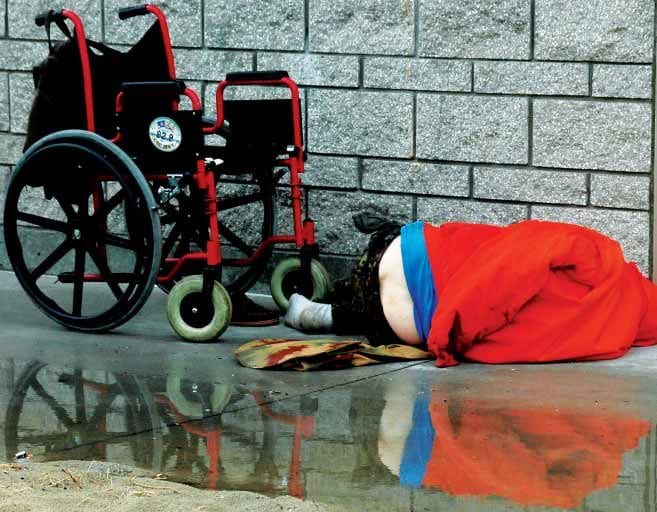
My first idea is to find John, who I remember from our previous conversations as a stubborn, cheerful, wheel-chair-bound veteran in his 60s who seemed to only ever wear shorts and a T-shirt. A landmine explosion in Vietnam left John with one leg and one eye. The one gray eye was mischievous, steely and sharp; the other socket was empty and fleshy. He was a common sight as he often panhandled in an alcove on the Third Street Promenade with his cardboard sign.
“Our country is really good for people climbing their way up, you know?” John used to say, his back straight as a rifle barrel, like a king in perennial short sleeves on his wheeled throne. “It’s the American dream. You go up, up, up. But when you fall down, this society don’t make it easy to get up again.”
He had done various jobs in the past, but the disability hurt his employment prospects. He was getting some money from the Veterans Administration before that was stopped, and he said he was trying to get just enough money to return to Massachusetts, where his sister might be able to house him. John could bring in $15 or $20 a day by panhandling, and for a wheelchair-bound homeless man, this place — safe and warm — was perfect.
John jerked his head backwards at a few men sitting on the railing behind him, and talked about how easy it is to be broadsided by the confluence of bad luck and be pushed across that threshold and onto the streets.
“You always think of bums like the crazy, psychotic ones downtown [Los Angeles],” he said. “It’s not really like that here. It’s a different group of people. A lot of those do come down here, but it’s a long bus ride. But these guys... a lot of former lawyers, doctors, Ph.D’s, you know.”
Behind him on the railing were a few men who had faces that could pass for distinguished professionals, their dirty clothes notwithstanding. I thought one man, with round cheeks and poofy white hair, looked kind of like George Washington.
On my first night, John’s the first person I look for where I expected to find him — Palisades Park. I don’t see him, and assume he got home to New England all right.
John has moved on as a new transient, Jim, takes his place next to that famous cannon aimed out at sea, Santa Monica’s defense in case the Japanese ever invaded.
Jim, in boots, shorts, a jacket and his legs propped on a mountain bicycle with a rolling rubber cart behind it, is talking to a woman named Jen, who is in the middle of devouring a pastry.
He’s one of those who could be mistaken for a pretty normal, middle aged white man.
“I personally try to look presentable, just so people treat you better,” he explains as he tries to give me, supposedly a traveling student who lost his wallet and is stranded in Santa Monica, some advice. He carefully goes over the procedure for establishing a money order account at Western Union, receiving money, and so forth. Jim dispenses some basic tips about taking Excedrin if I have trouble sleeping because of the cold, even though its a caffeinated painkiller.
He offers some further advice: Don’t sleep in front of businesses, don’t dig for food out of the common trash cans along Ocean Avenue, and stay alert for those who appear psychotic. There are too few cops and too many homeless “camping”illegally, he says, so the police only come and issue tickets if you blatantly sleep in front of a business or in the open where pedestrians might see you. The well-heeled types here in Santa Monica, and certainly the tourists, don’t want to see you sprawled out on the pavement. Otherwise, camouflage yourself well and it’s really not a problem. As for food, he has seen some people, usually the homeless, spit in half-eaten food out of spite before throwing it away so that another garbage-diver might get a big slobber-seasoned chunk of rotting bread, so watch out because you might get sick. If you wake up underneath some bridge one day and realize you’re so sick you can’t move, he says, then you’re in big trouble. It’s happened to him. Then there are the criminals, the types who were just released from San Quentin penitentiary, still buff from all the prison gym workouts, and out on the streets. You can see them with that look in their eyes walking towards you, he says, and they’ll never yield. But here in Santa Monica, he assures me, they’re really pretty rare. For some reason, there aren’t too many of the really ruined crack addicts either, he says.
But I have a hunch. I remember another conversation with a 46-year old acquaintance named Walter, an affable but reeking, self-admittedly hopeless alcoholic. When I did-n’t believe his name, we traded driver’s licenses. His face lit up to declare that his son shared my birthday, but then added that he hasn’t seen him in decades.
“You know why there isn’t so much crack here?” he asked with rhetorical smugness. “Because when those fools bring their crack from east downtown LA, me and my boys beat them up. If you want to smoke crack, do it on Skid Row. Santa Monica is cleaner. If you come here, don’t bring that sh** here.
“You can drink all you want, but if we see you with that crackpipe we’re going to beat your ass.”
Afterward, I always asked others on the street about a well-known vigilante group led by Walter, but no one heard of it. So, I didn’t bring it up with Jim.
Jim, 52, was born in Andover, Mass., as the son of a construction worker. He rubbed elbows with the blue-blood elite of the town, but watched the high school graduates pack their bags one by one and head off to Ivy League Schools. He never went to college. Instead, he worked as an electrician, and has been homeless since the bad divorce in 1981, when he was 26 years old. He decided to quit trying altogether, and since then, he has ridden his bike up and down the West Coast, watching the cars overtake him, or camped in the wilderness for months at a time and let the Northwestern showers drench him thoroughly. He likes that kind of stuff.
“I’m happy, I’m free,” he says.“For some people, the rich-er you are, the more you want. For others, the less you have and the closer you are to the earth, the happier you are. Look at these people with their expensive cars and their pretty girlfriends. They have to pay for their rent, their car, their children’s car, their children’s tuition. There’s so much responsibility. But the key is respect. You have to respect what they do and the responsibilities they have.”
But a quarter century after he first embarked down this path, he still has his fair share of doubts, which he reveals almost effusively after a few gently probing questions.
“What really kills you,” he begins slowly and pauses to nibble at his purplish lips, “is that you fall in love with the kids. Your bond with the children has a blood connection, as a man.You have a bond with the woman you have a relationship with, but you can break that.”
And yet, she remains one of his favorite subjects that he would spontaneously bring up whenever the conversation dies down. “Instant Debra,” or “I.D.,” people would call his wife because she was so mentally sharp. She took the house, the car and the children, and married a man who owned a ski slope, says Jim. Debra’s new sister-in-law got some kind of Harvard degree on full scholarship, he almost boasts with vicarious pride.
“I heard it costs $56,000 a year to go to UCLA now,” he says, grossly overestimating. “But there are people out there who can afford that, every year. It’s the Thanksgiving dinner issue. Look at me, I’m a nice guy, but those guys would never invite me to their Thanksgiving dinner because we’re just too different.
“There’s really that class issue that we don’t want to admit is there.”
On the other side of the cannon, a group of homeless Latino men tell animated jokes and pass around cigarettes. They mostly keep to themselves, Jim says, but they’ll still talk to the white homeless people before they talk to the housed people on the streets. Once you have no roof over your head, you’ve effectively dropped out of society.
EARLY CLOSING Tonight, you really have nowhere to go, Jim and Jen say, and a Latino man sitting nearby concurs. It’s already 7 p.m. The shelters all close at 5 p.m., and you have to go during the morning to sign up if you want to be assigned a bed. OPCC will assign you a caseworker, and if you get into the system, its a long-term commitment, but they can help you. Jen warned that Samoshel, now incorporated into OPCC, formerly had a reputation for being drug-infested.
Jen, a tidy black woman in her 40s, has her head wrapped with a cloth and wears a thin unbuttoned cardigan over a T-shirt. She shuffles around in faded black socks and sandals, and keeps all her belongings in two medium-sized plastic and cloth bags.
It’s not so bad out here, she says. “If you’re just yourself, people out here in Santa Monica aren’t going to hurt you,” she says assuringly. “They might take your stuff, rob you, but they won’t hurt you.”
Jim calls me to him to hand me my backpack. He’s about to leave and doesn’t want to leave my backpack behind.
“If someone takes it after I leave, you’ll think I stole it,” he says, and jumps on his bicycle and rides off, without any further good-byes.
When I return to where Jen is sitting, I catch her during a moment of introspection as she talks to her friend Yolanda, an older-looking black woman with several front teeth missing, smeared lipstick and disarrayed hair. Yolanda reeks of alcohol, but listens to Jen.
“I thank God every day, every time when I wake up,” Jen says and Yolanda nods, her head bobbling slowly, unevenly.
“Why, because you’re glad you’re alive?” I ask. “Of course!” Jen shoots back. Embarrassed about the awkward question, I leave Jen alone for a while and sit cross-legged on the ground. The air has become chilly, but the bricklaid ground has retained some heat from the daytime.
For the past half hour, a young man named Umberto has been putting his arm around Yolanda and whispering in her ear, although she is wearing white earphones.
Eventually, Umberto leans in and they kiss. Yolanda, dazed and drunk, puts her head on his lap and starts to drift in and out of sleep, her plastic radio earphones still in her ears. He squats down and gently unravels the tangle of the earphone cords.
To their right, Jen sits stoically, legs crossed and tries to distract our attention by giving tips on which shelters there are in town and what functions they serve.
A man dressed in a button-up shirt, black slacks and leather shoes yells from the sidewalk, where he joins his similarly-dressed friends and their girlfriends who brave the chill with plenty of skin exposed. They yell, talk and laugh loudly before getting into a taxi. Jen takes a look, then turns back around. Maybe they’re young consultants or bankers. Who knows who they are?
“They’re just crazy people,” she answers, “the ones always yelling.”
Jen, originally from Wheaton, Illinois, holds an MBA from Pepperdine University, where she used to help others by volunteering as a crisis counselor. She sold software for a living, driving extensively across the west coast on business for her company that sold automation software. She contracted carpal tunnel syndrome because of the excessive driving, and eventually hurt her knee in a serious accident that she doesn’t talk about. She lost her job, her apartment in Sherman Oaks, and has been waiting for the past four months for some disability or worker’s compensation money to come in.
“My situation isn’t so bad,” she says.“It’s been a couple of months, but I have some resources coming in. I’m ready to start again, I know I can find work. I’ll find a place with a roommate. Two roommates, if need be because it can get expensive.”
Jen confessed to strong Epicurean tendencies — particularly a predilection for pastries — and says she used to revel in cooking herself seafood and chicken because red meat is unhealthy. These days, her advice is to go to the Burger King outside the Santa Monica Place mall.
“Get a hamburger and don’t stay hungry,” she says at one point, while Yolanda gives Umberto some money to buy some drink. “Get something from BK and you can’t go wrong. It’s cheap and open late.”
Meanwhile, she assigns me to go check out Third Street Promenade: “You’ll like the shops and all the stuff going on.”
GOOD NIGHT AND GOOD LUCK When I return to Ocean Avenue almost an hour later, the benches are nearly deserted, but Jen looks livelier. She momentarily pauses her conversation with a man named Alberto.
“Have some of these,” she reaches into a plastic bag and offers two packs of Austin’s cheese cracker sandwiches. “Someone brought a box of these crackers. There’s a lot of them. Take some.”
There’s indeed a cardboard box with one opened pack of crackers left inside. Crumbs and wrappers are strewn on the ground; the box was probably passed around before everyone else left. Not yet comfortable with unrequited generosity, I pass around some cigarettes in exchange and Jen takes deep pulls while Alberto surveys Ocean Avenue with his hands in his pant pockets and begins to grumble about the cold.
Yolanda, hunched over and without Umberto, looks groggy and distracted, worse than before. A quick glance at the bottle of brandy — less than half is left — revealed her progress.
Soon Umberto returns with an upbeat, mustached smile and two grocery bags from 7/11. The contents: Two cans of Budweiser for Yolanda, a small bottle of white wine and a hot coffee for Jen, and a very liberal helping of the free packets of cream. While he distributes the cream — most to Jen for the coffee, some to Yolanda and some for himself — Jen pours some of her coffee into an empty Coke can for Alberto.
Once Yolanda surveys Umberto’s haul, she becomes furious and berates Umberto harshly and incoherently. It was her $12 and she expected more beer.
Umberto speaks very little English, and Alberto tries to reason with Yolanda on Umberto’s behalf. When he fails, he declares that it is time for him to go, and he leaves.
Jen says that she met Alberto a few months ago. He looked clean, well-spoken and well-dressed, and his grumbling about the cold seemed unusual for someone accustomed to the streets. So I ask Jen if he was without housing — she had subtlety implied earlier that she preferred the phrase — and she answers that he was, but owns a van that he sleeps in.
“It’s his birthday this Saturday and we’re going to celebrate,” Jen says. “You should come. He’s having a party. We’re going down to the beach. There are some grills down there that we can use.”
Yolanda seemed calmed temporarily and pushes a beer my direction. As soon as Umberto starts talking, she begins yelling at him again, and so he sits, looking apologetic, and everyone waits in awkward silence, staring at the dark sea in the distance.
“OK, folks, it’s time for good night,” Jen says and gets up to collect her bags and looks around.
A good sleeping spot is a valuable commodity. Jim had explained that you don’t tell anyone because you’re vulnerable while asleep.You might be robbed, someone might snitch on your location to the police, or perhaps worst, you might get beat up while sleeping by those who derive pleasure from beating up the homeless. Don’t tell anyone where you’re sleeping and don’t ask anyone where they’re going to be, Jim said.
Knowing that there is no shelter to go to tonight, I get a headstart towards the pier so Jen feels assured that no one is following her, and she shuffles along behind me by 50 feet. I turn around and she’s there. Halfway down the pier, I turn around again and she had already disappeared, veered off to her secret “camp” site where she will pass the night, wake up the next morning, and presumably mutter a word of thanks to no one in particular.
The ocean breeze really makes all the difference. The night was cold, but not as cold as the time I was stranded alone and penniless in the northern Japanese winter while foolishly traveling without planning. The homeless there had helped me steal some cardboard from a supermarket to make a cot and a boxy, corrugated sleeping bag.
Over there, there are no laws against “illegal lodging,” and the police didn’t mind it, and it’s not so jumpy. But here, so far, Santa Monica’s homeless seemed helpful, ordinary, the type who fell under some misfortune or made a decision to leave society and somehow couldn’t wade their way back up. This wasn’t a representative sample, I knew: There is a crowd out here that had fallen further, somewhere, but surely those who came to the Westside were a different breed than those from Downtown.
At a quarter past 4 a.m., I was woken by a patrol car that drove onto the dirt path and found my somewhat discreet location behind the senior center on Palisades Park at the very end of Broadway. The officer never got out of the car or spoke another word. A pleasant encounter with the police, if there ever was one, and I set off to find a new location, blanket in tow.
Not having realized that Tomorrow is OPCC, and we’ll see how good this famed Santa Monica system really works. (On Tuesday, part two examines the accessibility of local shelters and details one restless night inside a Venice ministry.)
Originally published in the Santa Monica Daily Press print edition on September 15, 2007. Read the original PDF.