

Success stories to be told at annual breakfast
By KATHLEEN BISHOP Special to the Daily Press
Sparing a dime for the homeless has translated into more than $100,000 for social service programs in the past decade.
The latest recipient from what’s known as the “Dolphin Change Program” is the Venice Family Clinic, which will receive $5,000 this week from the Bayside District Corp., a nonprofit organization that manages downtown Santa Monica with City Hall.
In an effort to deter panhandlers from the downtown area, officials started the dolphin program in 1993. The idea was to give passersby a place to put money for homeless people, other than in the hands of the vagrants themselves.
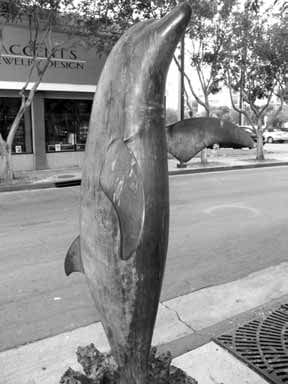
Five dolphin sculptures throughout Santa Monica serve as donation banks. The money taken from them goes to organizations that provide services for the homeless.
Bayside awards the donation annually at the Westside Shelter and Hunger Coalition Success Breakfast, which will be held this Friday. The award is part of the Marianne Dorn Memorial Grant. Dorn’s trust left a significant donation to the program in 1998 after her death, and the money is given in her honor.
“The dolphin program was the brain-child of the board of directors of the Bayside District Corp.,” said Kathleen Rawson, Bayside’s executive director. “When the first dolphin went up it really was to bridge the gap between people who wanted to give and people with needs.”
Bayside officials believe the Venice Family Clinic is meeting those needs. The clinic serves about 20,000 patients a year, 18 percent of them homeless. “We are delighted to receive these funds from the dolphin change program,” said Liz Forer, CEO of the Venice Family Clinic. “All of the money will go directly to our homeless health care program that includes medical as well as social services.”
Some of those services are HIV/AIDS, tuberculosis and substance abuse screening, medication, and access to local agencies that help the homeless with food, permanent housing and job training.
About one-third of the clinic’s funding is government subsidies and grants. The rest is community and private support, service and equipment donations, and third party reimbursements such as Medicare, according to the clinic’s 2003 annual report.
Many of Santa Monica’s non-profit organizations have been honored at previous Success Breakfasts, including Step Up on Second, Chrysalis and The Upward Bound House.
Though the clinic is the only recipient this year, three $5,000 grants were awarded in 2002, and two last year.
Rawson said there is no trend on how much money the dolphins collect each year, so the number of grants given out fluctuates. She also said marketing for the program is difficult since there is no fund for it. Bayside relies only on downtown district maps, the visitors’ bureau, hotel concierges, and the sculptures themselves to attract donors.
There are two dolphin sculptures on the Third Street Promenade, and the other three are located on the Santa Monica Pier, Main Street and Ashland Avenue and the Canyon Charter School.
While the program has been successful, it’s unclear what impact it’s had on curbing panhandling in the area.
“It would be impossible to create a program that would be a proportional response to homelessness,” Rawson said. “It is a huge issue nationally and Southern California has a significant regional problem. The dolphin program is simply an effort to give people who might not make regular charitable donations to homeless services an easy alternative to handing a dollar to a transient.”
There are some in the community that have criticized area social service organizations and City Hall for not being held accountable on their programs. Some say day drop-in centers that dole out free food and clothes without any requirements or counseling services attached attract transients to Santa Monica and they serve as enablers.
The dolphins are emptied about once every three months, and are full of things besides cash.
“We find all kinds of things,” Rawson said. “Bathroom tokens, prize tickets from the pier, trash, a lot of sand. One time we found letters from homeless people.”
One anonymous donor makes his generous contribution regularly.
“Each time we empty the banks, we find two or three rolls of five $20 bills,” Rawson said. “This is someone who truly wants to give anonymously.”
Formerly homeless people who have become self-sufficient will be honored at the Success Breakfast, along with students of Canyon Charter School, who donated $2,000 of their lunch money and allowances to the dolphin.
The two-hour breakfast begins at 7:30 a.m. Friday, Oct. 8 at the Fairmont Miramar Hotel. It is the ninth annual breakfast hosted by the Westside Shelter and Hunger Coalition, a group of human service and faith-based organizations and government agencies that has provided education and advocacy for homeless and hungry people in western part of Los Angeles County for 20 years.
Originally published in the Santa Monica Daily Press print edition on October 7, 2004. Read the original PDF.