

Imposing the ‘Rule’ should go long way to clearing air
STEWART STREET — Living near a dump has been rough on Rose Martinez’ senses.
Not only is the stench unbearable at times, the dust kicked up by construction companies dumping used blocks of concrete agitate the eyes, forcing Martinez’ daughter to take off from work.
“Then you have the trucks driving through, beeping all the time, ‘Beep, beep, beep,’” Martinez said, standing on her front porch overlooking the Santa Monica Solid Waste Transfer Facility, which has the capacity to handle as much as 400 tons a day. “Sometimes, it gets hard to sleep, but that’s what you get when you live by a dump.”
While the noise and the dust may continue to pose problems, the odor will soon be a thing of the past. At least that’s what officials with the South Coast Air Quality Management District (SCAQMD) hope will happen, following the passage of new requirements for odor management at 45 solid waste transfer stations throughout Los Angeles, Orange, Riverside and San Bernardino counties.
The new requirements, known collectively in the trash hauling industry as “Rule 410,” were proposed to provide a preventive approach to reduce odors instead of having regulatory agencies sit back and wait for complaints from residents and business owners.
Transfer facilities are second only to oil refineries in generating complaints about offensive and harmful odors, said Sam Atwood, spokesman for the SCAQMD.
“Prior to the passage of the Rule, our only existing tool required us to have a considerable amount of complaints about a particular odor and a particular time and we had to verify that odor,” Atwood said.“With a huge jurisdiction, even if we could respond to the complaints within an hour, the odor may be long gone.
“Now we can take a proactive approach to control odors.”
Operators of transfer stations would be required to file an odor management plan with the local enforcement agency, such as the Los Angeles County department of health or the SCAQMD. The plan would include facility information, type and amount of solid waste and green waste handled, a protocol for handling community complaints, contact sign, paper log of odor complaints, protocol for handling odiferous loads, housekeeping activities, coverings for recyclable materials and for transfer trailers.
Those operators who fail to register their odor management plans could be fined $1,000 per violation per day. If there are injuries involved, the fines could climb into the millions, Atwood said.
A worst case analysis for the 45 facilities indicates that the total average annualized cost of subjecting to a Rule 410 odor management plan is estimated at $1,654,257.
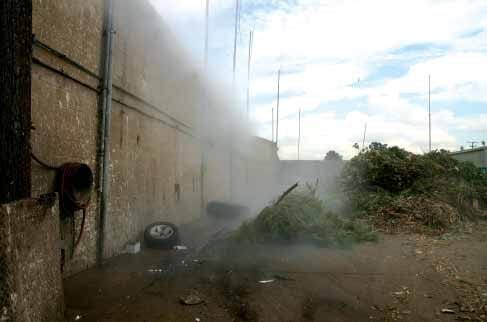
With an open-air facility, City Hall has had to work overtime to keep trash moving so that it doesn’t sit under the sun and have time to cook, said Wes Thompson, City Hall’s solid waste supervisor. City officials also use a “mister,”which sprays water treated with an enzyme that breaks down the odor to keep it from drifting into nearby homes.
The transfer station is located next to the city’s recycling center, a privately operated facility owned by Southern California Disposal (SCD). Both are within close proximity to the Mountain View Mobile Home Park and a residential neighborhood dotted with small, single-family homes.
Miguel Cancio, a manager at the mobile home park, said residents often complain about the smell of trash wafting into their trailers, but the stench is usually contained towards the back.
“We are cognizant of our place in the community,”Thompson said.“We have tried to move trash so there won’t be any funk. We also have an odor control system in place. We want to be good neighbors and we’ve worked very hard to make sure that we keep the odor under control.”
Atwood said the city-owned facility, as well as the privately run transfer station have not registered any violations with the SCAQMD, however there have been 47 complaints in the last four years, about a dozen attributed to the Santa Monica station and a similar number to the SCD facility.
Officials with the county health department said it is difficult to determine where offensive odors are coming from because the city-owned facility is located just down the street from the SCD facility. Using only one’s nose as a meter, it’s difficult to locate the actual source of an odor, county officials said.
Craig Perkins, City Hall’s director of environmental and public works management, said city officials are discussing building a new transfer facility that would be enclosed and include a significant number of improvements that would keep odor from escaping. The discussion is part of an overall review of the city’s solid waste hauling service.
“We would love to be able to build a new facility. We’ve been trying to do it for some time,”Perkins said.“We just haven’t been able to get there. With our existing facility, we’ll most likely have to make some minor modifications to be in compliance with the new rule, a few extra bells and whistles, but nothing major.”
At SCD, manager Mike Matosian said City Hall should move more quickly on the construction of a new facility because his company is being blamed for odors emanating from the city yards.
‘We’d argue that we are already complying with all the rules and the city facility does not,” Matosian said. “They are uncovered. We are partially covered. They have a misting system, but if you look at it, it’s not really effective. I don’t think any odor is suppressed by it.”
Over at Martinez’s home, she could care less about whose mister is the strongest. She just wants to be able to take a deep breath during the afternoons without having to smell garbage and yard clippings.
“You’d think you’d get used to it after all these years,” she said. “But, you don’t.”
Originally published in the Santa Monica Daily Press print edition on October 17, 2006. Read the original PDF.