

By The Surf Report is sponsored by: BY JAIME WETHERBE Special to the Daily Press
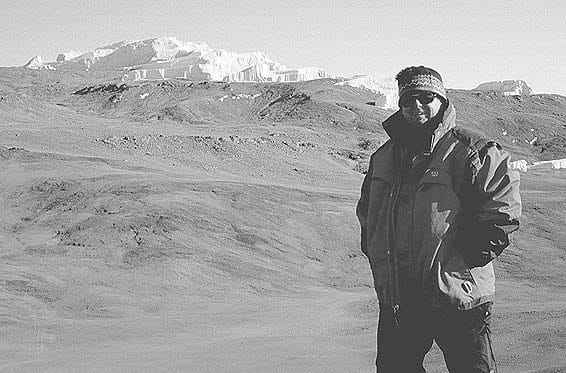
Santa Monican Randy Williams watched day break on Sept. 18 at the closest spot on earth to the sun — Mt. Kilimanjaro.
But Williams, 45, said he didn’t scale the world’s second-highest mountain just for the exercise, but also to raise awareness for prostate cancer. And he did it despite not knowing anyone who has fallen victim to the disease that kills tens of thousands of men each year.
As part of the second international Prostate Cancer Climb, Williams and a group of about two dozen men and women — including three prostate cancer survivors — scaled Kilimanjaro, a 19,340-foot peak that lies close to the equator at the northeastern tip of Tanzania, Africa.
The trek of more than 72 miles lasted six and a half days, with climbers and guides ascending through five different climates, ranging from the jungle lowlands to the glacier-covered summit.
Though Williams isn’t a prostate cancer survivor himself, after hearing about the climb through a friend he chose to participate because he felt it would prove to be an interesting way to draw public attention to prostate cancer.
“Instead of a benefit drive, climb a mountain,” Williams said.
He also said he wanted to raise awareness for the necessity of early prostate cancer detection measures, including regular prostate checks and blood tests, beginning as early as 30 years old.
“If what I did can save one life because it draws awareness to prostate cancer, it will all be worth it,” Williams said.
Each year, more than 200,000 men are diagnosed with prostate cancer in the United States, and close to 30,000 die from the disease, making it the second-leading cause of cancer deaths in men, according to the American Cancer Society.
However, prostate cancer is “one of the most treatable cancers if you get to it (in time),” Williams said.
The climb — sponsored by the nonprofit Prostate Cancer Research Institute of Los Angeles — was established three years ago with the goal of raising $1 million for prostate cancer research and public education.
Terry Weyman, a Los Angeles sports medicine doctor, started the Prostate Cancer Climb in 2000 after his father, Hap, a Hollywood production manager, died of the disease in 1990.
To date, about $350,000 has been raised for the Hap Weyman Memorial Fund, with climbers and cancer survivors ascending Mt. Aconcagua, Argentina, in 2001 and Kilimanjaro — two of the “Seven Summits,” the highest points on each of the seven continents.
In order to participate, all 26 climbers had to raise at least $2,000. Williams raised $3,000.
“Randy Williams was one of our biggest fundraisers for the recent Kilimanjaro climb,” said John Loesing, the Climb’s project director.
As a freelance sports event manager, Williams has worked two world cups — in Japan and Los Angeles — and each of the last five summer Olympics.
Williams, who had no previous experience as a climber, trained for three months before the climb. He also sought advice from a familiar source.
“My dad had done it in 1983,” Williams said, adding that he made the climb at the age of 60. The younger Williams’ climb marked the 20th anniversary of his dad’s reaching Kilimanjaro’s pinnacle.
This summer, the climb’s expeditions will continue with an effort to reach the summit of Mt. Rainier, Wash. And in 2005, the third “Seven Summit” climb will see participants tackle Europe’s highest peak — Mt. Elbrus, Russia.
As for Williams, he’s keeping his eyes in the sky, setting his sights on reaching summits such as New Zealand’s Mt. Cook.
Originally published in the Santa Monica Daily Press print edition on October 25, 2003. Read the original PDF.