

Marine-mammal rescue will cost Santa Monica $1 per year
By KATHLEEN BISHOP Special to the Daily Press
Despite having a contentious relationship in the past, city officials this month handed over their marine-mammal rescue operation to the Whale Rescue Team, a specialized nonprofit organization.
Don Umber, manager of Santa Monica’s animal control division, said last week a collaborative decision was recently made between City Hall and animal control officials to make the Whale Rescue Team’s founder, Peter Wallerstein, the first person to call for any marine-mammal rescue. Animal control had been in charge of rescues, but will now be used to assist the Whale Rescue Team on an as-needed basis. Marine mammals include seals, sea lions, dolphins and whales.
Santa Monica had been the only city from Will Rogers State Beach to Wilmington that didn’t call on Wallerstein first when marine mammals needed to be rescued.
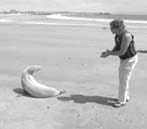
The Whale Rescue Team has rescued 152 marine mammals and dozens of sea birds throughout the area this year, mostly during the busy spring season. Wallerstein was performing multiple rescues a day during this year’s outbreak of domoic acid poisoning, which mostly affects pregnant sea lions. The poisoning forces the animals onto the beach and causes disorientation and seizures. During the slower fall season, the Whale Rescue Team can sometimes go a week with no rescues.
Wallerstein in the past has been critical of Santa Monica’s handling of marine mammals. He contacted Mayor Richard Bloom, Santa Monica’s Environmental Advisory Committee and other city officials about his concerns. He called for reforms in the department, or for the Whale Rescue Team to be named as the primary responder. Wallerstein questioned the training of animal control officers, the equipment used to catch animals and the city’s commitment to helping sick or injured animals.
Umber said Santa Monica animal control, which is a branch of the police department, is a full-service department and many officers have training in marine-mammal rescue. However, since the surrounding cities used the Whale Rescue Team for all of their rescues, Santa Monica officials said having animal control be the primary responder here was confusing for lifeguards and anyone who wanted to report sick or injured animals on the beach.
“It’s about having the best possible response,” Umber said.
Any criticisms animal control might have had of Wallerstein’s methods will no longer be an issue, said SMPD Lt. Frank Fabrega.
“He (Wallerstein) is the first responder,” he said. “If he says it’s going to be done this way, that’s how it will be done.”
Wallerstein was pleased with the change and said it is what’s best for the animals. He wants to overcome any differences between himself and animal control officials.
“Even when they’ve given me problems, if it came down to working side by side to help an animal, I’ve always acted professionally and I’ve always welcomed their help,” Wallerstein said. “I work with animal control officers in other cities, and we really get along quite well. It should-n’t be any different in Santa Monica.”
Wallerstein hopes to improve marine mammal rescue with equipment and expertise that he thinks will better serve animals. He is on call 24 hours a day and uses a custom cage he designed himself to transport animals to the Marine Mammal Care Center at Fort McArthur. Additionally, he sees this as an important step in his long-term vision for marine-mammal rescue. He eventually wants to hire a professional marine-mammal rescuer to replace him, as well as open an alternative care center for when the Fort McArthur center is full. He also wants to create a whale and dolphin rehabilitation center, since the only one in Southern California is at Sea World in San Diego.
The Whale Rescue Team has been helping with rescues in the area for 21 years and was incorporated in 1992. In 1996, Wallerstein approached cities and asked them to allow him to be the primary responder for rescues. His contract with Santa Monica as a secondary responder began in 1998.
The organization is funded completely by membership and private donors. Wallerstein charges cities $1 a year for his services. Though the savings for the city can’t be calculated, Fabrega said the most significant savings for Santa Monica will be in personnel time.
Originally published in the Santa Monica Daily Press print edition on November 29, 2004. Read the original PDF.