

MEMORIAL, from page 1 Tsunami detection system gives SM three-hour notice
By CORTNEY FIELDING Special to the Daily Press
SM PIER — Santa Monica might be thousands of miles away from the areas of Southern Asia devastated by December’s tsunami, but distance meant very little to more than 200 people who gathered here Saturday for a chance to say good-bye to the victims.
“We are affected by what happens on the other side of the water,” said Alice Williams, an Air France employee and 25-year resident of Santa Monica who came to the pier to pay her respects.
“Just because the city is not physically close to the destruction does not mean it was not moved by tragedy,” she said. “One day you wake up and realize there is 100,000 less people on this earth.” Mary Setterholm, director of the Surf Academy in Redondo Beach, organized Saturday’s interfaith prayer session and a surfer “paddle out” ceremony to honor tsunami victims and to raise money for the 11 countries that were caught in the path of destruction.
She referred to the paddle out as the surfing community’s reaction to tragedy. Although designed to give the community an outlet to share its grief, the event also was meant to be a “celebration of survival,” Setterholm said.
“I heard that term on the radio on my way over, and I just thought it fit perfectly — celebrate those who are here,” she said.
Religious leaders from six different groups in Santa Monica — representing Catholicism, Christianity, Scientology, Buddhism and Chumash Native American spirituality — stood together in the group prayer ceremony. Choosing different words to express their faith, they delivered a singular message of inclusion.
“We all call God by different names,” said Mati Waiyn, a Chumash tribal leader. “But we are all his children. We are all here for the same reason — because our hearts are broken.”
Rev. Hartshorn Murphy of St. Augustine by the Sea Episcopal Church in Santa Monica said the entire world is united — particularly in situations of disaster.
“While we may be of different faiths, we are all called to be partners,” he said. “We are all brothers and sisters, part of the same family.”
Speakers tried to make sense of the disaster, saying people must accept what they can’t control.
“We don’t have the answers, but we have to respect and honor [nature],” said John Weigelt, pastor of the New Life Christian Church in Carson.
Mahinda, a Buddhist monk from Sri Lanka, thanked the community for the support he received in Santa Monica, which he characterized as a blessing of “loving-kindness,” a basic tenant of Buddhism.
“May we all be free from suffering. May we all be free of sorrow. May we all be well and happy,” he said.
When the prayers ended, 12 surfboards with flowers, one representing each country affected by the tsunami and one for the unknown victims, were carried down the pier in a processional by volunteers. The boards represented the thousands of lives lost, Setterholm said.
Children, some of whom were walking down the pier with parents when the ceremony began, were asked to hold signs with the names of the affected countries.
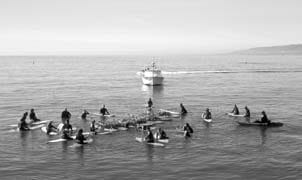
When the processional made its way to the beach, about 20 surfers paddled out to the end of the pier and formed a circle around surfboards covered in flowers for the final ceremony, which included the recital of a Chumash prayer known as “Four Corners” and the release of flowers into the ocean to memorialize the dead.
Onlookers stretched from the sand to the water on the northern side of the pier as they recited “rest in peace” for all 11 countries that experienced death, and tossed flowers given to them by volunteers into the ocean. Finally, surfers took the flowers off the boards and released them to the ocean to symbolize a final goodbye.
“Leaving the flowers there is what really tore me up,” Setterholm said. “I knew it would. It was tough paddling away because that meant you had to accept that death happened.”
Melissa Neff, a surf instructor who participated in the paddle out, said she wanted to be a part of the event because as a member of the surf community, she felt especially close to the tragedy.
“Out in the water there was this vibe, you really felt close to everyone,” she said.
Many of those in attendance were visitors to Santa Monica. Miriam Goodwin, a tourist from
“There were many memorial ceremonies in Europe,” she said. “I had been very disappointed because I missed them, so I was so happy to be able to participate here. I love Santa Monica, and the ceremony was very moving.”
Setterholm said her biggest fear was that the event would be a disappointment. But after the surfers emerged from the water, her fears subsided.
“I think the community will feel good knowing we did this,” she said. “For some of these people, this was the only opportunity for them to express their grief. Spiritually, I feel like we did something good.”
Setterholm said the event would not have run smoothly without the coopera-tion she received from the Santa Monica Police Department, the Los Angeles County Lifeguard, the city of Santa Monica, and the Pier Restoration Corp., which manages the pier.
The PRC, which Setterholm said usually charges about $5,000 for an event, waived the fee and let the memorial take place free of charge.
“The community really came together,” she said. “I have seen that a few times before in times of tragedy.”
The Santa Monica chapter of the Red Cross, UNICEF, Save the Children and The Dharma Vijaya Temple — a Sri Lankan Buddhist temple and nonprofit organization providing aid in that country — also participated in the event by taking donations and updating participants on progress in the area.
According to a spokesman for the Santa Monica chapter of the Red Cross, $250,000 has been collected from Santa Monica residents for tsunami relief, and $400 million has been collected overall. More than $50 million of that will go toward temporary infrastructure to house displaced people and provide safe drinking water.
Ananda Amarawansa, a Sri Lankan native and representative from The Dharma Vijaya Temple, was visiting his country at the time of the tsunami and witnessed the damage firsthand.
“Children are displaced, families are displaced, and lives are destroyed,” he said at Saturday’s memorial.
Sri Lanka was one of the countries hardest hit by the earthquake and floods, but despite the destruction, Amarawansa is confident his country will become a beautiful place once again.
“Within one year we are going to rebuild and bring the smiles back to the people,” he said.
Many Santa Monicans at the ceremony couldn’t help but draw comparisons between their homes and those destroyed in Asia. There is, however, one difference between the two areas. In Asia, there was no detection system in place to give advance warning of a tsunami. Although plans are now being discussed to add systems in the Atlantic Ocean in lieu of the disaster, the Pacific is the only ocean with a system, giving Californians much-needed warning time in the event of an emergency.
Lifeguard Chief Scott Davey of the Los Angeles County Fire Department Lifeguard division said if a tsunami were to head toward southern California, the detection system put in place by the National Oceanic and Atmospheric Administration would give officials about a three-hour notice to evacuate residents.
Davey said the lifeguard is tied to the U.S. Coast Guard. In the event of the emergency, all three divisions would coordinate from the beginning, making the evacuation and rescue process expedient and efficient.
Still, California sits on a fault line, and the ocean lies in Santa Monica’s back-yard. Because a similar tragedy could happen here, having an event in Santa Monica was especially relevant, Setterholm said.
“For all we know, LA may be next on the list of nature’s capricious assaults,” she said on her Web site. “Will we be a people prepared with hearts of courage and generosity toward strangers on a ‘tsunami day?’”
Originally published in the Santa Monica Daily Press print edition on January 17, 2005. Read the original PDF.