

Miller in disbelief following series of events
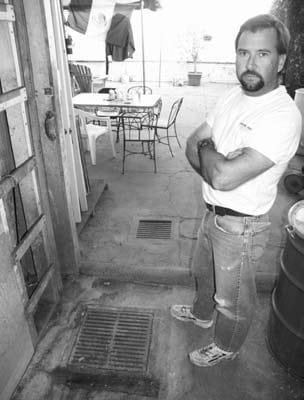
OCEAN PARK — When armed FBI agents stormed his garage shop last year, Santa Monica furniture stripper Michael Miller never imagined he’d be sent to federal prison.
Miller, investigators noted, smiled as agents cordoned off his Main Street shop and hauled off boxes of evidence, as if he didn’t take seriously the burns suffered by a sewer repairman working below his shop.
Miller contends he was smiling nervously, unable to believe he was suspected of illegally dumping toxic chemicals. Now more than a year later, Miller is still in disbelief of how what he characterized as a trace leak of harmless rinsewater led to hard time.
“I’m basically a poster child of everything that’s wrong with our judicial system right now,” said Miller, 41, a Santa Monica native who grew up north of Montana Avenue. “It’s mind-boggling what’s going on.”
At issue in the case are controversial mandatory sentencing guidelines imposed by the federal government, which many view as too rigid. The guidelines are currently being challenged in two cases before the U.S. Supreme Court. Also at issue are Miller’s claims that his unintentional leak couldn’t have caused the injuries suffered by sewer worker Vin-cente Valenzuela, and questions raised about Valenzuela’s work conditions.
FBI agents arrested Miller in March of 2003, after Valenzuela fell into cardiac arrest and suffered severe burns while working in the sewer below Stripper Herk, Miller’s furniture-stripping business on Main Street.
Authorities charged Miller with three felonies, including one for illegally dumping methylene chloride into the sewer.
Those charges were later reduced, and Miller pleaded guilty in July to a misdemeanor charge for unwittingly letting the chemical seep into the sewer and a felony for keeping sealed, 55-gallon barrels of the toxic substance at his business for longer than the 90 allowable days. In keeping with minimum federal guidelines, U.S. District Judge R. Gary Klausner last month sentenced Miller to one year in prison.
Alan Rubin, Miller’s attorney, was taken aback.
“The reason that came out that way was the judge didn’t follow the comment in the guidelines that said for negligence, a downward departure may be warranted,” Rubin said. “How could Congress have sincerely believed that you should get the same sentence for a felony as a misdemeanor? It was crazy to me.”
Miller, too, was shocked. He must turn himself in by the end of the year and has yet to secure a slot in a minimum-security prison for white-collar criminals. Even if he does secure an opening in one of the preferred prisons, Miller may be kept in the prison system’s general population during processing.
“There should be some kind of a safety net for dudes like me,” he said. “But the judge bangs his gavel and I’m headed to a federal facility. It’s freaking bananas.”
Assistant U.S. Attorney William Carter, who had pushed for an 18-month sentence, called the sentence strong.
“The judge obviously felt that what Mr. Miller did was very serious and posed a threat to his employees and the neighborhood, and therefore imposed what I would consider a significant sentence for someone who has no prior criminal convictions,” he said Tuesday.
Klausner, who was appointed to the bench in December of 2002 by President George W. Bush, declined to discuss Miller’s case and said he wouldn’t comment on the controversial federal sentencing guidelines until after the Supreme Court makes a decision on them. With the guidelines in limbo, law experts said federal judges are in a difficult position.
“It is a bit of a mess for federal judges,” said former federal prosecutor Laurie Levenson, a 15-year law professor at Loyola Marymount University. “There are many federal judges that have just held off on sentencing until we get a decision from the Supreme Court.”
Beyond the controversy over mandatory sentencing guidelines, Miller maintained that a slight rinsewater leak from his shop couldn’t have caused Valenzuela’s injuries. Lawyers agreed the concentration of methylene chloride found on Valenzuela’s clothing was just 29 parts per million, adding it takes 200 parts per million to cause injury. A stronger concentration of a chemical called “acetate” was found on Valenzuela’s clothing that didn’t come from Stripper Herk, he added.
“When it was all over, they came back with a big fat ‘Oops, what do we do now?’” Miller said.
Carter disagreed sharply, adding Valenzuela had third-degree burns covering more than half of his body.
“Methylene chloride acts the same way as alcohol,” he said. “You can dip your hand in alcohol or rub alcohol on your arm and it evaporates real quickly, and you get that cool sensation...
“If you’re in an open space, methylene chloride is going to evaporate quickly off your skin, but if you’re soaking in it in a confined space where there is no evaporation, you’re going to get burned, and that’s what happened to Mr. Valenzuela,” he added.
As to the felony charge over illegally storing the 55-gallon barrels, Miller said he feels duped for telling the truth. When investigators sifted through his shop, Miller admitted he had let about 20 barrels accumulate over several months, because it is expensive to have them carried off and he was struggling to make ends meet. Had he told the investigators the 20 barrels had accumulated in the previous 90 days, the backlog may have been considered legal, Miller suggested.
“The drums were there,” said Miller, an avid fisherman who added he would never knowingly pollute the ocean. “I did-n’t put them in the trash. I didn’t dump it... It was in a sealed, certified container out in the open.
“I wasn’t trying to hide anything.” According to Carter, only a fence covered with ivy separated the barrels from the shop’s residential neighbors.
“These wastes were stored right next to an apartment building,” he said. “There were over 20 drums, they weren’t labeled with anything and they’d been there over 90 days. That was the government’s concern.”
Rubin and Miller suggested Valenzuela’s injuries were exacerbated by unsafe working conditions. They said he wore jeans and a T-shirt, but no breathing apparatus, adding the exit from the 36-inch sewer line he worked in was blocked by equipment.
City officials said an inspection of sewer contractor BH-Garver, the firm that hired Valenzuela, was conducted by the office of Occupational Safety and Health Administration, but added they didn’t know its results.
“Whatever recommendation came out, that’s between OSHA and BH-Garver,” Santa Monica City Engineer Tony Antich said Tuesday. “If we were to seek hiring a contractor in the future, we would ask the question, in the future, ‘Have their been any violations?’ And, if so, what had been the outcome of that.”
Officials from BH-Garver did not return calls. Carter said he didn’t investigate the claims, because even if true they wouldn’t have changed the fact that Miller negligently discharged the chemical. Meanwhile, Valenzuela has also filed a lawsuit against Miller in civil court.
The FBI was first tipped off to Miller by Gary Welling, a wastewater specialist from City Hall who had cited Miller in the past. In 1992, when Miller managed but didn’t own the now-28-year-old shop, he was cited for dumping methylene chloride into the sewer after the city first switched to a policy of recycling. The following year, he was cited for letting a backlog of the barrels accumulate.
Miller said the 1992 citation was the first he’d heard of the policy change, and said he let barrels stack up in 1993 for the same reason he did 10 years later, a lack of money.
On Tuesday, Miller said he will spend the next several weeks preparing to turn himself in to authorities, and confronting myriad details associated with leaving his work and home. Though he feels mistreated by a rigid system, Miller said he realizes he made a mistake.
“I’m going,” he said. “I’ve got no choice.
“I am wiped out,” Miller added. “Mentally, financially, physically — I’m ruined. I have absolutely no clue how I’m going to survive this thing.”
Originally published in the Santa Monica Daily Press print edition on November 24, 2004. Read the original PDF.