

Subway to the Sea expected to cost at least $6 billion
MTA officials this week unveiled two possible routes for the highly-touted Subway to the Sea project that would finally establish a long-awaited railway system from Downtown Los Angeles to Santa Monica.
The proposal comes more than a year after the Metropolitan Transportation Authority began analyzing different ways to connect the Eastside to the Westside and as drivers recover from a summer of high gas prices, which led to a record number of boardings on public transit lines.
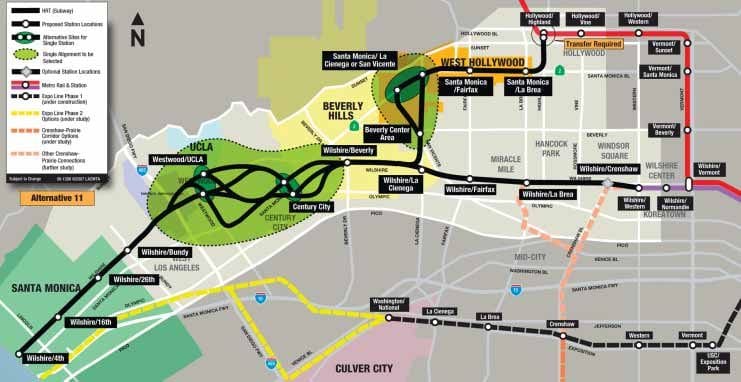
The options include a $6 billion plan to extend the subway from the Wilshire/Western Purple Line station and a $9 billion combined route that would also see a heavy rail train leave from the Hollywood/Highland Red Line stop.
The first proposed route would essentially travel along Wilshire Boulevard through Beverly Hills, taking a detour in Century City before connecting back past Westwood, ending at the corner of Wilshire and Fourth Street. The second would keep the first route and add another extension from the Red Line station, traveling through West Hollywood and down toward the Beverly Center area, eventually connecting to Wilshire around La Cienega Boulevard.
The MTA began holding a series of community meetings on Wednesday at the Santa Monica Public Library, seeking public input on the two proposed routes. The Board of Directors in the fall will be asked to approve the two lines to go through the 18-month-long environmental impact report phase, which will study possible effects from station locations and the route itself, according to Jody Litvak, who manages regional communications for the Westside Extension project.
The second alternative route seemed to garner the most praise from those who attended the meeting at the library.
“It has the greatest potential to eliminate traffic from the San Fernando Valley,” Philip Schwartz, a Santa Monica resident, said.
Gary Kavanaugh, who lives and works in the city, also spoke in favor of the second route, pointing out that he often stays with his girlfriend in Hollywood and bikes to work, which can take about 40-45 minutes.
Driving to the city on the other hand can take more than an hour.
The Westside Extension project was studied in depth during the 1980s and 1990s when the federal government signed a full funding grant agreement to build a 2.3 mile extension from the Wilshire/Western line to Pico/San Vicente in 1994. The project was suspended four years later because of insufficient funding, leading the MTA to look into bus and light rail options.
The MTA board authorized an Alternatives Analysis a few years ago to study various modes and routes to alleviate congestion between Downtown L.A. and the Westside. Metro staff returned with a variety of options that included a bus rapid line and a monorail, both of which have since been eliminated from consideration.
Several subway routes were also considered, including one that would travel along Santa Monica Boulevard, which was also nixed because it was expected to have low ridership and cost more to construct.
Staff considered several factors in narrowing the options, including mobility, cost effectiveness, project feasibility and most importantly, public acceptance.
“We listen closely to what you have to say,” Litvak said.
The biggest hurdle to the project being realized is funding as the $6-$9 billion price tag is expected to rise as time passes. The current estimate of $6 billion for the first alternative route comes out to be about $475 million per square mile, the second about $510 million per square mile.
The project, which has not secured any funding, could be paid for in part by a half-cent sales tax increase that county voters will be asked to approve in the fall. The measure would bring in $40 billion over the next 30 years.
Dana Gabbard, the recording secretary for Southern California Transit Advocates, said that while progress has been made in the fight to bring railway transportation to the Westside, the battle is only beginning, stressing that the county will have to fight with other big agencies from across the country over federal funding.
The sales tax measure is not even guaranteed to be on the ballot this fall, still awaiting approval of state legislation, AB2321, which would lift an existing tax cap.
Gabbard said that just 10 years ago, people laughed when told that a subway would one day come to the sea.
“It’s been an amazing journey and it’s just the beginning,” he said.
Jump hedline: Subway expected to cost at least $6 billion
Suggested pullquote: “It’s been an amazing journey and it’s just the beginning.”
Originally published in the Santa Monica Daily Press print edition on September 5, 2008. Read the original PDF.