

Panelists: Pentagon too focused on war on terror
DOWNTOWN — A distinguished panel of military experts last week addressed U.S. defense issues at the new RAND Corp. office, where they agreed that the U.S. government is not paying enough attention to nuclear weapon threats, which are building throughout the world.
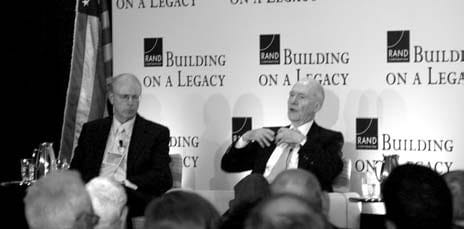
“Building on a Legacy,” the theme for last week’s conference, was held in honor of RAND’s new West Coast office building at 1776 Main St. and moderated by the think-tank’s president, James A. Thomson. Thomson asked a four-person panel of former defense secretaries and national security advisors their thoughts regarding the proliferation of nuclear weapons, future U.S. involvement in Iraq and recent military recruitment challenges — including whether the draft ought to be reinstated.
The four-person panel included former defense secretaries Robert McNamara, who served from 1961 to 1968, and Harold Brown, who served from 1971 to 1981.
The panel also included former national security advisor Brent Scowcroft, who served from 1975 to 1977 and again from 1989 to 1992. A fourth panelist, Frank Carlucci, served both as national security advisor from 1986 to 1987 and as defense secretary from 1987 to 1989.
McNamara said preventing nuclear weapons technology from getting into the wrong hands should be the top U.S. security concern, and he believes not enough is being done to address the issue. McNamara said within 10 years 40 countries could be in the market for nuclear weapons, which will make the world increasingly volatile unless efforts are made to regulate them.
“Let’s make nuclear proliferation our No. 1 problem,” McNamara said. “I don’t think we should just stand around and do nothing about it.”
“Let’s make nuclear proliferation our No. 1 problem. I don’t think we should just stand around and do nothing about it.” — ROBERT MCNAMARA Former U.S. Secretary of Defense
The panelists said the nuclear issue in regard to North Korea and Iran should be handled through diplomatic channels. McNamara said a military solution was not realistic, especially in North Korea.
“The North Koreans have 2,000 artillery pieces aimed at Seoul and our military forces,” McNamara said. “That’s about the distance from the capitol to the Potomac. Our troops would be annihilated.”
McNamara said the United States needs to strengthen relations with China so the government there can help address the nuclear threat in North Korea. Also, panelists agreed greater diplomacy was needed with China to help diffuse the dispute for independence with Taiwan.
All of the panelists expressed concern over how nuclear technology will be tracked worldwide among developing nations.
Scowcroft suggested the International Atomic Energy Agency (IAEA) could regulate a future global nuclear energy industry. He said right now Brazil is looking to capitalize on its rich uranium deposits in order to sell nuclear rods to other nations. Scowcroft said the IAEA could be empowered to regulate those kinds of transactions.
Brown shot down the idea by saying the United States would have to agree to such regulation if the program were to be successful, which he said would be unlikely.
Scowcroft also said a proposal was on the table to ban nuclear technology as an energy source, but none of the panelists responded to the idea.
The panelists also discussed the transformation of the military. They said they were in favor of the military becoming more mobile and responsive to new information technology available on the battle field, but they said the role of technology in combat should not be over-emphasized and that technology would never be a successful substitution for well-trained troops.
None of the panelists were willing to put a time frame on how long the American military forces will remain in Iraq, but Brown said the military is facing less resistance in Iraq than it did during the Vietnam War, and there were signs that conditions in Iraq were slowly improving. Brown said he believed Iraq would continue to struggle but would ultimately become a democratic society. He said the lack of a long-term economic redevelopment plan since the occupation began more than two years ago was having a serious impact on Iraq’s recovery.
The panelists said reinstatement of the draft to assist troops in Iraq and Afghanistan and help fight the global war on terrorism was unrealistic and wouldn’t be successful from a military perspective. They said it would be more effective if better educational, housing and pay incentives were in place to beef up recruitment numbers, especially because the economy is slowly improving and the military will have to be more competitive with the private sector.
While Carlucci said the Pentagon’s blanket approach allowed the military to keep an eye on hot spots worldwide, Scowcroft said the Pentagon is too focused on the global war on terrorism, diverting its attention from other issues the military should be addressing.
“There is a split between foreign and domestic operations since 9-11,” Scowcroft said. “It’s a huge problem that’s not being addressed.
“We now have Homeland Security if it ever gets up and running that will depend on the CIA and FBI, but the question is who is going to do what? The interpretation is very difficult.”
Originally published in the Santa Monica Daily Press print edition on April 22, 2005. Read the original PDF.