

Glass passion: Local man’s handiwork on display
By PAM WIGHT Special to the Daily Press
MID-CITY — A 79-year-old nun, a renowned French artist and a local glass master are just part of a colorful story behind the stained glass windows in the newly opened pavilion at St. John’s Health Center.
When the designers of the new hospital decided to put 31 stained glass windows along passages and at the end of all of the hallways, they began a long and complex process that involved much thought, design and labor.
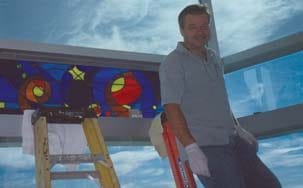
“They were hoping to have all of the windows in before they opened, so we basically did a yearlong project in six months,” said Jim Piechowski, owner of Stained Glass for Worship, a Venice-based company that manufactures stained glass windows for churches, commercial buildings and private residences.
To help with the designing, Piechowski turned to long-time friend and sometimes-business partner, Sister Genevieve Underwood, who began studying stained glass design nearly 30 years ago.
After Underwood got her M.A. in fine arts from The Catholic University in Washington, D.C., she taught design classes as a professor emeritus at Loyola Marymount University for 15 years.
“One summer I saw some very good stained glass in Los Angeles,” Underwood said. “I heard of a local European artist by the name of Roger Darricarrere who had apprenticed under Marc Chagall in France. He had a studio in Los Angeles and did workshops there sometimes. He only had time for a few pupils so I was really privileged to have worked there and studied under one of the very best masters.”
Underwood has worked with Piechowski designing and manufacturing stained glass windows for the past 20 years, beginning with a joint project for a church in Catalina.
Since then, they have collaborated on projects for 15 churches in the Los Angeles Archdiocese.
“This project is unique in our collaboration … most of our work has been religious,” Piechowski said. “Even though most of these designs are completely abstract, they’re all based on the first book of the Bible, Genesis, talking about creation of some sort.”
The only window with an explicitly religious theme is in the hospital’s oratory. Images of a chalice, host, grapes and wheat are based on the Catholic sacrament, Piechowski explained.
“This hospital is religious but opened to the entire population, so the rest of the windows are abstract,” he said.
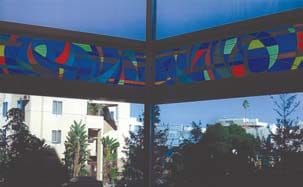
Underwood designed all 31 windows at St. John’s. The swirling, decorative shapes are meant to have some relation to the operation of each floor of the hospital, Piechowski said. For example, a window on the fourth floor maternity ward displays an explosion of intricate, colorful shapes resembling stars, moons and planets sweeping around a womb-shaped center.
“Stained glass windows were originally used to educate an illiterate population (about the Bible story),” Piechowski said. “I like to say it was the first ‘multimedia.’ But with the abstract windows, they can read into anything they want.”
Because of the reflective glass used by the hospital, it’s difficult to see the windows from the outside during the daylight hours. But from the inside, the colorful windows warm an otherwise sterile structure.
The colored glass sheets from which shapes are cut are all hand-made by a glass blower. The resultant glass is referred to as “mouth blown” or “antique.” Three dry chemicals make up the base of any glass — silica sand, like beach sand, and soda and lime, both dry chemicals.
“When I used to teach stained glass art at LMU, I would tell the students it was like baking a cake,” Piechowski said. “You mix all of the ingredients into a dry element, and when you put it into the oven, it becomes a completely different kind of beast.”
Glass is considered a super-cooled liquid, as it is first melted into a molten substance at temperatures of up to 1,000 degrees Fahrenheit, resembling the consistency of molasses.
A glass blower then blows the liquid glass into a long cylinder with a blow pipe. It’s allowed to cool, then it’s cut and laid flat before being put into the annealing oven. The annealing process is like using a firing ceramics kiln, Piechowski explained. One sheet of glass takes a little more than 24 hours to make.
Color is created by adding certain chemical compounds to the mix, such as gold oxide for reds, and cobalt oxide for blues.
“The color is inherent in the glass, not painted on like a lot of people think,” Piechowski said.
Two black steel bars are blended into the images to strengthen the long-term life of the window which, depending on the environment, is about 100 years. Lead strips separate the individual pieces and “draw” the image.
Piechowski’s company manufactures the windows from glass that is already made by a German company, called Lambert. Underwood does the designing, creating a cartoon of the image for each window.
The intricate windows installed at St. John’s average 150 individual pieces each at a cost of approximately $250 to $300 per square foot, Piechowski said.
Despite its labor-intensity nature, for Underwood and Piechowski, artistic passion is what drives them.
“Sister and I, we live for projects like these,” Piechowski said. “So it was definitely God-given.”
Originally published in the Santa Monica Daily Press print edition on December 16, 2004. Read the original PDF.