

Nomadic museum made debut in NYC
By SARA KAUFMAN Special to the Daily Press
SM BEACH — Against the shimmering blue backdrop of the Pacific Ocean, a modern day industrial palace has been sitting idle among the forklifts, drills and hustle of workmen. That all changes today, Jan. 14.
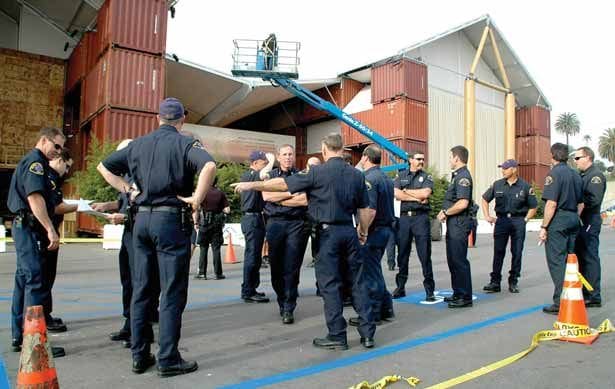
A month ago, the Santa Monica Pier stood alongside an adjacent parking lot filled with old cargo containers and equipment. This week, construction crews have been scurrying to put the finishing touches on a gigantic structure that will likely stop passersby in their tracks.
The rust-colored containers, mustard yellow columns, and white tarp roof comprise the outside shell of the Nomadic Museum — the first of its kind, and home to artist Gregory Colbert’s “Ashes and Snow” exhibit.
The museum, open to the public beginning today, is as much a piece of art as the art it houses.
Under the watchful eye of the Santa Monica branch of the international architecture firm Gensler, the traveling museum is the brainchild of renowned architect Shigeru Ban, who created a blueprint to compliment Colbert’s vision. All of the materials used in the museum’s construction are reusable or recycled, the hallmark of Ban’s designs. “(Shigeru Ban) is an architect with the eye of a poet,” Colbert said. “This project is a seamless melding of our work. I wanted to inspire a reverence for all the poets in nature.”
The third installment of Colbert’s 14-year photographic journey, the Santa Monica exhibit consists of more than 100 large scale photographs and three 35mm films. None of the 5 x 8-foot photographs are digitally enhanced and each captures moments of contact between man and animal. The photos loosely reference the literary component of the exhibit, which is the fictional tale of a man who, over the course of a year-long journey, composes 365 letters to his wife. The Nomadic Museum debuted in New York last year alongside the second installment of Colbert’s photographs. Constructed out of 152 steel cargo containers and paper tubes, the entire structure fits into eight containers as it travels from location to location. The remaining 144 containers are borrowed from each “port of call.” Colbert approached Ban about constructing a structure that would compliment his art, engage the viewer and act in harmony with the environment.
“It’s a post-industrial temple to nature,” Colbert said. “We are not in the market of buying and selling art. It is all about sharing the experience.”
Massive paper columns herald the entrance, inviting the viewer into an environment where man’s interaction with nature takes center stage. Irwin Miller, the project director and senior associate at Gensler, said Ban worked closely with a team of roughly 12 associates on the design and construction of the museum. RMS Construction has close to 75 people building the museum at peak hours, said exhibit spokesman Charles Windisch-Graetz. “(The museum) compliments what Greg’s work is about,” said project manager John Picard. “What a waste to have a building that cannot adapt and be reused.”
Standing 560 feet high, the 56,000-square-foot structure contains two immense hallways that surround an interior screening room. The checkerboard pattern of railroad cargo containers stands 34 feet high and is topped with triangular trusses and tensile roof fabric. Colbert’s photographs are suspended from cables and hang on either side of a massive central wooden walkway in two of the three wings of the museum. The central wing boasts an 800-person screening room where Colbert’s hour-long film, narrated by Laurence Fishburne and edited by two-time Academy Award winning editor Pietro Scalia, plays on a continual loop. The post-industrial feel of the exterior compliments the environment inside, creating a rough shell that nourishes the aesthetics of the interior exhibit.
The Santa Monica incarnation of the Nomadic Museum took the best aspects of its New York predecessor and expanded upon the lessons learned there, Picard said. Each shipping container is now the exact same size and shape, and rather than welding the containers together, Picard said construction includes the use of specialized shipping discs to hold the containers in place. Additionally, Picard said it takes just as long to plan the removal of the museum as it does to plan its construction.
Colbert said he hopes the traveling exhibit will restore people’s capacity for wonder and inspire emotion that is not just passive. While he admitted that anything is possible, Colbert said there are no plans to erect a permanent museum to house “Ashes and Snow.”
“We’d have to change the name,” he said.
“Ashes and Snow” at the Nomadic museum runs through May 14. Tickets are available at www.ticketweb.com, by phone at 1-866-468-7619, or at the “Ashes and Snow” box office at the Nomadic Museum during regular exhibition hours.
Originally published in the Santa Monica Daily Press print edition on January 14, 2006. Read the original PDF.