

Affordable housing goes off the grid
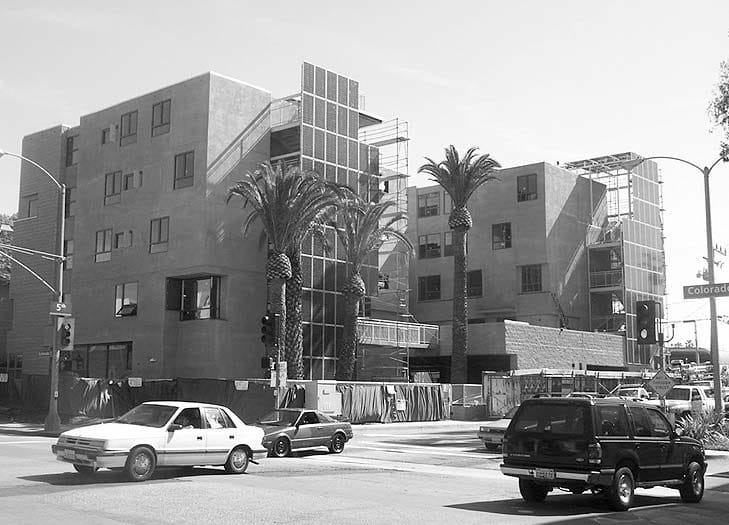
The new Colorado Court apartment building is much greener than the color of its stucco facade lets on.
Only a few of its kind in the country, the new apartment building will operate 92 percent of the time without electricity from power lines. Its power will be generated by solar power cells and a generator that runs on natural gas — called a micro-turbine.
During the day, when the building’s residents are at work, the solar cells will generate more electricity than will be needed. That new power will be sent into the general power grid for use.
“Basically, the meter will run backwards,” said Jim Kemper, a senior administrative analyst in the city’s housing division. “What would be pulled off the (electricity) grid would only be the difference between what the turbine creates and what is needed.”
The 44-unit building, which is located on the corner of Fifth Street and Colorado Avenue, has been situated to catch cool sea breezes. Windows will be placed so they are in the shade, and the plants around the building’s exterior were chosen for their ability to go long periods without water.
The insulation is made of shredded newspapers and the floors are covered in recycled carpeting. The glass in the window panes has been specially designed to be energy efficient, blocking the sun’s heat from getting through.
“This is very much an experimental building,” said Joan Ling, executive director of Community Corporation of Santa Monica. “What we want to do is share our stories as we manage the building to find out what works and what doesn’t. We see this as a community resource that everybody can learn from.”
“This is very much an experimental building. What we want to do is share our stories as we manage the building to find out what works and what doesn’t. We see this as a community resource that everybody can learn from.” — — JOAN LING Executive director of Community Corporation of Santa Monica
The project’s architect, Angie Brooks, said much of the planning was done with an emphasis on energy conservation and the building’s designs were based on old skyscrapers.
“We started looking at the building before we put any of the (energy) systems on it,” she said. “We based our design on old skyscrapers in New York City when they were designed to let light and air flow through them.”
Because of air conditioning and modern lighting, many of those elements are no loner taken into consideration.
“The way we used to build 10 years ago is inadequate and wasteful,” she said. “Most developers don’t think of long-term costs, they think of initial costs. I think as a society we need to focus on the long-term costs and the benefits buildings like this make to our environment.”
All of the building’s apartments will be 350-square-foot studios that will rent for between $300 to $350 a month. The apartments are intended for people who make less than $15,000 a year.
“We are leasing right now,” said Ling. “Since we got over 3,000 applications (for affordable housing) at the beginning of this year, we won’t have any problem filling those units in a short amount of time.”
Most of the approximately $5.8 million project, which should be completed by the end of March, has been paid for by money from federal, state and local grants. The city provided the land for the building and Community Corp. is overseeing the project.
“The credit for this project has to go to the city,” said Ling. “Their desire to do a demonstration project like this is very commendable.”
The environmentally-friendly aspects of the building did not come cheap — using them cost roughly $14,000 more per apartment unit than if the building had been designed regularly.
The added costs were so high that Kemper believes developers won’t jump to do similar buildings any time soon.
“Right now though, I don’t think you will have developers jumping at projects like this because the initial prices are so high,” he said. “If utility prices skyrocket, maybe then it would become more feasible sooner, but for the time being it doesn’t seem realistic.”
Originally published in the Santa Monica Daily Press print edition on February 27, 2002. Read the original PDF.