

Charities continue to conduct feedings in SM
The two sides of a lawsuit over outdoor public feedings in Santa Monica both said this week that it’s up to the other to act next.
Carol Sobel, attorney for the plaintiffs in the case, said she is waiting on the city to file two responses to the lawsuit before making her next move. But the city attorney’s office said it’s already responded to the lawsuit and that it is up to the plaintiffs to make the next move.
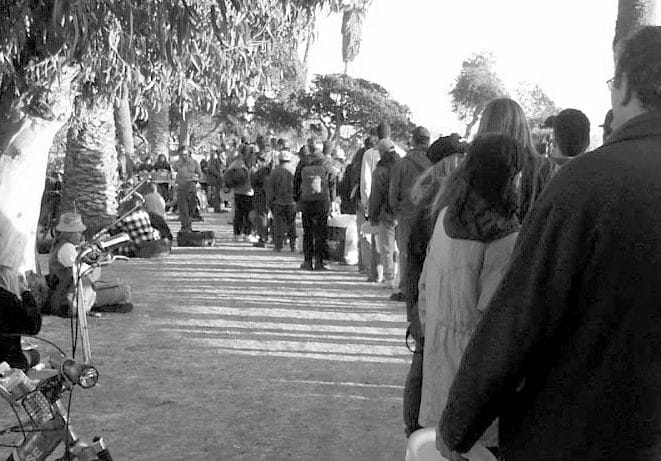
However, with the lawsuit pending and concerns over implementation of the new law, feeding programs in Santa Monica’s parks are carrying on uninterrupted.
The City Council in October adopted an ordinance that gives police the ability to break up food distribution programs that lack the proper permits. That ordinance was challenged in a federal lawsuit filed in January by the non-profit organization, Santa Monica Food Not Bombs, and other charities.
Homeless rights activists say the law steps on the constitutional rights of charities and other organizations by providing the city unilateral power to block feeding in public parks.
The city last month denied the lawsuit’s claims and requested a jury trial. The next step, according to the city attorney’s office, is for the plaintiffs to schedule a pre-trial meeting. The issue will then be brought to a judge, who will set the lawsuit for trial, according to city officials.
But Sobel, attorney for Food Not Bombs and the other charities attached to the case, said Monday she was waiting on Santa Monica Chief of Police James T. Butts, Jr., and City Manager Susan McCarthy to file responses to the lawsuit before moving forward. Butts and McCarthy were named as defendants in the lawsuit along with the city, according to court documents.
Deputy City Attorney Jannette Schactner said the city’s response, which was filed Feb. 11, included all three defendants.
“The next step is for the plaintiff to schedule a meeting,” she said. “So far we’ve got nothing.”
While attorneys wrestle with procedures, social services groups have vowed to continue feeding poor and homeless people outdoors in Santa Monica’s parks.
“We have volunteers who are willing to get arrested over this,” said Moira LaMountain, a team leader for Helping Other People Eat, a plaintiff in the lawsuit that has served food at Palisades Park twice a week since 1992. “We intend to continue to challenge this.
“We have volunteers who are willing to get arrested over this. We intend to continue to challenge this. The eye of the nation is on Santa Monica over these inhumane laws. I cannot tell you what strong support we have.”
“The eye of the nation is on Santa Monica over these inhumane laws. I cannot tell you what strong support we have.”
LaMountain said HOPE hasn’t encountered any resistance from city officials since the ordinance was adopted by the City Council.
“There has been a stronger police presence, but all they’re doing is monitoring,” said LaMountain, who added that there has been no education or outreach to charities regarding the new law. “I believe this was a political ploy during an election year. It isn’t about health and safety.”
City officials said they are working with the health department to educate the roughly 30 social service organizations that hold public feedings before the law is enforced.
“There was never a plan to enforce (the law) before April,” said City Attorney Marsha Moutrie. “The city wants to do training because (the organizations) may choose to abide by these rules.”
As to the pending lawsuit, Moutrie said it was up to the plaintiffs to make the next move and said she knew of no injunction or stay currently in effect against the ordinance.
“We’re kind of in a waiting, see what happens mode,” she said of the case.
Christine Schanes, who works with Children Helping Poor and Homeless People, a plaintiff in the lawsuit that has been serving canned food in Memorial Park for 16 years, said she is confident the city will lose.
“The charitable giving of food cannot be made criminal,” said Schanes, who pointed to a 1973 law that banned gatherings of 35 or more people in Santa Monica parks that she said was overturned as unconstitutional. “The next step is to stand by and pray that the court recognizes that these are unconstitutional laws.”
The council passed two ordinances in October responding to complaints that the city had become a magnet for homeless people who panhandle and urinate in public.
The first ordinance, which is now being enforced, makes it illegal to sleep in front of business doorways downtown from 11 p.m. to 7 a.m. The second law requires groups who feed the hungry in public to go through a rigorous government process to get a permit from both the city and the Los Angeles County Health Department.
Mayor Richard Bloom, a proponent of the ordinances, said city staff was “moving forward” with the enforcement of the feeding law.
“The law is in effect,” he said. “It was passed by the City Council and enforcement of the law depends on our staff and the county coordinating their efforts.”
Bloom said the law was intended to get charities to work in conjunction with the city to provide services, not to stop feedings altogether or chase homeless people out of Santa Monica, as some opponents have alleged.
“We’ve gone to great lengths to ask (the charities) to work with our non-profits, and in most cases they’ve denied us outright,” Bloom said. “We spend millions of dollars every year supporting (these programs).
“For me, the main issue is that the homeless population in Santa Monica is not receiving the benefits in the way that the city policy envisioned. (The charities) show up, provide food, pack up and leave. The city’s programs are there 24/7.”
Originally published in the Santa Monica Daily Press print edition on March 19, 2003. Read the original PDF.