

Palm readings display a short lifeline for trees
By JOHN F. MULLER Special to the Daily Press
CITY HALL — Residents who think Santa Monica’s urban forest is going to just remain the same might be barking up the wrong tree.
The city forest, which includes some trees that go back more than 100 years, is entering something of a mid-life crisis. Around 40 percent of the city’s trees are nearly 40 years old, and the vast majority of the palm trees lining city streets are getting near the end of the road. About 90 percent of the city’s Canary Island date palms are more than 40 years of age, as are about 80 percent of its fan palms.
“You’re going to see more diversity (in the forest),” said Walter Warriner, the community forester for the City of Santa Monica. “Different species are being brought in. When you think about the fact that about 40 percent of our forest is close to 40 (years of age) or over, when statistically the average life span of a street tree is 60... our forest is in transition at this point. “We are looking at how we are going to rotate out the old, declining trees and bring in new trees that are going to benefit our forest and add diversity to the community forest as a whole.”
Many of the city’s trees are facing problems other than just old age. Some of the Canary Island date palms, many of which were planted along Ocean Avenue 60 or 70 years ago and tower to more than 50 or 60 feet in height, are suffering from a fatal fungus disease that has struck cities across the Southern California. The palms generally have a life span of around 100 years.
“Generally, once these palm trees are infected, that’s it,” said Jim Downer, the farm advisor in environmental horticulture and plant pathology for the University of California Cooperative Extension in Ventura County. “It’s a one-way ticket to the dumpster. There’s nothing you can do about that.”
The fungus is spread from tree to tree by unsterilized pruning implements and remains dormant for many years before a palm becomes obviously affected, Downer said. It can also spread through the soil if a palm is planted in the same spot where the fungus claimed the life of another palm.
Donald R. Hodel, an environmental horticulturist at UCCE who works in LA County, likened the disease — which is known as Fusarium Wilt — to AIDS. He pointed out that it is both an entirely preventable and an entirely fatal disease.
However, much remains unknown about the fungus because it has received little research funding and cities have not been forced to actively confront the issue, Downer said. With mature Canary Island palms fetching prices in upwards of $10,000, he said research would be costly. “(Cities) are in denial,” he said. “If you have a really big problem and it doesn’t evolve too quickly and you can kind of forget about it until it gets really bad, then you can deny that it exists, especially when the disease can be latent — that is, in the tree but not showing symptoms yet.”
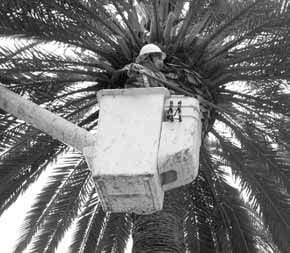
Warriner said the city has been addressing the issue for years, replacing between 10 and 15 Canary Island date palms a year for a variety of reasons, requiring tree trimmers to soak their cutting implements in bleach between trees to stop any potential spread of the disease. The city has also been putting in different species of palm trees to preclude new trees from catching the disease in infancy.
“We’re not raising the red flag about Fusarium,” he said, adding that the city has also had to deal with other threats to its tree populations. “Fusarium has been around for decades. It’s something we’ve always known about, we’ve always had it, and we’ve always dealt with it.”
As the Canary Island palm population phases out and a number of older tree populations continue to decline, the city will witness a gradual change in its urban forest, Warriner said.
Originally published in the Santa Monica Daily Press print edition on August 25, 2004. Read the original PDF.