

Cracking quake funding a very shaky experience
THE FAULT LINE — It’s been a decade since this city was rocked by the Northridge Earthquake, and many parts of it are still rebuilding.
The quake, which registered at 6.7 on the Richter Scale, caused an estimated $250 million in damages city-wide and countless nightmares for residents who were awoken at 4:17 a.m. on Jan. 17, 1994, in absolute panic and fear as the earth came out from underneath them.
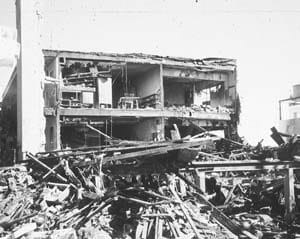
Police and emergency and city workers responded swiftly to the 12 fires that broke out as a result of the quake, as well as the 300 reported gas leaks and hundreds of injured people. Both hospitals — Santa Monica-UCLA Medical Center and Saint John’s Health Center — were hit especially hard. Doctors scrambled to attend to patients in facilities that were inoperable. Both hospitals were closed for months and are still rebuilding today.
The devastation included 530 buildings, containing 2,300 housing units, that were uninhabitable. Approximately 1,500 buildings with 16,000 units sustained damage. Of those, 118 were city-owned buildings. And while nearly every building at Santa Monica College sustained damage, its science, liberal arts, library and parking structures had to be entirely replaced. All of them have been demolished and rebuilt, except the liberal arts building, which is scheduled to be constructed this spring and completed in 2006.
And while emergency workers responded quickly to the incident, so too did elected officials who immediately passed several laws and approved procedures to get the city back to normal for residents and businesses. They also called upon the federal government to help pay to clean up the mess. But because Northridge had been the focus of the media’s and federal government’s attention, Santa Monica almost got lost in the fray.
The Santa Monica Freeway was shut down, and it was nearly impossible to get here just days after the quake. Santa Monica remained isolated, and most of the country was unaware of the devastation that had occurred.
“We had much more damage than any other city,” said then mayor Judy Abdo. “People did-n’t know our hospitals were being closed and all these buildings were red tagged.”
The quake happened on Martin Luther King Day, a Monday. By Wednesday, federal officials, including President Bill Clinton had arrived in Los Angeles. Abdo attended a meeting at a Burbank Airport hangar that included President Clinton, members of his cabinet, state legislators and more importantly, LA Mayor Richard Riordan — as Abdo would soon learn.
“There was a whole string of people there explaining how the money was going to come through one block grant, and I realized we would have gotten little money,” Abdo said, adding she was sitting in the back of the hangar with hundreds of others. “I was getting a little agitated because I could see they weren’t going to help us — it was all going to be funneled through LA.”
She raised her hand and because she and Riordan had become mayors at the same time, he spotted her in the crowd. A microphone was brought to her, and she was able to address the politicians on stage.
“I informed everyone of what had happened to us,” she said, adding the meeting was being aired on national television. “I said ‘This won’t work as suggested,’ and it went everywhere, and everyone knew what had happened to us.”
Abdo was invited up to the podium after the meeting and was able to speak directly to President Clinton and other legislators.
“He asked if the Loews Hotel was okay because that’s where he liked to stay,” she recounted. “It was then that they started inviting me to meetings with the feds.”
From then, things just changed, Abdo said. FEMA officials had to rethink how they were going to administer money to residents, particularly renters, most of who live in Santa Monica. Housing assistance and loans were given directly to renters and homeowners as a result.
Abdo spent the days after the quake answering phones at City Hall and touring the city with federal officials. Many places in the city were intact — like Ocean Park — where Abdo lives. But as many residents later learned, her house ended up sustaining serious structural damage.
City Councilman Herb Katz, who has lived in LA since he was a child and now lives in Santa Monica’s Sunset Park neighborhood, woke up to his house shaking.
“It was probably the scariest thing I’ve ever experienced,” he said.
Originally published in the Santa Monica Daily Press print edition on January 17, 2004. Read the original PDF.