

Made in the shade? Landlord wants a trim
WILSHIRE-MONTANA — A property owner committed to scaling back the city-landmarked tree on his front yard to make room for condos just may get his day in court after all.
Attorneys said they have submitted all the necessary paper-work, as of August, and are waiting to hear back from the California District Court of Appeals to know when their case may be made regarding the fate of Andrew Enayati’s deodar cedar, located at 918 Fifth Street.
If Enayati had his way, he said he would trim back the 100-year-old tree on his lot, raze the aging house that currently sits in the rear of the property and construct condominiums around his massive deodar cedar.
Enayati doesn’t have that option, though, because City Hall in January of 2003 designated the sprawling tree a city landmark. As such, the cedar was protected not just from being uprooted, but also from being trimmed without city supervision.
A fierce legal battle ensued, but not over whether the tree should be preserved. Enayati claimed he was denied his constitutional rights and forced into involuntary servitude by City Hall, because the tree was in the process of being landmarked as he was in escrow to buy the property. He claims he never received notice.
Attorneys for City Hall succeeded in having the lawsuit tossed out of Superior Court in April of 2004, arguing that although Enayati was never formally served with the landmark paperwork, which was mailed to the previous property owner, Enayati had several opportunities to oppose and later appeal the landmark designation.
“He was there at the hearings and closed escrow while the landmark process was underway,” said Carol Kurtz, deputy city attorney, who is assigned to the case. “So what he purchased was a property with a very large tree and a small house.”
Attorneys for Enayati appealed the Superior Court ruling in February and began filing opening briefs in the California Second District Court of Appeals. Enayati claims he was unfairly denied use of his property by the actions of City Hall, and wants to have the tree’s landmark status either tossed out or heard again on appeal.
Kurtz said City Hall received notice of the appeal in May and the California District Court of appeals has been “fully briefed” on the case. Attorneys are waiting to hear back from the appellate court as to when the case may be argued before a judge.
Kurtz said part of the reason she is confident in City Hall’s position is because the courts, so far, have supported its side.
“The city prevailed in the Superior Court action and I don’t see why the Court of Appeals should overturn that decision,” Kurtz said.
Kurtz claims the case rests on whether the property owner can show the Landmarks Commission abused its discretion when it decided to preserve the tree.
“So far, (Enayati’s legal counsel) has been unable to make that showing,” Kurtz said. “The city has always stood by that it was not an abusive discretion.”
Harold Griffin, who is representing Enayati, didn’t comment on the case.
James Jacobson, a paralegal who authored the court documents on behalf of Griffin, said Enayati hasn’t asked for permission to develop the site because it would cost in upwards of $15,000 to assemble the professionals and draft plans for a development that ultimately may never even be considered.
In an April 2003 article entitled “Hysterical Landmarks Stories, Part 1: Revenge of the Tree Huggers” in “WAM,” a publication for area landlords, Jacobson accused City Hall of unfairly protecting the “big ugly” tree and requiring Enayati to trim it, even though the very thing that made the tree worthy of landmarking was that it grew wild for several decades.
Enayati, of Pacific Palisades, owns several properties in and around Santa Monica. He’s told the Daily Press he doesn’t intend to cut the tree down, but accuses City Hall of being unwilling to cooperate with him in managing the tree so he can make best use of his property.
The tree’s canopy covers more than half of his 50-foot-by-150-foot Fifth Street property, which is north of Wilshire Boulevard. Despite the city’s concerns, Enayati maintains he would trim the tree so it covers 40 percent of the lot, rather than the 60 percent it presently spans.
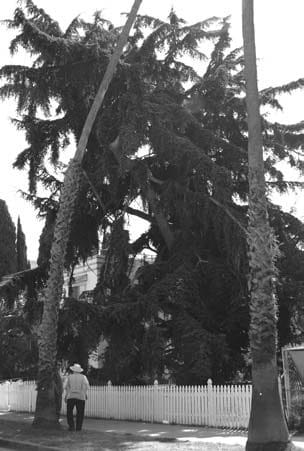
Known among horticulturists by its Latin name, Cedrus deodora, the tree stands nearly 50-feet tall, with a 175-inch trunk circumference. It differs from other cedars because its lower branches were not cut and, therefore, sprawl out horizontally. According to the Jan. 13, 2003 landmark determination, the tree could not be easily reproduced today and has a longer life span than other, more manicured cedar trees in the city.
“The subject tree was planted... at a time when the properties on the street were developed with low-rise single-family homes or multi-family bungalows,” according to the landmark decision. “As the street changed and became characterized by three-story condominium buildings, this tree, with its unusual, natural shape, has remained as an established and familiar visual feature in the neighborhood.”
Originally published in the Santa Monica Daily Press print edition on September 28, 2005. Read the original PDF.