

Georgina Avenue home faces historic designation
By TIM MURPHY AND LARRY HOFFING Special to the Daily Press
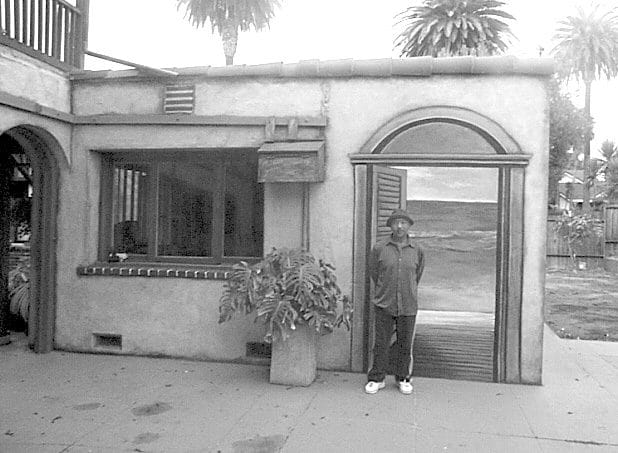
On any given morning, if you walk past Georgina Avenue and Fourth Street, you’ll likely see Zion Yu tending his gardens and 70-year-old bonsai pine tree.
Although Yu’s home is a place for peace and serenity, it is located in an area that is turbulent with controversy.
The city recently hired a consultant to determine whether areas north of Montana Avenue should be considered historic, which means designated homes wouldn’t be allowed to be altered on the exterior without heavy government scrutiny.
The consultant’s report, scheduled to be released in April, has many homeowners fearful that the government will be able to rule over private property.
Situated in the middle of the dispute is Yu’s home. The house is located in the center of the Palisades tract, which runs north of Montana and west of 7th street. It is one of the areas being examined by the consultant, Historic Resources Group, and Yu’s home is likely to be rated as a highly significant historical building.
The city paid to have an inventory taken of Santa Monica historical properties in the 1980s. The result is the Historical Resources Inventory, a seven-volume report, which examined hundreds of houses in relation to their historical significance. It was updated after the 1994 Northridge earthquake. Currently, the inventory is being updated again.
Yu’s home was rated a “No. 3 dwelling,” which means it is eligible for individual designation in the National Register of Historic Places.
Liz Bar-El of the city’s planning department, said the designation is highly significant, adding that when an owner applies for a building or demolition permit and the home is placed on the National Register, the city’s planning commission will hold the permit for further consideration.
“The commission will talk with the owner and discuss possibilities other than demolition or significant changes to the home,” Bar-El said.
The Historical Resources Inventory listed three reasons 404 Georgina is significant: its notable architecture, its rare construction material and its location in the historic Palisades tract.
The Palisades tract first opened in 1905 after six developers spent $100,000 on improvements such as grading and oiling streets, cementing sidewalks, installing sewers and planting trees.
Shortly after Santa Monica annexed the tract and in 1906, the city began keeping building records for the area, according to Luther Ingersoll, author of “Century History of Santa Monica Bay Cities.”
Records indicate that in 1920 a Mrs. MacBennett “applied for a permit to build a dwelling for a cost of $7,000,” at 404 Georgina, according to the resources inventory. MacBennett hired notable architect and builder John Byers, who was Santa Monica’s most foremost architect at the time.
Byers’ forte was utilizing indigenous materials to recreate Spanish-style homes. Byers used adobe to build MacBennett’s home, and traditional methods of construction were used. Byers’ style was one of the earliest forays into this realm of building and it can still be seen at 404 Georgina today.
Even before MacBennett commissioned her house, there is evidence of a structure on that lot dating back to the 1800s.
James W. Lunsford’s “Looking at Santa Monica,” states “Portions of the house are believed to date back to the 1840s as a shelter for ranch hands.”
“Looking at Santa Monica,”
“Portions of the house are believed to date back to the 1840s as a shelter for ranch hands.” — James W. Lunsford’s states Yu’s home could be among the oldest in Santa Monica’s history
Yu’s home could be among the oldest in Santa Monica’s history.
Shortly after it was built, MacBennett sold the house to cowboy movie star William S. Hart. The Hart family owned the house until they sold it to Yu in 1990.
Yu opened the home as a place of healing where he teaches Tibetan chanting. Yu has been a “healer” in California since 1970, when then Gov. Jerry Brown legalized acupuncture.
One of his students, Danuta Rothschild, a Dutch Artist, became friends with Yu, and the two opened the place as an art house to display local artists’ work. Four paintings were sold at the grand opening last year.
Rothschild felt that galleries were “robbing” artists by taking too much commission, and envisioned the Hart house as a place where artists could express, create, display and sell their work while at the same time keeping 70 percent of profits.
Yu envisions the house as a little art city, complete with a community kitchen and solar heating and lighting system.
Following his divorce in 1990, Yu was praying to God to help him find a home. Driving around Santa Monica, he happened to park his car next to the Hart house and saw a “For Lease” sign.
Yu, 53, had seen a courtyard in a dream and knew that the house would be a perfect fit for him. Bill Hart saw Yu approaching the house and said to him, “Howdy, I’ve been waiting for you,” according to Yu.
Bill Hart had had many offers on the house, but didn’t trust that they’d would take care of the landmark. His mother had told him, “Don’t worry Bill, you will find a Chinese doctor.”
Originally published in the Santa Monica Daily Press print edition on March 18, 2002. Read the original PDF.