

A resident wants to house homeless in small modules
DOWNTOWN If sleeping in closet-like capsules is good enough for Japanese businessmen, then it should be good enough for Santa Monica’s homeless.
That’s what resident Randy Walburger thinks, which is why he has developed an urban camping plan that he believes can move those without shelter into temporary housing faster than what is being done currently.
The only problem is finding the money and the space to make it happen.
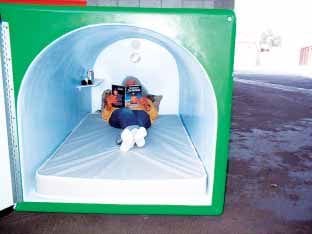
Under Walburger’s proposal, which he has been sending to just about anyone who will listen, including City Hall staff and representatives with the Los Angeles Homeless Services Authority, those living on the streets would be housed in plastic modules stacked on top of one another and placed in parking lots or land yet to be developed, where case workers could connect with the down-and-out and provide them with counseling, job training and other services.
The urban campsites would include showers, toilets and lockers to store personal items.
“Many homeless people have caseworkers but not a bed to sleep in at night, forcing them to go into hiding when the sun goes down,” said Walburger, who almost became homeless himself a few years back when he lost much of his money in the sock market, causing him to become severely depressed.
“If people are caught lying down, they can get a ticket,” Walburger said. “That ticket quickly turns into a warrant because they can’t get to court or pay the fine, so ultimately, lying down becomes a jailable offense. That’s where we are today and I want to change that.”
By using modular construction, Walburger believes entire campsites could be easily assembled and disassembled at a low-cost. Sleeping modules would be constructed out of sturdy, waterproof polyethylene plastic, insulated with 3-inches of fire retardant acoustic foam. The inside dimensions would be 7-feet long by 3.3-feet wide and 3-feet tall. Each capsule would contain a twin bed, a light and a small shelf.
The modules would be ventilated front to back so the air flows through. Each module would have a louvered screen window that would serve as the front door. Each would also have a lock box to place personal items.
Each campsite would need to have electrical and water hook-ups. A campsite serving 12 people could be assembled on less than 550 square feet, Walburger said. There would be two toilets, one shower, one dressing room and a sink.
Not just anyone would be allowed to stay there. Walburger said case workers with agencies like OPCC and St. Jospeh Center would select candidates who are committed to getting off the streets. Police would also be allowed to refer and transport those who are willing to reception campsites where they can be evaluated for compatibility with urban camping and find a site that would best suit their needs.
“For some, a camping approach can be the first step into more permanent shelter when an indoor bed or program becomes available,” Walburger said.
Those who are shelter resistant may also be more apt to stay at a campsite and receive assistance, Walburger said.
Each site would have an on-site manager to oversee the day-to-day operations and make sure campers are staying on track. Campers could be assigned duties at the sites, such as maintenance or laundry service, to help them reintegrate into the workforce.
The campsites would be closed during the day since they would most likely be located in parking lots or CalTrans land that is used from 6 a.m. to 6 p.m. This would also discourage people from hanging out at the campsite, turning it into an eyesore.
One major hurdle is funding. Walburger said creating the mold that would make the modules would cost roughly $50,000, with each module running roughly $3,000 a piece or less, depending on how many are made at one time. There is a limited amount of money available for such projects, meaning Walburger will most likely have to find private sources instead of relying on public agencies and municipalities.
There are also concerns about public health and safety, said Julie Rusk, human services manager for City Hall who manages the city’s response to homelessness and has spoken with Walburger about urban camping several times.
“This idea comes up periodically and for good reason,” Rusk said.“It seems like a very practical, simple way to help large numbers of people, and it can be cost effective. But in the end, it always comes down to public safety. You are effectively putting a large number of people in what ultimately amounts to a substandard living condition.
“Homelessness is the ultimate substandard living condition, but when you are sanctioning camping as a way for people to live, you really take on a lot of unintended consequences and problems,” Rusk added.
“Concentrating a lot of people in onc place is just not what we are trying to do. We are focused on helping the most chronically homeless now, trying to make an impact by targeting those who have been on the streets the longest.”
Rusk said organized camping is a project more suited for the private sector, with funding coming from foundations that can take more of a risk.
John Maceri, executive director of OPCC, the largest homeless services provider in Santa Monica, said he has spoken with Walburger many times about his camping concept and believes it has some merit, but points to the difficulties in finding a suitable location to place the modules.
“We all know that we do not have enough housing to meet the need,” Maceri said.“But it becomes a question of where do you put these sites. They would be on public parcels that would be very visible, such as parking lots at the beach or CalTrans sites. Having people in these modules is better than doing nothing but you run the risk of them becoming more than a short-term solution and turning into a pretty large encampment, and how do you manage that?”
There is already a feeling amongst many Santa Monicans that City Hall has done more than its fair share to help the homeless and are looking for a reduction in services, or at least in the number of homeless people seen on the streets. By building campsites, there is a fear that more homeless would be attracted to Santa Monica.
Walburger realizes there are many obstacles standing in his way and knows that if he is able to secure funding, there will be many critics who will try to shut him down or push him out of their neighborhoods. However, he remains committed to pursuing organized camping in Los Angeles County, and plans to make presentations to county officials.
“Every new concept is before its time,” Walburger said. “But organized camping with caseworker management is not before its need.”
Originally published in the Santa Monica Daily Press print edition on January 14, 2008. Read the original PDF.