

Cedar tree lawsuit before state appellate court
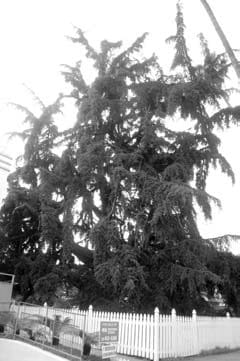
MONTANA — If Andrew Enayati had his way, he said he would trim back the 100-year-old tree on his lot, raze the aging little house that sits in the rear of the property and build condominiums around his massive deodar cedar.
Enayati doesn’t have that option, though, because City Hall two years ago designated the sprawling tree a city landmark. As such, the cedar was protected not just from being uprooted, but also from being trimmed without city supervision.
A fierce legal battle ensued, but not over whether the tree should be preserved. Enayati claimed he was denied his constitutional rights and forced into involuntary servitude by City Hall because the tree was in the process of being landmarked as he was in escrow to buy the property. He said he never was notified.
Lawyers for City Hall succeeded in having the lawsuit tossed out of Superior Court last April by arguing that although Enayati was never formally served with the landmark paperwork, which was mailed to the previous property owner, Enayati had several opportunities to oppose and later appeal the landmark designation.
“They had all the notice in the world,” said Deputy City Attorney Carol Kurtz, adding Enayati and his attorney even attended some of the landmark meetings. “It wasn’t as if they didn’t know. It’s not as if he bought this property and all of a sudden was shocked to find it had a historically landmarked tree. He knew about it.”
“It wasn’t as if they didn’t know. It’s not as if he bought this property and all of a sudden was shocked to find it had a historically landmarked tree. He knew about it.”
Attorneys for Enayati appealed the Superior Court ruling and last week filed opening briefs in the California Second District Court of Appeals. Enayati claims he was unfairly denied use of his property by the actions of City Hall. He wants to have the tree’s landmark status either tossed out or heard again on appeal.
B2A,“The city says, ‘No, you can’t do anything around the tree,’” said Enayati, adding the tree’s canopy covers more than half of his 50-foot-by-150-foot Fifth St. property, which is north of Wilshire Boulevard. “I’m not kidding, the city is being very unreasonable... They’re playing all sorts of legal maneuverings around us.”
Despite the city’s concerns, Enayati maintained he would not uproot the tree but rather trim it so that it covers 40 percent of the lot, rather than the 60 percent it covers now.
“Whatever I do, I’d like it to be around the tree,” said Enayati, of Pacific Palisades, who owns several properties in and around Santa Monica. “It’s not my intention to hurt the tree or cut down the tree or anything like that, but — and there’s always a but — the city doesn’t want to cooperate with us.”
Kurtz questioned Enayati’s true motives, but said there was no way to know for sure what he wants because he hasn’t filed any proposal to develop the property. Any plan would have to be mindful of more than just the tree’s massive limbs, she said.
“The whole construction issue has to do with protecting the root system,” Kurtz said. “If you build under the canopy of the tree, you’re building in the roots, and you’ll kill it.”
City attorneys will file a reply to Enayati’s appeal sometime in the next two months, according to Kurtz.
Paralegal James Jacobson, who authored the court documents on behalf of Enayati’s attorney, Harold Griffin, argued that Enayati hasn’t asked for permission to develop the site because it would cost upwards of $15,000 to assemble the professionals and draft plans for a development that ultimately might never even be considered.
Jacobson in an April 2003 article titled “Hysterical Landmarks Stories, Part 1: Revenge of the Tree Huggers” in “WAM,” a publication for area landlords, accused City Hall of unfairly protecting the “Big Ugly” tree and requiring Enayati to trim it, even though the very thing that made the tree worthy of landmarking was that it grew wild for several decades.
The tree, known among horticulturists by its Latin name, Cedrus deodora, stands nearly 50 feet tall, with a 175-inch trunk circumference. It is different from other cedars because its lower branches were not cut and therefore sprawled horizontally. According to the Jan. 13 landmark determination, the tree could not be easily reproduced today and has a longer life span than other, more manicured cedar trees in the city.
“The subject tree was planted... at a time when the properties on the street were developed with low-rise single-family homes or multi-family bungalows,” according to the landmark decision. “As the street changed and became characterized by three-story condominium buildings, this tree, with its unusual, natural shape, has remained as an established and familiar visual feature in the neighborhood.”
Originally published in the Santa Monica Daily Press print edition on February 21, 2005. Read the original PDF.