

BLOCH, from page 1 Bloch spurred more studies
SANTA MONICA AIRPORT — It’s somewhat surprising that a seventh grader said to have made a significant contribution to the scientific study of airport air quality would grow up to be a jazz musician.
“I always loved science, and still do,” said Jake Bloch, now 17.“I made some really good friends in middle school and continued to stay friends with them through high school. We grew up together playing jazz and I came to appreciate music.
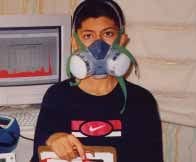
“There is nothing better.” Bloch had a more scientific career in mind when his seventh grade science fair project to measure ultra-fine particles emit-ting from aircraft at Santa Monica Airport grabbed the attention of local environmental scientists, begetting more studies on airport air quality issues.
Today, the Santa Monica High School senior is putting the final touches on his college applications to the University of Southern California, Indiana University and Julliard School in New York in the hopes of being admitted to one of the schools’ prestigious music programs.
Bloch’s seventh-grade study — one of the first to examine ultra-fine particles at a small airport like that in Santa Monica — helped spur additional studies at LAX, Van Nuys Airport and Vancouver Airport, according to his mother Ping Ho, who is a member of the Friends of Sunset Park Airport Committee, which deals with issues related to Santa Monica Airport, including noise violations and environmental issues.
Ultra-fine particles are the smallest and most toxic of the three different categories of air pollution particles. The other two categories include coarse and fine particles. The ultra-fine particles are small enough to enter cells, have been associated with heart disease, and can penetrate the brain and produce inflammatory responses, said John Froines, a professor of Toxicology at UCLA and director of the Southern California Particle Center.
“All the research going on in our center over the last seven years would indicate ultra-fine particles are particularly toxic,” Froines said on Monday.
Froines is currently working on a study on the emissions of particles from jet aircraft at LAX, downwind of LAX, around Aviation Boulevard and in the community on the other side of the 405 Freeway. He could not comment on the findings on the study since the Environmental Protection Agency and the California Air Resources Board have yet to review the final report. The two agencies are expected to review the report in January.
“I’m proud I could help the community and help spur all these other studies that are leading to cleaner air.” — JAKE BLOCH
The South Coast Air Quality Management Board has conducted its study for about a year and is still in the field monitoring phase, according to Sam Atwood, spokesman for the SCAQMD.
Atwood could not confirm whether Bloch’s study had any weight in the board’s decision to conduct a study on air quality, specifically focusing on lead levels in the air, at Santa Monica and Van Nuys airports.
“We want to make sure there is no community impact,” Atwood said on Monday. The study is expected to be completed next year.
Rather than make a telegraph machine or another typical science fair project, Bloch decided in the spring of 2002 to investigate air quality at the airport — located about two blocks away from his home in Sunset Park.
“Back when I was in seventh grade, I used to often smell the airport exhaust at the house,”Bloch said.“I wondered whether that would be harmful to my health or anyone’s health later down the line.”
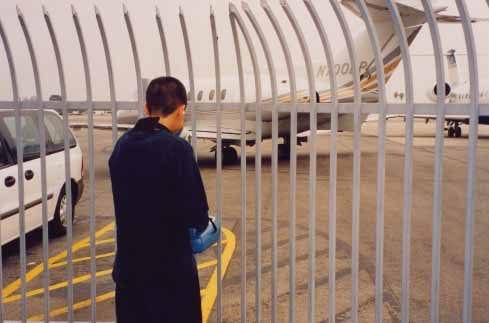
Borrowing a P-Track particle counter, which measures ultra fine particles, from Froines, a family friend, Bloch spent a few months gathering data at various locations around the airport. The measuring spots were taken less than 100 meters from airport activity and away from vehicular traffic when possible.
The “hot spots,” as Bloch called them, included the intersection of Sardis and Armacost avenues in West Los Angeles, and a gate east of the Museum of Flying, where Bloch found jets taxiing.
While those around Bloch told him he would not be able to gather significant results from his study, he was surprised by the findings. They showed there was an unhealthy level of ultra-fine particles emit-ting from the airport, the highest levels being produced from jet aircraft idling and taxiing, the report found.
“Santa Monica Airport is surrounded by heavy traffic roads. He had to try and separate vehicle emission from aircraft emission,” Froines said. “It’s amazing a seventh grader would have awareness. This is not one of those projects that the parents got the A plus for the study.”
Originally published in the Santa Monica Daily Press print edition on December 6, 2006. Read the original PDF.