

By LESLIE ANNE JONES Special to the Daily Press
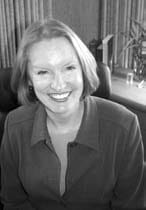
Patricia Farris’ path to becoming one of Santa Monica’s top religious leaders might have been driven by divine intervention, seeing as how she didn’t even consider a career of serving a higher power until her years of higher education.
Having completed a tour of duty that spanned both coasts, Farris now finds satisfaction working with people from all walks of life — senior citizens, youth, the homeless, the brokenhearted, the addicted and people in crisis. Although based in Santa Monica, Farris maintains relations with communities as far away as Nigeria and Vietnam.
It’s a career fit only for an adept public figure, a role that Farris has embraced as senior pastor of First United Methodist Church of Santa Monica for the past five years. She feels blessed that the congregation has accepted her, and its members feel equally blessed to be led by a woman who has decades of experience in the ministry.
The only child of an accountant and homemaker, Farris, 53, was active in her church growing up in Phoenix. There, she learned what it meant to contribute to the community and to the world.
But the thought of making a career out of it never crossed her mind — women weren’t even allowed to be ordained ministers in the United Methodist Church until 1956.
Farris attended Carleton College in Minnesota, where she majored in political science and remained religiously active. When she graduated in 1974, Farris was sure she was headed for a career in either law or international relations. But God came calling when an opportunity to study at Harvard presented itself. Her chaplain at Carleton suggested she apply for a scholarship offered by the Rockfeller Brothers Foundation, a fellowship aiming to expand the pool of ordained ministers.
With expenses paid for one year, Farris headed to Harvard Divinity School. Her plan was to study ethics for a year and move on to international relations or law.
“But I discovered women students at the school, women teaching in all the various academic fields and had my eyes opened to real exciting new developments in the church and the whole field of religion,” Farris said. “That second year, I realized I did have that calling. I could never hear it before because there was no framework for it, no way to imagine it.”
At Harvard, Farris molded that framework to fit her passions. While getting her master’s degree, Farris met her husband, David Bremer, who now teaches literature at the OTIS College of Art and Design.
The Methodist Church appointed Farris to the campus ministry at the University of Delaware, where she ministered for five years. Farris then headed West to serve as the pastor of a small congregation in Gardena.
Farris honed her pastoral skills in Gardena for six years before moving to United University Church, near the USC campus. The congregation was a merged group of Presbyterians and Methodists. For five years, Farris was recognized as both a Presbyterian and Methodist pastor.
But then Farris was asked to step into a larger role — the Church Bishop tapped her to be the superintendent of the San Diego district. Farris was in charge of 57 congregations in Imperial and San Diego counties. During her three-year stay as superintendent, Farris dealt with pastoral appointments, congregational conflicts, and sometimes legal issues, including a highly publicized sexual abuse case involving a pastor in her district.
Her best assignment, though, has been at First United Methodist — a church as old as Santa Monica and, as a result, one with deep roots in the community. The church, located at 11th Street and Washington Avenue, is the place where countless community-wide events are held, including holiday concerts and Southern California’s largest Martin Luther King Day celebration. With 1,700 members and a long history of community involvement, Farris jumped at the chance to become the church’s senior pastor and live in this city by the sea.
The Daily Press recently caught up with Farris, who shared her thoughts on Santa Monica, the church and the community.
What’s the most fulfilling part of your job?
“Seeing lives transformed. When people catch a glimpse of a powerful calling in their own life, and I don’t mean ordained ministry, I mean vocation. That is, you know, every year our youth go on a service project, usually to Appalachia, and they go for a couple of weeks, and they go and work and come back, and for a lot of them it’s the first time they’ve seen that kind of poverty and what an impact people can make. And it changes how they think about what they’re going to do with their lives, and I love that. I love people. I think church should be a place where people’s lives are centered and grounded, and opened up to possibilities they didn’t even know were there.”
What appealed most to you about Santa Monica?
“Santa Monica is such a wonderfully unique community, within the larger metropolitan area. And really, I love Los Angeles. I love the diversity of people, and cultures... It’s an area that faces challenges like floods and fires and earthquakes and riots and stuff like that... Santa Monica, in the midst of all that, has such a long history. There are four-generation families within this congregation, which is remarkable for Southern California.”
Is First United Methodist one of the largest churches in Santa Monica?
“Yes. It’s the largest Protestant by far. Saint Monica’s beats us all. But we’re by far the largest Protestant congregation. So it’s got community outreach, we’ve got great facilities, which means we can do a lot with ourselves and with community groups and hosting events.”
What is the church’s mission, in Santa Monica and globally?
“This congregation is very committed to being a place where its members are always growing in faith and discipleship. So we emphasize worship, we emphasize education, small groups, fellowship groups, so that people of all ages and different stages in the life cycle find community, find friends to support and help the issues that they’re having. So a lot of ministry to the families and people of the congregation — young adult groups, people 25 to 35 years old, we have a youth program, we have a lot for children, and then that overlaps with outreach to the community.”
How many community programs does the church have?
“Oh my gosh, I never counted them.”
Would you say dozens? “Yeah, I’d have to count them. Of course, Upward Bound House is the most tangible and visual testament to our community and its needs. The senior villa part is housing for low-income seniors. The other part of it is called Family Place. And that is for families transitioning out of homelessness. Families are screened, and it turns out to be mostly single moms and kids, and they’re screened by the staff so that they fit the program. They come, they have a place to live rent-free, and then they’re given a lot of support, counseling in parenting skills and how to save your money, and how to do a job interview and how to organize your life and set your goals and stick to them. And they save money, and when they leave, they move into their own housing situation. And the statistics are phenomenal, it’s about 90 percent of our families are now, still, in stable situations.”
How long do they stay? “Now they’re moving after around a three-to four-month stay, which is much shorter than we initially thought. And it’s because we’ve been at it now for several years, and the program is really very strong and very efficient.”
How else is First United Methodist Church involved in Santa Monica?
“The health ministry for example: We had a program Wednesday and Thursday that was co-sponsored by St. John’s Hospital on women’s cardiac health. And all together I think we had 450 people that were there on those two days to hear three speakers talk about women’s cardiac health. This has been one of our newer ministries, in terms of expanding public education around those kind of issues, or partnering. We do a lot partnering with other organizations whether it’s the hospital or Santa Monica College, the Martin Luther King Coalition, the space is used by boy scout troops and girl scout troops. I think we host 10 or 12 12-step groups.”
What’s the biggest challenge facing Santa Monica?
“I think one of the big issues facing our community centers around what I might call ‘quality of life’ issues. Whether it’s ‘How do we grow in ways that are healthy and manageable?’ or ‘How do we continue to evolve as a community with policies about growth and development that are going to make sense and be manageable?’ The things that people have always loved about living here — quality education, community life, neighborhood, safety, civic involvement — how do we maintain all that and forward? And I think that the church is a place that holds up all those values. I think that as we become increasingly more affluent of a community, for some, it becomes harder for more middle class people to live here. It used to be that the middle was really our (the church’s) base, so the question becomes how do we relate, on the one hand, to very affluent people, and on the other hand, to people of limited means, who are here mostly working in homes, in restaurants, in the service industry and so on. How do we reach out to them in ways that are meaningful? That’s not only our challenge, I think it’s the challenge of the community.”
How do you prepare for Sunday sermons?
“Sometimes people say, ‘Why can’t you just pull out an old sermon?’ I could never do that. I mean, I might take a paragraph or something, but I could never do that because the world is always changing, whether it’s our immediate community or the larger world. So I read a lot, I watch the news a lot, and I try to just pay attention to what’s going on out there. And I try to have a broad range of interests because, again, our congregation is really diverse. Some of them love sports, some of them love health issues, some of them are in business, some of them are in academia, some of them are really most focused right now on their families and their kids, so I try to pay attention to what’s going on at all those levels. I do take Thursdays as my day. I don’t even come in here because it’s too distracting. It’s my day for study and writing. I’ll do some tweaking on Friday and Saturday, and sometimes I’ll throw it out on Saturday, luckily that doesn’t happen too often, but it’s kind of scary when it does. Every Sunday, it’s kind of a relentless schedule, it comes around real frequently — every week — there it is.”
The ultimate deadline? “Exactly. There’s no escaping it. You know, there are some Sundays where I think, ‘This maybe isn’t going as well as I wished it would,’ and yet somebody listening will say, ‘You spoke to me today, what you said was exactly what I needed to hear.’ And I just have to thank God, because you know I just do my best. I try to keep my mind open, my heart open, my spirit open, and then I just put it out there.”
What’s your philosophy on life? “Life is a beautiful gift; we’re given this amazing creation, amazing bodies, amazing people around us, it must be enjoyed, it should be cherished, it should be fought for. We’re created in communities, so it’s not about selfishness at all, it’s about connecting with people and helping to make the world a more just place. I think we have a responsibility beyond ourselves. Most of us here are really fortunate. We have a lot of material resources, we’ve been given a lot of opportunity, I certainly have. So I have a lot of responsibility back. I don’t think I’ve ever been asked that before. That’s a great question.”
What’s your favorite thing about living in Santa Monica?
“Movies, friends. I mean it’s an amazing community, what great people — people involved in this community in so many ways, I love that. People have a stake in what happens.”
What’s your least favorite thing about living in Santa Monica?
“We can all become insulated — from even the rest of L.A., and it’s tempting to get too comfortable, I think, and it’s not inherently bad, it’s just if that closes us off to people’s needs and the needs of the world.”
What’s the future plans for the church, locally? What do you have going on?
“We have a new director in the nursery school... We’re always strengthening our music program, we’ll provide some great concerts for people, and we’re going to refurbish our social hall this year and really bring it up to date and get new lighting and a new sound system and make it an even better venue for serving our community. Sending the kids back to Appalachia this summer. We have a new covenant partner relationship with the Methodist Church in Nigeria, and our associate pastor Larry Young has been (to Nigeria). We also, our health ministry nurse went to Vietnam on a medical mission team there, and we’re exploring ways to send more of our folks both to Vietnam and Nigeria.
“Also more short-term involvement opportunities for people in the congregation more locally. So, take a Saturday and work with the homeless, or work at one of the community centers, or work with the hungry, or take a few days of your vacation and go work. We’re encouraging. We’re not to the planning stage yet, but we’re getting close, because we know that not everybody can go to Nigeria.”
Can you address the Methodist Church’s recent decision not to recognize same-sex marriages?
“The Methodist Church is a very big denomination, and, as I said to you, it is now global. So it brings together people of very conservative social values as well as people of very liberal social values, or moderate. My own personal point of view is that over time it needs to become a place where everyone is accepted and respected. The Methodist Church in the west has always been, actually, a place where diversity was valued. We’ve always been open, we’ve always embraced diversity. We’ve always been more open minded in the sense of accepting people where they were and then saying, ‘Let’s focus on the work of the church, the needs of the community, whoever we are, let’s come together and let mission be our focus.’”
Originally published in the Santa Monica Daily Press print edition on February 28, 2005. Read the original PDF.