

Pier amusement park forced to close Henna stand
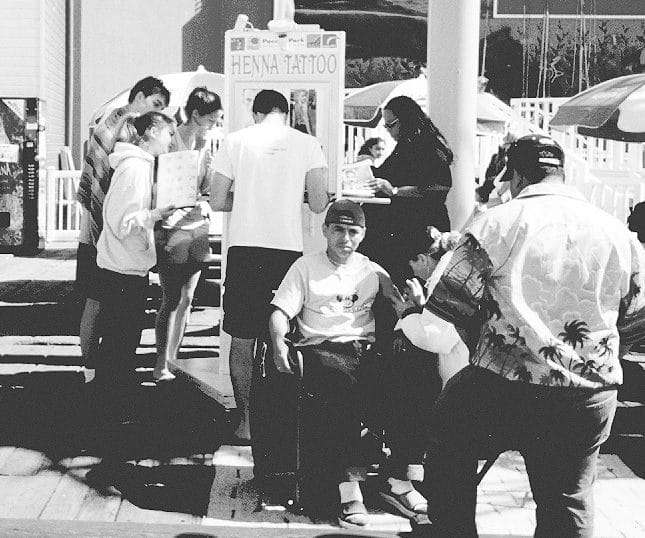
Despite being banned throughout the city, a henna tattoo stand has been operating on the Santa Monica Pier for the past month.
But no more. City officials shut down the Henna operation, which was being run by the amusement park on the pier, this week at the Wednesday meeting of the Pier Restoration Corporation.
Pacific Park’s lease with the city specifies what the amusement park can and cannot do, a city official said.
“It’s not specifically mentioned in the lease that they can do this,” said Mark Richter, a city official in the Economic Development Department. “And the lease is structured to say what they can do and it says nothing about tattoos.”
“It’s not specifically mentioned in the lease that they can do this.” — — MARK RICHTER City official
Officials at the amusement park said they have been running a Henna booth during the weekends and had set up a special stand during Spring Break. They hoped to also operate two temporary tattoo booths during the summer.
A spokesman for Pacific Park confirmed that city officials asked the amusement park to close its Henna booth.
Cameron Andrews said the amusement park would comply with the request, though he added that the park had not received any complaints about the service.
Henna itself is not illegal under the city ordinance, Richter said.
Artists who practice the form of body art can open a store or rent a cart on The Third Street Promenade or on the Santa Monica Pier, he said.
“It would be like any other service opening up shop in the city,” he said. “It’s just that it can’t be done on the public right-of-way as an art form. It’s a service, like hair-braiding.”
The Santa Monica City Council voted 4-3 in October to ban henna artists from the Third Street Promenade and the pier because they posed a public safety risk.
Previously, Henna was considered by the city to be a form of performance art, which would be allowed legally on public streets because it is an art form.
However, a majority of council members disagreed with that classification, saying Henna tattoos are a cosmetology service and therefore could be regulated by the city.
The ban took affect Jan. 1. Henna is a red, non-permanent dye that has been used for skin decorations and body art for thousands of years. However, council members cited public safety in establishing the ban because some artists use dangerous toxic chemicals.
Skin rashes and other complications are caused by “black Henna” or phenylenediamine, a hair dye. The black Henna is cheaper than traditional Henna dye.
Councilmen Kevin McKeown, Richard Bloom and Mayor Mike Feinstein, the three councilmen who voted to keep Henna in the city, think it’s an art form and should be included under the city’s street performer ordinance — just like a clown who does face painting. Feinstein vowed to bring back the issue again when a new council is elected this fall.
Linda J. Sullivan, a member of the Pier Restoration Corp., board of directors, said she suggested at Wednesday’s meeting that the PRC permanently designate one of its kiosks for Henna artists.
“My suggestion was met with a cone of silence,” she said, adding that she thinks the “beautiful art form” should be available in Santa Monica.
At least one Henna artist alleged city officials banned the art form instead of trying to enforce performance laws already on the books that force artists to rotate every two hours and remain at least 50 feet apart from each other.
“Now we realize there are alternative motives,” said Like Chanthadara, a Henna artist who is protesting the city’s ban. “Basically, they said ‘Let’s see how we can get more out of these people and capitalize on their art form.’”
Chanthadara does not want to see Henna artists working out of permanently stationed carts. He has been fined numerous times for continuing to practice Henna publicly in Santa Monica and he said he faces serving time in the Los Angeles County Jail because he is being considered a repeat offender.
City officials deny they had any motive other than protecting the public from the dangerous “black Henna.”
Originally published in the Santa Monica Daily Press print edition on April 5, 2002. Read the original PDF.