

City staff: Finding the right place for port-a-potties has been difficult PORT-A-POTTIES, from page 1
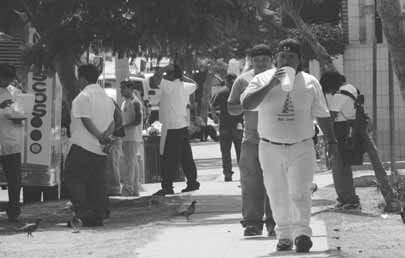
11TH STREET — Hundreds of suspected illegal immigrants who loiter on the sidewalks waiting for work will soon have a place to squat come January.
So says City Hall, which is set to deliver two port-a-potties to 11th Street as a means of helping residents and businesses deal with a day laborer situation many claim is out of control.
Those concerned about crime in their neighborhood — not to mention excrement on their sidewalks — asked City Hall in August to step in and help regulate the illegal immigrants who gather in this part of town while waiting for someone to drive by and offer to pay them under the table in exchange for labor.
City Hall officials say they have budgeted for two port-a-potties in the area, but finding the right location for them has been difficult, said Elana Buegoff, a senior administrative analyst in City Hall’s economic development division.
In October, city staff met with residents in the area to discuss the placement of the port-a-potties.
The site that’s been tentatively agreed on is the west side of the street outside of Bourget Brothers building material and lumber store, located at 1636 11th St.
Buegoff said what’s needed is confirmation from business owner John Bourget.
“I will likely approve it,”
Bourget said on Tuesday, as he read the letter requesting his permission to place the port-a-potties adjacent to his store.
For decades, day laborers have loitered on the sidewalks near 11th Street and Olympic Boulevard, where they keep a watchful eye on traffic coming and going from the Salvation Army outlet, Bourget Brothers, the old Fisher Lumber site and other businesses from which they might be called upon to help with construction, landscaping, home improvement, moving and other fix-up jobs.
However, residents have grown weary of the blight created by the masses, which can number up to 175 people on a given day. The two port-a-potties, each to be tied to a tree, will cost the city $465 per month to be maintained three days a week, Buegoff said.
“It will create a more sanitary environment for the public for now,” Buegoff said. “A more long-term solution the city may explore is to create an organized day labor station, if it could be structured to work well, like they do in other communities.”
Councilman Richard Bloom said he will urge staff to contact officials in Pasadena, who he said seem to have a successful program for regulating day laborers.
Ann Erdman, a Pasadena spokeswoman, said the city passed an amendment in 2003 called the “No Vehicle Solicitation” ordinance.
It prohibits vehicles from stopping in posted areas along Villa Street, which has had a problem with day laborers congregating there at least since 2001, Erdman said. There also are large signs posted that say “no vehicle solicitations.”
Traffic safety problems were the main impetus for creating the ordinance, Erdman said. Other issues related to day laborers, such as littering, defecating, public urination and the rare fist fight, are being handled by a combination of the Pasadena Police Department, organized neighborhood associations and the code compliance office, Erdman said.
In addition, a nonprofit group called the Institituto de Educacion Popular del sur de California has established a day laborer center at 500 N. Lake Ave., just a few blocks from Villa Street. Erdman said the center serves as an organized way for day laborers to find work, and it’s very popular. To participate, day laborers must go through a registration process.
Erdman said the combination of law enforcement and providing the day laborers with employment options seems to be working well for Pasadena.
Bourget says he would like to see a similar approach taken by City Hall.
“As long as they are there to find work, I don’t mind them,” Bourget recently told the Daily Press. “The problem is that some of these day laborers aren’t actually waiting around to work. They’re drunk, pissing on the sidewalk, some of them selling stuff they’re not supposed to be selling.
“Those who are there by the afternoon, it’s clear they’re not going to be working.”
Bourget suggests City Hall set up an enforcement program whereby the day laborers are welcomed between 7 a.m. and 1 p.m. “Those who loiter after lunch should be subject to fines, because that’s when there’s trouble,” Bourget said. “I think a program like that would do a lot to remedy the situation.”
Originally published in the Santa Monica Daily Press print edition on December 21, 2005. Read the original PDF.