

Historian gets his ‘kicks on Route 66’
It was the beginning of the end for Jim Conkle on Tuesday when he set out for a 66-day journey across the country on Route 66.
Conkle, a Route 66 historian and preservationist, made Palisades Park, widely known as the “symbolic ending” of America’s most famous road, the beginning point for his 2,448-mile journey.
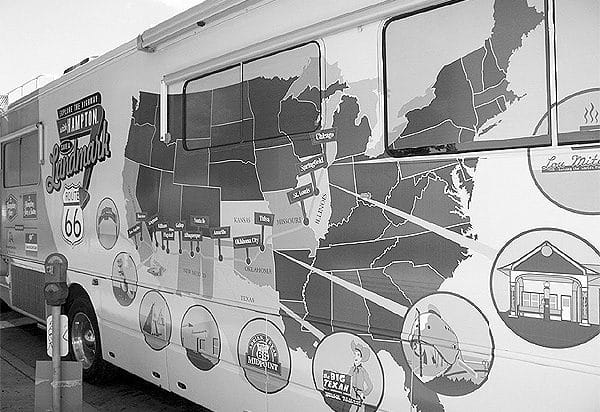
Conkle is using the trip as a pilgrimage to mark historic landmarks along the route and bring awareness to the road most commonly referred to as “America’s Main Street.”
On the journey in his decorated RV, Conkle and a handful of other Route 66 enthusiasts will make more than 60 stops to post new Route 66 “Roadside Attraction” signs that tell the story of the historic sites, treasured landmarks and vintage establishments. The first sign was put up in Palisades Park on Tuesday.
Route 66 is much more than a just a road, Conkle said. The communities and cultures along it are a slice of what America represents. It has been immortalized in American culture for its quirky diners, neon signs and funky roadside attractions.
“We are celebrating Americana,” Conkle said. “It’s the culture of the road.”
Santa Monica Mayor Richard Bloom, who was on hand at the small ceremony Tuesday, said Route 66 is a large reason for the growth of Southern California and stands for all that is important to diversity across America.
“We have no future without our past and we have no past without our future,” he said. “Preserving heritage and the character of our communities is so much of what we do in municipal government.”
After two years of planning, Conkle, with the help of Hampton Hotels and Route 66 associations, will refurbish select locations along the route to help bring them back to their original glory.
Conkle, in his RV, and more than a dozen Route 66 enthusiasts drove their classic cars — representing every decade — down Santa Monica Boulevard Tuesday morning for the first leg of the cross-country trip to Chicago, where the road ends, or begins, depending on where you begin the journey.
Conkle will travel through eight states before landing in Chicago. Along the way, Conkle plans to take in several events at towns located on Route 66. He planned his trip around those communities’events so he could celebrate their traditions and cultures. Some of those events include the 10th Annual Fun Run in Kingman, Ariz., and the Galena Good Old Days in Galena, Kan.
Conkle ‘s biggest challenge of the trip may be his attempt to eat all of the 72-ounce steak at the Big Texan Steak Ranch in Amarillo, Tex.
“They make you eat all the salad and bread too,” he joked. “I tried to get them to make a 66-ounce steak but they said ‘no.’”
Route 66 is 76 years old this year and although entrepreneurs Cyrus Avery of Tulsa, Okla., and John Woodruff of Springfield, MO., deserve most of the credit for promoting the idea of an interregional roadway between Chicago and Los Angeles, their lobbying efforts were not realized until their dream emerged with the national program of highway and road development.
While legislation for public highways first appeared in 1916, with revisions in 1921, it was not until 1925 that the government executed its plan for national highway construction.
When the official numerical designation of 66 was assigned in 1926, it was acknowledged that the roadway was one of the nation’s most principal east-west roadway arteries.
Public road planners intended U.S. 66 to connect the main streets of rural and urban communities along its course because small towns had no prior access to a major national thoroughfare. Its diagonal route linked hundreds of predominately rural communities in Illinois, Missouri and Kansas to Chicago, thus enabling farmers to transport grain and produce for redistribution.
John Steinbeck’s “Grapes of Wrath,” coined Route 66 as the “Mother Road,” and an estimated 210,000 people migrating to California to escape the Dust Bowl used it as the “road to opportunity.”
Ironically, the public lobby for rapid mobility and improved highways that gained Route 66 its enormous popularity eventually signaled its demise in the early 1950s.
When the Federal Aid Highway Act passed in 1956, a financial umbrella opened to underwrite the cost of the national interstate and defense highway system.
In Dwight D. Eisenhower’s second term, the federal government spent millions to develop a national highway system.
By 1970, nearly all segments of the original Route 66 were replaced by a modern four-lane highway. The outdated, poorly maintained vestiges of U.S. Highway 66 completely succumbed to the interstate system in 1984 at Williams, Ariz. when the final section of road was replaced.
Originally published in the Santa Monica Daily Press print edition on April 30, 2003. Read the original PDF.