

New noise meter will help nab loud musicians
PROMENADE — After several years of tweaking, local lawmakers believe they have finally found harmony in regulating street performers here.
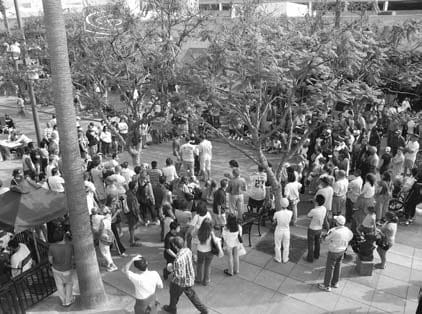
The Third Street Promenade has become well known around the world as a mecca for street performers. When the outdoor mall was redeveloped more than a decade ago, city leaders found themselves grappling with how to balance protecting people’s civil liberties with maintaining order on the public street.
Laws were created about six years ago to provide a method to the madness. On any busy weekend night, there are thousands of people taking in the eclectic mix of entertainment delivered by not only talented artists, but also some wacky personalities. Issues of public safety, crowd control, preserving the city’s aesthetic values and minimizing unfair competition always are on the minds of city regulators.
Each year the Santa Monica City Council reviews the laws and makes changes to the system in an effort to protect the public and maintain a sense of order. But not this year. There are no plans to change the ordinance, which up until now has been modified before the start of the summer season.
“We actually have a street performer ordinance that is working,” said City Councilman Kevin McKeown. “In a uniquely freedom-aware city, we have found a balance finally.
“It seems to be working as we intended,” he added.
The ordinance regulating street performers is 10 pages long, built with layers of restrictions that were designed from experience over the years. City attorneys spend hundreds of hours a year crafting new laws in an attempt to address the issues that arose during the previous year.
But apparently the issues that have come up in the past year haven’t risen to the level that warrants a modification of the law.
“There hasn’t been much discussion,” said John Warfel, chairman of the board of directors for the Bayside District Corp., a nonprofit organization that manages downtown Santa Monica in conjunction with City Hall. “There hasn’t been any controversy.”
However, the street performers themselves and merchants along the Promenade believe that if there is anything that needs to be changed, it is the distance by which they are separated. Noise is definitely an issue on the Promenade, especially on a busy weekend when up to 37 acts could be performing simultaneously.
According to the law, performers have to be 40 feet away from each other, which is supposed to create enough room that a person walking by will only hear one act. But when one performer goes beyond the legal decibel level, the artist next door has to turn it up to be heard. Within a short time, the sound level has risen way beyond what’s allowed.
Samantha Sanchez, a hostess at George’s Bistro between Arizona Avenue and Santa Monica Boulevard, believes 40 feet is definitely not enough. She said she sees performers competing with each other on who can draw the largest crowd, and often that means who is the loudest.
“It’s also rude for the customer,” she said, adding it’s worse on the weekend.
Musicians James Heaney, 23, and Andrew Billings, 20, said they perform on the Promenade as a way to practice. They agree there is not enough room between acts — most of the time they are drowned out by louder performers who have more sophisticated equipment.
The types of acts that descend upon the Promenade have changed over the years. Performers are now more focused on entertaining the crowds through gimmicks rather than performing an art. The result is musicians who come to express themselves through instruments and verse now compete with the loud boom boxes of performers who use comedy and fast moves to attract large circles of people.
The Promenade was a much louder place this spring after Steele Smith, the street performer liaison, quit his job to move to Mexico. For five months, there was no monitoring of the performers, except for the occasional police patrol.
Thomas J. Upton, a pianist and singer, said the situation is much better now that Stephen Bradford, the new “venue manager” on the Promenade, is on the scene. Upton, who lives in a shelter, has been performing on the Promenade and the Santa Monica Pier since February. On a good day he makes at least $100, he said.
As more artists realized the magnitude of exposure the Promenade offered, the city realized it couldn’t handle the influx of performers with just an ordinance alone. So in 1999 City Hall created the street performer liaison position, whose primary job is to manage the artists and maintain order.
Bradford, who started in May, consistently monitors street performers and makes sure they comply with the permitted decibel levels — 97 during day, and 107 between 7 p.m. and 10:30 p.m. After midnight, the allowed decibel level is 87. Bradford is now equipped with a noise meter that can record the volume of an artist, which can be used in court if a citation is issued.
He said there are several issues to watch regarding the performers, most of which are complaint based.
“Every day I hear from performers that are complaining about something or another,” Bradford said. “Most of it is self-interested based.”
The business of regulating street performers might be yet another level of bureaucracy in City Hall, but it also generates some revenue for Santa Monica. The city issues nearly 1,000 permits a year to artists at $37 a pop. And citations, fines and tickets can cost hundreds of dollars for performers.
Performers are routinely cited for infractions usually involving public safety hazards. Some get tickets, and others are cited and charged with misdemeanors. But instead of pursuing the violation criminally, City Hall set up its own justice system for street performers. Artists who violate multiple laws have to go before a city administrative hearing officer who will determine if their permit should be suspended or revoked.
But city officials hope it doesn’t get to that point.
“It’s a great deterrent, being here all the time,” Bradford said. “Honestly, I think most people are happy I’m here, monitoring the situation, and if people realize that I’m here all the time and operating in a fair manner, I think they appreciate it.”
Originally published in the Santa Monica Daily Press print edition on June 28, 2004. Read the original PDF.