

TL;DR
Filing a business name in Southern California seems easy until you hit the mandatory publication rule. If you do not follow every step, you risk account freezes, invalid contracts, and total brand loss. This guide breaks down the full filing and publishing process step by step so you can stay fully compliant.
What Is a Fictitious Name and Why Do You Need It?
When you launch a business using anything other than your legal personal name, California law treats that name as a fictitious business name. Learning how to file a DBA in Los Angeles County is the first step toward getting your operational rights. Without this registration, banks will not let you open a corporate checking account, and vendors will not write contracts in your company's name.
Starting a business is exciting, but technical administrative hurdles can pause your momentum quickly. Many entrepreneurs complete the initial paperwork with the county clerk and assume their job is done. In reality, filing the initial application is only half the battle. State law mandates public disclosure to keep business ownership fully transparent across the region.
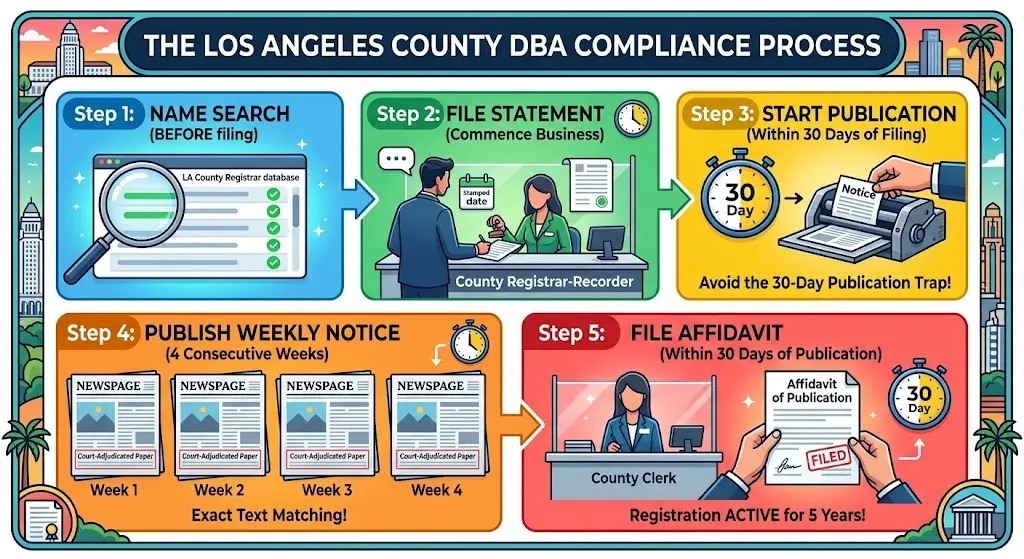
Step 1: Search and Reserve Your Unique Business Identity
Before submitting forms or paying processing fees, verify that no other entity uses your preferred brand identity. You can search existing records online through the LA County Clerk FBN Portal. If another business operates under an identical name in the same local jurisdiction, your application may be rejected immediately.
Federal business studies show that naming conflicts create major legal vulnerabilities for new business owners. The official U.S. Small Business Administration Guide emphasizes that trade name registration does not grant automatic trademark ownership, making accurate record checks critical. Taking ten minutes to search the official registry saves you hundreds of dollars in filing mistakes later.
First, search the local database to confirm your name is available. Once confirmed, you can prepare your owner identity form and proceed with filing.
For sole proprietors, your filing must include your full legal name and physical residence address. Corporations and limited liability companies must provide their exact entity registration details matching state records. Make sure every character matches your official identity documents before moving forward.
Step 2: Submit Your Statement to the County Clerk
Once your name search comes up clean, you must file your statement with the County Registrar-Recorder's office. The current filing fee covers one name and one registrant. You can submit your documents in person, by mail, or through third-party agents.
- In-Person Submissions: Require valid photo identification and a notarized affidavit of identity form.
- Mail-In Applications: Require original signed forms, notarized affidavits, and exact fee payments by check or money order.
- Corporate Applicants: Must include printout evidence of good standing from the California Secretary of State.
After processing, the county returns a stamped copy showing your official filing date. Keep this document safe, because the clock starts ticking on your legal publication deadline the exact day your paperwork gets stamped.
Step 3: Avoid the 30-Day Publication Trap
Under California Business and Professions Code Section 17917, you must publish your legal notice within 30 days of filing your statement. If you miss this tight deadline, your original registration expires automatically. You will be forced to refile your paperwork, pay all county fees again, and restart from square one.
From Day 1 when you complete your county filing, you have a strict 30-day window to begin your official newspaper notice.
This specific requirement is where most new business owners make costly mistakes. Many founders get busy with daily operations and forget the 30-day window completely. Others pick non-approved online blogs or flyers, which causes the county to reject their proof of publication.
If you want complete peace of mind, check our Fictitious Business Name Guide for a clear breakdown of publication schedules. Getting your notice published quickly protects your brand and keeps your business compliant from day one.
Step 4: Publish in an Adjudicated Newspaper
You cannot pick just any local paper or digital blog for your legal notice. The law requires publication in an officially adjudicated newspaper of general circulation located in the same county as your principal place of business. The notice must run once a week for four consecutive weeks without any gaps.
- Exact Text Matching: Every single character, spelling, and address detail must match your stamped county form.
- Consecutive Schedule: Skipping a single week breaks continuity and resets the entire four-week requirement.
- Court Authorization: Running your notice in a non-adjudicated paper renders your entire filing void.
Selecting a reliable partner simplifies this technical phase. Explore our DBA Publication Services to see how our team manages formatting, weekly schedules, and county compliance for you. Working with experienced professionals removes stress and guarantees zero missed publishing deadlines.
Step 5: Secure Your Proof of Publication Affidavit
After your legal notice runs for four consecutive weeks, the newspaper generates an official affidavit of publication. This legal document acts as your sworn proof that you satisfied all California public notice requirements.
Once your 4 weeks of notice are complete, the newspaper issues your official affidavit, which you must file directly with the County Clerk.
You must file this signed affidavit with the county clerk within 30 days after your final publication run finishes. Once the county records your affidavit, your trade name becomes fully legal and active for five years.
To protect your legal standing, review our detailed guide on Newspaper Legal Notices. You can also read about Where to Publish DBA Notices to understand how local courts verify compliance. Proper execution protects your entity from contract challenges and keeps your operations running smoothly.
Step 6: Maintain Your Five-Year Renewal Schedule
Your trade name registration remains valid for exactly five years from the original county filing date. Mark your calendar early because the county does not send automatic renewal warnings before expiration. If your filing expires, you lose legal rights to operate under that trade name until you refile.
- Renewal Timeline: Submit renewal forms before the five-year expiration date arrives.
- No Info Changes: If your business details stay identical, you do not need to republish in a newspaper.
- Address Changes: Updating owner details or business locations requires a brand new publication run.
Keeping your records updated prevents unexpected banking delays and maintains uninterrupted business protections. If you want to review the full filing steps, read our DBA Filing Requirements breakdown. You can also explore our broader Legal Notice Directory for additional public notice guidelines.
Smooth Paths to Complete Brand Ownership
Completing your trade name filing does not have to feel overwhelming. Understanding the exact rules protects your company from legal challenges and preserves your investment. By handling each step carefully, you build a firm base for your business growth.
- Always run an initial name search before filing your paperwork.
- Mark your 30-day publication deadline the moment your form gets stamped.
- Work exclusively with court-approved local newspapers.
- File your proof of publication affidavit on time to finish the process.
FAQs
What is a fictitious business name statement?
It is an official county registration that links a custom business name to the real owner's legal identity. It lets you operate under a trade name while keeping public records transparent.
How long does the entire publication process take?
The publication process takes four full weeks. Your notice must run once every week in an approved newspaper before the publisher issues your final affidavit of publication.
What happens if I miss the 30-day publishing window?
If you miss the deadline, your original filing expires completely. You must refile your statement with the county clerk, pay new processing fees, and restart the full four-week publication run.
Can I publish my legal notice in any newspaper?
No, you cannot use any paper. California law requires you to publish in a court-adjudicated newspaper of general circulation approved within the county where your business operates.
How much does it cost to register with the county?
The initial county filing fee covers one business name and one owner. Additional business names or extra owners listed on the same statement cost a small extra fee.
Do corporations need to file trade names in California?
Yes, corporations must file if they do business under any name other than their exact corporate name registered with the state. They must also submit proof of good standing.
How long does a trade name registration remain active?
A registered trade name remains active for five years from your original county filing date. You must file a renewal statement before it expires to maintain ownership.
Can I enforce legal contracts without publishing my trade name?
No, California law blocks you from enforcing contracts in court under an unpublished trade name. Proper filing and publication are required to maintain full legal standing.
What is a proof of publication affidavit document?
It is a signed legal document issued by the newspaper publisher. It proves your notice ran for four consecutive weeks as required by state law.
Important Takeaways
- Filing your paperwork with the county clerk is only step one of the process.
- You have exactly 30 days from filing to start your mandatory newspaper publication run.
- Your legal notice must appear once a week for four straight weeks in an approved paper.
- Failing to publish invalidates your registration and exposes your business to legal risks.
- Submitting your affidavit of publication on time completes your five-year registration.
Complete Your Trade Name Filing With Confidence
Do not let complicated publication rules hold back your business growth. Our team handles formatting, weekly newspaper schedules, and affidavit filings directly with the county clerk so you never miss a deadline. Send your stamped county filing today, and let us take care of your legal publication from start to finish.
