

Dismayed cart operators unhappy with new vendor
THIRD STREET — Those concerned about the Promenade’s new cart program hope City Hall will help iron out issues with the new vendor, but elected officials are still trying to figure out how they can help.
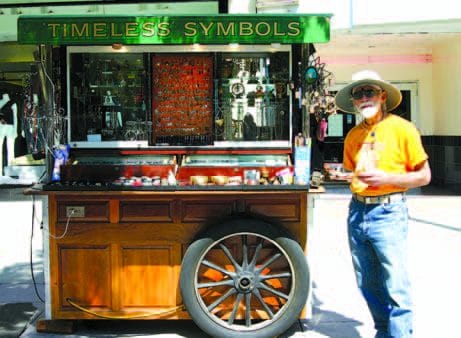
The program, intended to improve the consumer experience along the Promenade, has been taken over by a new management company. As part of the changes, the company has only offered to sign on five of the 17 existing retail operators. However, more may be allowed to stay if selected, and can meet new financial terms and business conditions, according to cart operators.
In June, Provenzano Resources Inc., (PRI) was awarded a 10-year contract to replace Promenade Services Inc., the group that had managed the Promenade’s mobile cart operations since 1989. City officials and the Bayside District Corp. — a nonprofit group of business leaders who help manage downtown along with City Hall — felt it was time to see if there were any vendors who could present better concepts or approaches to handling the Promenade that would make it more profitable for all parties involved.
But the road to a sleeker Promenade presentation and the expected revenue increase won’t come easy, cart operators said. Those who have been chosen to stay will receive a six-month contract to start, face double their current rent and thousands of dollars in start-up fees.
“In my experience, you don’t do business like that,” said Itay Yona, who has managed Antiqua jewelry and other carts on the Promenade for 10 years.
Yona said PRI is requiring cart operators to invest too much money without guarantees they will be able to recoup their costs within the six-month period. However, their investment would likely allow PRI to pay for its new carts, which it will use for years.
It’s a matter which has piqued the interest of Councilman Richard Bloom, who said he is waiting for more information from city staff to see if this short-term contract is unusual, and if so, what might be done about it.
“One of the things that caught my eye about this issue was the six month’s length of the contract,” Bloom said. “I look forward to hearing from staff why that approach has been utilized.”
City staff is expected to prepare a public report this week, available online, which will update the council on community concerns about the cart program and what may be done to address them. The report is anticipated to brief the council so they can weigh-in on issues related to the new cart program at the council meeting on Sept. 27.
Deborah S. Kravitz, PRI’s president, said the new cart program, expected to be underway by Nov. 21, will consist of 17 retail carts, five food carts and three carts for artists. The new carts are intended to be a more attractive addition to the Promenade, Kravitz said. PRI also has hired a merchandising expert who will see to it the wares for sale at each cart are distinct from other carts and nearby shops.
Such moves will likely increase revenue for the cart operators, Kravitz said.
PRI, which owns the carts, has the discretion to choose which cart operators it will use, according to Miriam Mack, the city’s economic development manager.
Previously, merchants complained because an operator could have multiple carts on the Promenade. Under the new system, operators will only be allowed to have one cart, so “everyone can have piece of the pie,” Kravitz said.
Also, now there will be carts dedicated solely to artists and food vendors. The crafts to be sold, such as photographs and paintings, are intended to promote LA-based artists, Kravitz said.
Beginning Oct. 1, no carts will be operating on the Promenade while PRI renovates the carts’ storage facilities. The improvements are expected to be finished by Nov. 21, in time to have the new carts up and running for the holiday shopping season, Mack said.
Meanwhile, veteran operators whose contracts have been renewed will have a six-week lag during which they won’t be earning revenue.
JURY OUT ON NEW PROGRAM Yona, who works with a company that competed with PRI’s bid, said that with a new vendor a certain level of turmoil can be expected as the parties involved adjust to the new program.
However, besides the initial contract term, Yona said he is generally optimistic the new program will work, because it has to at this point.
“Nobody on the Promenade likes how this is going, but the city has signed a contract which could cost millions to break,” Yona said. “The city signed the contract because it believes a better business will come from it.
“But people must realize a good business takes time to develop.”
Yona’s attitude, however, may prove to be the exception along the Promenade, where many operators feel betrayed by City Hall and still want a system in place that caters more to the needs of small businesses, which they argue the new program doesn’t.
Aneeta Sagar, who, along with her husband, owns three carts on the Promenade, including the hat display, said many of the cart operators are foreigners beginning their first business. As such, their efforts represent substantial money, resources and time to create, which is now being threatened to be swept out from under their feet.
“This is these people’s livelihood who have put all of their savings into it and now they’re just axing us out completely and leaving us with nothing,” Sagar said. “Needless to say, employees working with us will be out of a job.”
Sagar said she hired a homeless man named “Bob,” who receives a regular salary, enabling him to put a roof over his head and help his other homeless friends.
However, with the new program in place, Sagar said she isn’t certain how she will be able to keep people like Bob on board.
“Bob is faced with moving back to the streets,” Sagar said. “Do we want to contribute to the homeless population any more in Santa Monica?”
It’s a question which rings true for Greg Jest, also known as “Jest Greg,” a former homeless man who earns $80 per day and a roof over his head at a local motel, by pushing carts to their locations.
Jest, who said he has been attending the local vendor meetings, said PRI plans on replacing the cart pushers with an automated system, resulting in a loss of work for dozens of people who might otherwise be homeless.
“I want to keep my job,” Jest said. “What am I going to do without it, move back to the streets?”
Paul Sauer, who works a sunglasses cart, said he is not surprised by the latest developments on the Promenade, which has been deteriorating for years ever since the city’s leadership began to open the pedestrian street to well-heeled operations.
“It’s another greedy corporate project brought on by Bayside and the city,” Sauer said.
Sauer said there used to be more people who visited the Promenade when it was mostly run by mom-and-pop shops, providing the street with a friendlier feel.
“Until the city takes a local approach to the Promenade, ‘good business’ will be long in coming,” Sauer said. “How many Starbucks and Tommy Hilfigers can you have on one block?”
In some ways, Santa Monica city coun-cilmembers said they have been trying to answer the same question.
Councilman Kevin McKeown said he is concerned with how the city is managing its contracts on the Promenade, pier and the city’s beachfront in making sure the city’s policy toward encouraging small businesses is being utilized.
At the same time, McKeown said the council agreed that a variety was needed in the cart operations on the Promenade to ensure their was no overlap and to encourage diversity for consumers, conditions which he believes the new vendor shall meet.
“I went back and read the license agreement that came out in June, and what we’re asking for is that the new program include more locally made products and space for artisans and vendors,” McKeown said. “I understand the lessee has taken a new direction, and not everyone is selling cell phones and sunglasses, and for some of the people there the change of product is a challenge.”
McKeown and Bloom said they are looking into options which might allow cart operators the opportunity to take out loans to stay in business.
Another concern McKeown and Bloom are hoping to address is the six-week downtime vendors expect in October and November.
McKeown said there’s a chance the downtime may not happen, since City Hall is looking to find alternative storage facilities until the remodeling is complete, and the new cart operators may be able to use the old carts until the new ones arrive.
McKeown said he’s committed to helping vendors any way he can.
“I’m very committed to small businesses and think that’s a direction we need to go, away from corporatization of our society, so the money stay in the community and our local economy,” McKeown said.
Meanwhile, Yona said PRI was acting as the middleman, subject to pressures from both City Hall and cart operators. Considering this, Yona said cart operators who would like to remain on the Promenade may need to keep the situation in perspective when dealing with the new vendor.
“You can say the glass is half empty or half full, but either way, you have what’s in the glass,” Yona said.
Originally published in the Santa Monica Daily Press print edition on September 23, 2005. Read the original PDF.