

Removals could begin Monday project that also includes lighting and sidewalk improvements.
Meanwhile, City Hall has stood firm on its assessment that 23 of the ficus trees have severe structural damage to their trunks and primary limbs.
“I should have names for these trees,” said Walt Warriner, the community forester and arborist, on Wednesday as he walked the downtown streets and pointed to examples of the trees’ structural damage. “I’ve walked here so many times.”
Each of the 153 ficus trees included in the project area were evaluated during multiple visits by a design team led by Warriner.
The damage with the trees range from internal decay to a poor canopy structure, caused by multiple culprits from the oversized vehicles that strike and break off the limbs to the extensive pruning practices, Warriner said. The trees have also presented issues for sidewalks, the roots growing and pushing the concrete upward.
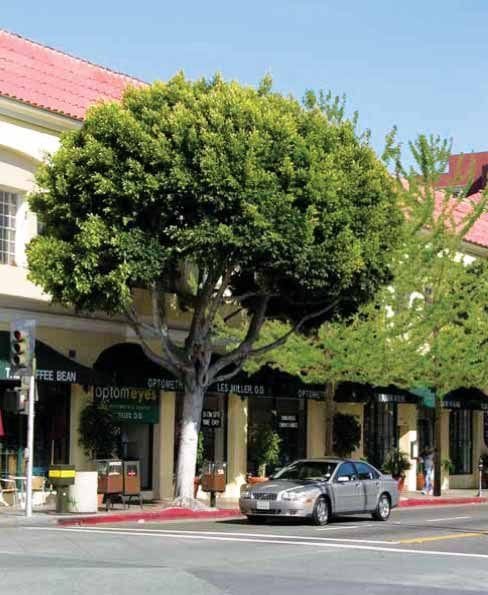
In front of a lamp shop on Fourth Street, between Broadway and Santa Monica Boulevard, stands a ficus tree marked for removal. At the root of the tree is a sign of internal decay, visible courtesy of a gash caused by a car that struck the tree.
The callus wood has since started growing over the wound, but the decay continues up and down the tree, rendering it unstable, Warriner said.
“It doesn’t mean the decay is gone,” he said.
Even if the tree isn’t targeted in this project, it would probably be removed in a few years anyway, the city arborist added.
The average life of a street tree, according to national statistics, is about 60 years, while in Santa Monica, the average lifes-pan is about 50-80 years, Warriner said. The ficus trees were planted on Fourth Street in 1965 and one year later on Second Street.
Less than 15 percent of the total canopy coverage on Fourth and Second streets would be removed in the upcoming project.
In front of parking garage 4 on Second Street stands another ficus tree expected to bid adieu to the downtown area, one of its limbs recently torn out by an oversized vehicle. The tree leans at an angle into the street, presenting a hazard to both cars and pedestrians.
“If we don’t address this aggressively, we’re exposing the public to risk,” Warriner said.
But the Treesavers aren’t buying it, arguing that the problems can be solved with corrective pruning, which Warriner said cannot be done for the trees with damaged stems.
“One arborist told me every tree has structural problems and it’s no reason to be chopping down a tree,” said Susan Hartley, one of the founders of the Santa Monica Treesavers. “If these trees are in such bad shape, how come the city let it be in that state for years?”
The Santa Monica Treesavers have questioned the city’s assessment that 23 of the ficus trees have severe structural damage, accusing city officials of just wanting a new look for the downtown area and seeing the trees as obstacles standing in their way.
“They’re trying to come up with justification for these fashion design changes,” Hartley said.
Another sour point with the Treesavers is the plan to relocate 31 of the ficus trees elsewhere in the city.
“Why not move a skyscraper?” Hartley said. “It’s insanity to take a tree, to uproot it, to disrupt, to put it where there’s no guarantee it’s going to make it.”
In the 10 years that Warriner has worked with City Hall, he has overseen the transplantation of approximately 350 trees. The success rate of the arbor relocations is around 95 percent.
“What people fail to recognize is that I am an arborist first and a community forester first,” Warriner said of those who have questioned his assessment.
Some of the trees that will be impacted by the streetscape design project will be relocated as called for under the Community Forest Management Plan, which tries to conserve trees in major projects by transplanting them rather than getting rid of them. Several factors were taken into account in determining which trees would be relocated, including whether the cost of transplanting would exceed the appraised value of the trees, which in that case, would not be moved.
One of the failed moves happened as a result of a resident who thought the transplanted tree was not getting enough water when it was actually getting too much. A few other mishaps were in species that could not handle relocation — one of the earlier projects that Warriner called a “learning experience.”
The trees will be scattered throughout the city, some to Pearl Street in front of homes, some relocated to another spot in the downtown project area, others to an empty lot next to the RAND Corporation, another batch will be sent to the Santa Monica Airport. About 29 ficus trees were moved to the east end of the airport a few years ago to screen the runway from the residences. But some of those trees haven’t fared well because of the toxic fumes from the planes, Hartley said.
Adjacent to the RAND Corp. building on Main Street is a large dirt lot, blocked off to public access by an encircling fence. Inside this lot are close to 60 trees that have been relocated from other parts of the city, each tree boxed in until they’re replanted.
Examples of previous tree relocation projects can be seen throughout the city. At the corner of Main Street and Pico Boulevard on the Civic Center property is a Metrosideros tree, also known as the New Zealand Christmas tree. The tree was uprooted from the Public Safety Facility about 10 years ago.
Along a block on 11th Street are three trees that were relocated from the MGM property about two years ago, now growing healthily, Warriner said. Around the corner is another recently relocated tree, still receiving extra support from cable wires. The wires are used to help every transplanted tree come into its own.
Each empty ficus plot on Second and Fourth streets will be replaced with a pair of ginkgo biloba trees, a deciduous tree.
The lifespan of a ginkgo tree is longer than a ficus tree and maintained differently — pruned biennially rather than every year. Maintenance costs are estimated to be less than for the ficus trees, freeing up the pruning budget for other trees in the city.
Warriner adds that the new trees will provide enough shade during the summer, while adding sunlight to the winter, saving residences and businesses money in heating costs.
Under normal circumstances, it would take about 20 years for the ginkgo tree to grow to a size where it could provide ample shade. But the project calls or the use of engineered soil that would accelerate the growth process to about 10-15 years.
Still, the Treesavers see the use of approximately $600,000 to remove and transplant trees as a waste of money.
“Why not put the money in new trees?” Hartley said.
Originally published in the Santa Monica Daily Press print edition on October 4, 2007. Read the original PDF.