

Mobile home park tenants at a loss
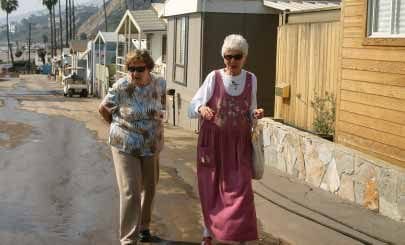
PCH — While she may live in a mobile home, 77-year-old Florence Cotton has no plans to pack up and move along, leaving behind the community she’s grown to love over the last four years.
Despite long cracks in the streets, a torn and tattered putting green, and a hillside that could give way during a heavy rainstorm, Cotton is fond of the eclectic seaside community she discovered at the Palisades Bowl Mobile Home Park, located just outside the Santa Monica city limits on Pacific Coast Highway.
“It really has that small-town feel. You pretty much know your neighbors … and everyone tries to look out for one another,” Cotton said, as she sat in her modest living room decorated with family photographs, books and videotapes of “The Sopranos.”
“It’s the perfect place for someone like me,” Cotton said. “The rent is low, and even though I live alone, it doesn’t feel that way. We’re all kind of like one big family.”
And like most families, the residents of the mobile home park are coming together in the form of the recently created Palisades Bowl Residents’ Association, which was created in August to fight what they perceive to be the most significant threat to their way of life — the proposed conversion of Palisades from a rental to a resident-owned mobile home park.
If approved, residents said the conversion will wipe out one of the last remaining pockets of affordable housing on the coast and trigger a tidal wave of mobile home conversions citywide, forcing thousands of people to join the ranks of the homeless.
“This is not for the residents who live here to buy their own homes,” said Beatrice Prentice, 76, a Palisades resident opposed to the conversion. “Most of us who live here can’t afford to buy the land, and besides, many are seniors or are entering retirement. Why would they want to get into a mortgage?”
Palisades owner Edward Biggs is expected to file a request by the end of October with the City of Los Angeles to convert the park and allow residents the chance to purchase the land underneath their homes.
Currently, residents own their own homes, however, they rent their plots of land from Biggs. The rents are kept low due to Los Angeles rent control, enabling seniors like Cotton, as well as moderate-and low-income residents, to own a piece of the American dream.
If the park is converted, rent control will no longer be available to many residents, forcing them to find another park and move their homes, or sell them. Without rent control to entice buyers, some residents fear they will lose thousands in equity and will be unable to sell their homes.
Rents for low-income tenants — those making less than $38,000 year — will still be protected under state rent control laws if the conversion goes through, however, those who are moderate income — earning more than $47,200 a year — will have their rents raised to market level over a four-year span.
“This is really all about affordable housing,” said Norman Kulla, district director and senior counsel for Los Angeles City Councilman Bill Rosendahl, who is currently working on a moratorium on condominium conversions and is concerned about the loss of mobile home parks such as Palisades Bowl.
“Mobile home parks are some of the few places remaining where, essentially, everyday people have an opportunity to own a home and live on the Westside,” Kulla said.
Attorney Richard Close of the Santa Monica law firm Gilchrist & Rutter, who is spearheading the process for Biggs, said the conversion is not an evil attempt to circumvent rent control or to reap exorbitant profits. Close said tenants would not be obligated to purchase their lots and would be allowed to stay at the park and continue renting.
“This will give residents true homeown-ership, which in the end will increase their land values and give them a better return on their investment,” Close said. “We have seen time and time again that when people truly own their own home, they take better care of it … A lot of residents say they want this to happen as soon as possible before land values continue to rise.”
Close said state rent control laws offer better protection than local laws, and feels the opposition to conversion is coming from those residents who would no longer be eligible for rent control.
“They are trying to scare people out of owning their own home because they don’t want to pay fair market rent,” said Close. “Once this is completed, people will have a bigger stake in the community and in seeing the park improved to make it better than it is now.”
Residents said Biggs is trying to pass off the liabilities of an unstable hillside by selling the land. Meanwhile, Close contends Biggs has invested a considerable amount of resources to shore up the hillside.
For those concerned about not being able to buy their plots, there are low-interest loans from the state under the Mobilehome Park Resident Ownership Program for which they can apply, Close said.
Funds for the program are generated from the annual payments of existing loans, plus a certain percentage from mobile home registrations, said Janet Huston, director of communications and governmental affairs for the state’s Department of Housing and Community Development, which runs the loan program.
“Presently, we are in the process of determining how much, if any, funds are available so we could issue a request for proposals,” Huston said.
The loan limits per project have been set at $1.5 million. The program provides loans to mobile home park resident organizations, qualified nonprofit corporations, or local public entities to finance the park purchase and ensure affordable housing costs for lower-income park residents.
Prices for the lots will be determined by the Department of Real Estate if the Los Angeles City Council approves a new tract map for the park. The process can take anywhere from 14 months to more than two years, Close said.
For Cotton, she simply wants to live out the rest of her days without worry about what will happen to her son when she dies.
“I don’t want to leave him with this huge burden of trying to sell my home,” she said. “I know it would be rather easy to do that now with rent control, but I don’t think anyone would want to buy my home and then on top of that buy the land also. I just think it will be too expensive and I don’t want him to have to worry about that when I’m gone.”
Originally published in the Santa Monica Daily Press print edition on October 14, 2006. Read the original PDF.