

Resident calls freeway project a ‘boondoggle’
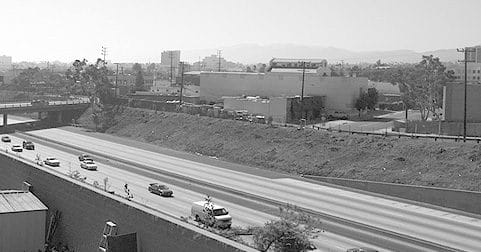
A botched effort to spruce up Interstate 10 between Fourth Street and Cloverfield Boulevard in Santa Monica has turned the once-green corridor into a brown lunar landscape.
And those who live next to the freeway want it fixed.
“It was like a virtual forest,” said Richard Martin, 56, a writer who has lived on the south side of the Santa Monica Freeway at 21st Street for six years. “Then Caltrans or the state or some genius decided that this rich greenery was no good, that it was going to die in the next 20 years or something, so they tore out every last leaf.”
And nothing has grown in the once lush hillside since.
Two state bureaucracies and an errant landscaping contractor played roles in the upheaval, which began in the spring of 2001 with the removal of 35-year-old trees from the freeway’s embankments.
New trees and other decorations were planted in their place, along with a new automatic irrigation system. But less than a year after the $850,000 project began, many of those new plantings began to die, apparently because of a lack of water.
A California Department of Transportation spokeswoman said the general contractor for the project, Tapuz Enterprises, Inc., had defaulted on the job, and Caltrans was at the tail end of getting a new contractor.
She couldn’t confirm whether anyone was tending to the area in the interim, but added that the new contractor would be paid from bonds that Tapuz held.
“They were not doing the work that they were contracted to do,” said Caltrans’ Chief of Public Affairs Deborah Harris. But she said she didn’t know why Tapuz had stopped work on the project.
The Department of Labor Standards Enforcement said the Encino-based contractor, who also operates the Gali Landscape & Maintenance Company, were busted in March of this year for underpaying employees, irregular bookkeeping and misdirection of employee wages. They are barred from bidding on or doing any public works projects for three years.
The Tapuz telephones are no longer listed and numerous messages on their old business line were not returned. A woman answering the home telephone number of Tomer Rotholz — the president of Gali Landscape & Maintenance Company, which has been barred from public works projects along with Tapuz — first said to call back in the evening, but later said he was “out of the country.”
Caltrans officials said they removed the trees because they were dying, though they admitted the trees appeared healthy to the untrained eye.
“The plantings had outlived their life cycle,” Harris said, adding that the trees were planted in the late ’50s and early ’60s and had a life span of 20 to 25 years. “They were crushing under their own weight.”
After uprooting the old trees, Tapuz workers then began planting. Caltrans’ plans called for more than 500 new trees, 1,500 shrubs and vines, and 38,000 ground coverings.
But Martin, who’s apartment looks out upon the freeway embankment, said the new plantings didn’t take root.
“The weeds grew lush and little else,” he said, pointing out that more than half of the Jacaranda trees on the embankments had gone brown and apparently died in the summer heat.
Martin demanded answers from the project’s manager, Lydia Deets.
“I told her the trees were dying,” Martin said. “She said they had inadvertently had the watering system set for spring conditions … and we should be seeing improvements shortly. I told her the trees looked dead to me, not merely dry.”
Deets wouldn’t comment. “I’m certainly not going to talk to a reporter,” she said.
Caltrans’ Harris couldn’t confirm if anyone is currently watering the trees, but she did say the irrigation system is designed to be automatic and new contractors would begin working on the situation “shortly.”
In the meantime, Martin and his neighbors are waiting for the plants to grow again.
“At the least this thing is a portrait of incompetence and bureaucratic idiocy,” Martin said. “At the worst it’s a serious boondoggle. The result is not only a waste of taxpayer money, but a loss of plants in a world that needs every green leaf it can get.”
“At the least this thing is a portrait of incompetence and bureaucratic idiocy. At the worst it’s a serious boondoggle.” — — RICHARD MARTIN Santa Monica resident
Originally published in the Santa Monica Daily Press print edition on September 3, 2002. Read the original PDF.