

“The Last Samurai” is a fine example of what happens when all the elements of epic filmmaking are precisely fused: Sure-handed direction from Ed Zwick (“Glory,” “Legends of The Fall”), resplendent performances by Tom Cruise and Ken Watanabe, breathtaking visuals courtesy of celebrated cinematographer John Toll, and an easily accessible story about a man unwittingly thrust down a treacherous path towards redemption. And while it is surely an entertaining film, there’s something a bit too familiar about “The Last Samurai” to anoint it one of the year’s best.
Originality has to count for something, after all, and Zwick’s account of a 19th century battle for the soul of Japan (and a man’s battle to find his soul) is highly derivative of antecedents such as “Dances With Wolves” and “Unforgiven.” And unlike those superior films, “The Last Samurai” takes one too many liberties “reinventing” the past, apparently on the dubitable grounds that it’s OK to tinker with a culture’s history as long as it’s not our own.
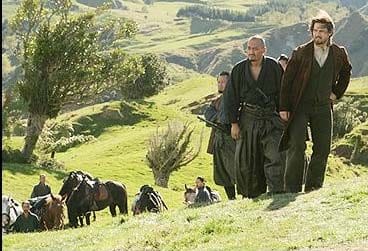
Tom Cruise, striking the movie star pose he’s purposefully avoided the past few years, plays Captain Nathan Algren, a soulless veteran of the brutal Indian campaigns of the Ole’Wild West who’s lost in a haze of liquor and regret. For reasons that are never explained, the Emperor of Japan seeks out the mid-level Army officer to come to Tokyo to train conscripts to kill the fearsome Samurai who stand in the way of progress. Boasting that “for $500 a month, I’ll kill anyone you want,” which seems odd, given that he’s supposedly torn up over the “Injuns” he was forced to slaughter — Algren packs up his troubles and sails for Japan. Once there, he and his ill-prepared troops are summarily overwhelmed by the Samurai and, for reasons not fully explained, Algren’s life is spared. (Perhaps they want to keep him around for a sequel). While tucked away with the Samurai and their kin in one of those tiny mountain villages that are all the rage among production designers, Algren strikes up a friendship with the leader, Katsumoto (Watanabe), and develops an appreciation for the values and codes of the ancient line of warriors … as well as for his comely hostess, Taka (Japanese model, Koyuki).
With the evil imperialistic Americans and their Japanese counterparts setting upon Katsumoto’s tribe, Algren must choose between duty to his country and his deep connection to his new pals and their honorable way of life. If you’ve seen the trailer or have even the faintest idea of how Hollywood action heroes operate, you know which path he chooses. Of course, history tells us that the Samurai did disappear in the 19th Century. But nowhere in any history books will you find an account of a dashing American warrior with movie star good looks who not only joined the ranks of the Samurai, but became the best of the best. An argument can be made that “Samurai” is just a movie and therefore not beholden to facts, but would that argument hold up if someone tried to make a Civil War epic about Robert E. Lee surrendering to Jackie Chan? Come to think of it, that sounds like a great idea for a comedy. Maybe I should get Jackie’s agent on the phone … (Rated R for strong violence and battle sequences. Running time: 144 minutes)
Originally published in the Santa Monica Daily Press print edition on December 5, 2003. Read the original PDF.