

Surge in local bus ridership unmatched by federal funds
By ALICE OLLSTEIN Special to the Daily Press
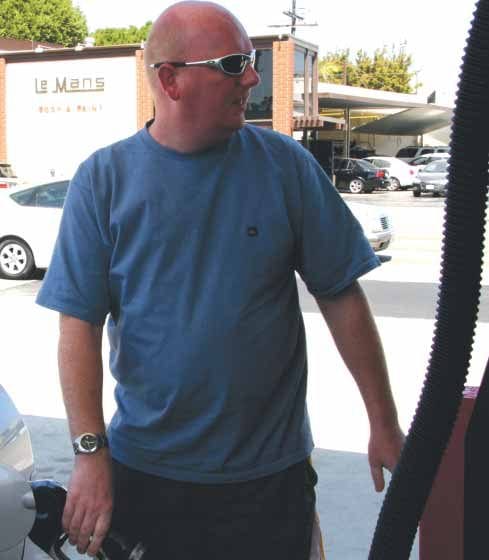
DOWNTOWN Due to skyrocketing gas prices, which cleared the $4 per gallon mark and look well on their way to $5, newly released statistics show that Californians used 3.2 percent less gasoline in March than they did a year ago.
The California State Board of Equalization (BOE) released a report Monday detailing the decline in consumption, which began when gas exceeded $3/gallon in 2005 and shows no signs of slowing.
“This is the first time a downward trend has been sustained for such a long period of time,” said BOE Communications Representative Anita Gore. “We don’t have a crystal ball, but since the price [of gas] has trended upward, we can assume consumption will trend downward.”
While Californians still shell out up to $16 billion a year at the pump, they purchased 43.5 million fewer gallons of gasoline in March this year over last. Due to the steep increase in price, however, the sales tax will continue to generate adequate funds for the state’s transportation fund. In fact, the BOE estimates that nearly twice as much sales tax is generated annually by higher gasoline prices than five years ago and predicts that it will continue to rise.
In 2003, gasoline generated $2.1 billion in taxes, and it is estimated that if gas stays at $4 per gallon or higher, the tax revenue will reach $5 billion.
This trend could, however, hurt the state in the long run. On one hand, higher diesel prices and the slowing economy are making for less freight movement on California roads and highways, weakening the state business sector. Gore also explained that as people use more of their discretionary income to pay for gasoline, and less to buy other taxable goods, less money will go to the state’s general fund.
“People who would once buy an outfit for work are now using their money to get to work,” she said.
Gore noted that the state legislature and government will have to decide whether or not to use the gas tax revenue, earmarked for road repair and other transportation needs, for other purposes.
The one certainty is that Californians are radically altering their behaviors and lifestyles in order to lower spending.
“I’ve seen more and more hybrids, a rise in public transportation, people running three or four errands at a time instead of making separate trips,” she said.
Dan Dawson, the customer relations manager for the Big Blue Bus, reports that ridership is up 7 percent from last year, compared to the normal 2 percent annual increase. He also noted that based on the influx of customer calls at the Transit Store in Downtown Santa Monica, the new riders are overwhelmingly commuters unable to pay for the gas required to drive to work.
“We’re getting even more calls than during the MTA strike of 2004,” Dawson said. “People tell us that gas is way too much and they want to save money.”
Dawson sees a future where oil prices and demand for public transportation continue to rise, and faults the state government for its “shortsighted” attitude towards funding public transit. Current proposed cuts divert almost all of the state’s $1.4 billion transit fund to other line item budgets. If the legislature adopts the budget, it will mark at $4 billion loss for transportation over the last 10 years. “Imagine what that $4 billion could do,” Dawson said. “We could have light rail, subways, bus only lanes. The current budget that would prevent us from doing any sort of expansion, and maybe even force us to cut service.”
Understanding that gas prices hit students especially hard, UCLA began its “Bruin Go” program in September of 2000. The program, which gives students drastically discounted rides on the Big Blue Bus, has seen a huge surge in membership this past year, inspiring Santa Monica College to design its own version. This August, they will unveil the “Any Line, Any Time” program, wherein SMC students will ride the Big Blue Bus free of charge.
According to Dawson, public transportation can and should be the cure to what Gov. Arnold Schwarzenegger recently called America’s “addiction to oil.”
“If everybody in America just took the bus, the U.S. would reduce dependence on foreign oil 40 percent, besides reduce greenhouse gases in the air,” Dawson said. “But if people can only make a commitment to two days a week, that’s still a huge environmental and financial impact.”
Originally published in the Santa Monica Daily Press print edition on July 1, 2008. Read the original PDF.