

Promenade and pier demand higher permit fees
(Editor’s note: This is the first article in a two-part series examining the film industry’s impact on Santa Monica. Tuesday’s article will focus on the economics of filming in the city.) Flip through a magazine, go to the movies or turn on the T.V. and chances are you’re going to see familiar backdrops from your own backyard.
Studios and advertising agencies are consistently choosing Santa Monica — along with its well-known tourist stops — as locations for commercials, movies, television shows, and photo shoots.
Officials estimate the city will make more than a hundred thousand dollars from film permit fees this year. And local businesses will make even more as production companies shell out thousands of dollars a day to use their properties as locations.
“Without even looking, location scouts think of our bluffs, our beaches and all the places they have been in the city,” said Kathy Ruff, the city’s film permit coordi-nator. “It’s made us an extremely attractive place to film.”
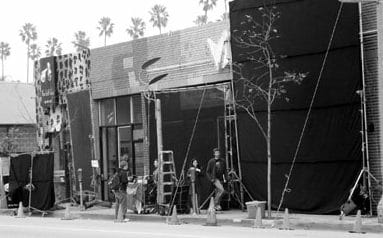
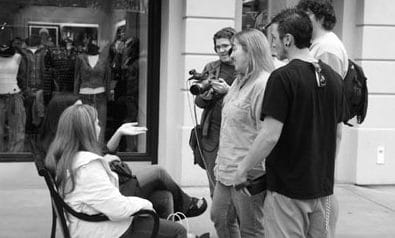
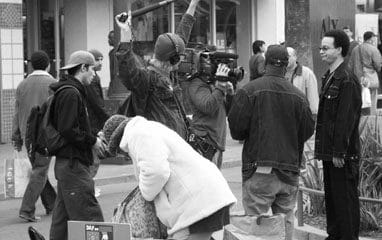
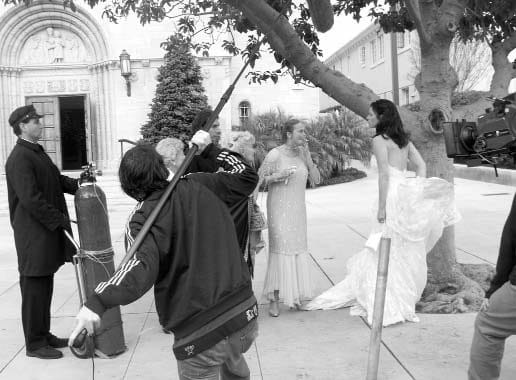
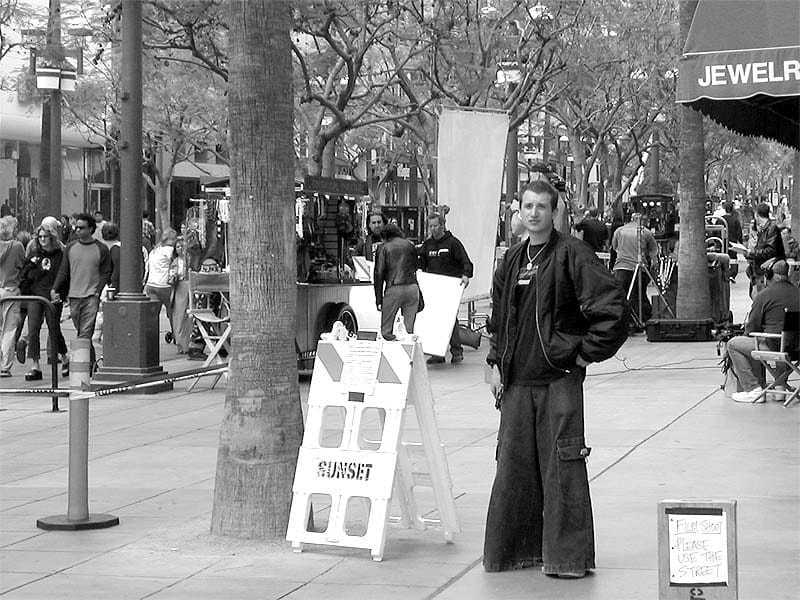
That was apparent this past Friday as scenes for Showtime, the Discovery Channel, Comedy Central and an independent movie were simultaneously being filmed at locations throughout Santa Monica.
Film crews have become so common on the Third Street Promenade that some business interests have said it’s part of the outdoor mall’s draw.
Some have attributed the street’s popularity because of its ability to be used as the background for nearly any location. Last year, a company shooting a public service announcement for residents in Delaware used the facades of Third Street stores as a backdrop.
“You’d be surprised how easy it is on a gloomy day to make this look like Delaware,” one production worker said. “But really we can make this look like any street in America.”
In the movie “Oceans Eleven,” actors Brad Pitt and George Clooney discuss plans to rob a Las Vegas casino while sitting at a table in the Lobster restaurant, overlooking Palisades Park and the entrance to the Santa Monica Pier, which is the most popular location in the city for shoots.
When actor Tom Hanks — playing Forrest Gump — runs across the country, his voyage stops momentarily at the entrance to the pier, the place where the Historic Route 66 ends. And in the 1986 movie “Ruthless People” actor Judge Reinhold drives a get-away car off the end of the pier to escape police.
On television, both “Baywatch” and “Three’s Company” relied heavily on Santa Monica locations for their shoots. Even today television shows, such as “Buffy the Vampire Slayer” and “7th Heaven” — which are filmed in studios located in Santa Monica, can often be found shooting scenes on the Promenade, at the pier or along the beach.
HBO’s hit show “Curb Your Enthusiasm” by “Seinfeld” creator Larry David takes place — and is almost entirely filmed — in Santa Monica.
Last month, a national magazine advertising campaign undertaken by a automobile manufacturer featured a display of the company’s cars in front of an art and architecture book store on the Promenade.
This past summer, K-Swiss shot a commercial on the pier featuring a new line of tennis shoes.
“I would say it’s fantastic for us,” said Ben Franz-Knight, acting executive director of the Pier Restoration Corp., which manages the pier. “And it’s great for our tourists, who some of them are from the Midwest and they don’t get to see this stuff too often. Some actually end up being extras in the shoots. It’s really great.”
Film permits are big business The city on average issues 800 annual permits for filming and still photography, though that number has been declining slightly over the past five years, Ruff said. Officials attribute the decline to the recent slow-down in overall Hollywood film production.
Permits vary dramatically in price. Each takes into account the size of the shoot, whether roads or sidewalks will have to be closed, and how many police and fire officers will need to be assigned to the location.
Location managers say on average Santa Monica charges $500 a day to shoot.
That can go up by several hundred dollars a day if the film companies use the Promenade, the pier or the airport as a location — or if they take up a large number of parking spaces.
City officials say the higher fees are needed for those areas because they require extra precautions and an extra layer of bureaucracy.
As the number of permits have shrunk, the number of larger film productions have decreased as well, Ruff said.
The average film production has been reduced from two days to about 1 1/2 days. The fewer days have resulted in less money from permit fees.
The city issued $222,755 in film permits in 1997, but this year officials estimate the city will take in about $122,000.
The decline in film permits also has affected other cities in the Los Angeles region. West Hollywood’s film permit official said that city typically issues about 225 permits a year but recently the number of permits dropped to 190. In 1999 — the last year West Hollywood had records available — the city took in $163,000 from its film permits. Last year it dropped to $125,000.
Before an anticipated actors’ strike was settled in 2000, the entertainment industry cranked out movies to have on hand during a strike. Now that the strike has been averted, Hollywood has slowed its production of new films, while the ones that were made are slowly released.
“There’s a lot of factors why those numbers are declining,” said Terry House, a West Hollywood film permit official. “It’s everything from the strike being settled to the economy, but things are starting to look better.”
House reports that West Hollywood saw a spike in filming during November, and the city is on track this year to issue 200 permits again. Santa Monica city officials said they are monitoring the number of permits being issued, but they are still predicting a low number this year.
Not included in the city’s film fees are the salaries paid to Santa Monica police and fire personnel assigned to film locations.
Off-duty Santa Monica fire and police officers are assigned on a volunteer basis and they are paid regular overtime wages directly from the film’s production company. The police are there to make sure the public isn’t endangered by the filming and the fire fighters check for fire and environmental hazards.
“Some people think we are there to guard the equipment,” said Lt. Frank Fabrega, a Santa Monica Police Department spokesman. “But really we are there to make sure the film company follows through with the requirements in their permit and they don’t try to do something harmful like close streets.”
Popular locations to film While all film permits come out of City Hall, production companies looking to shoot on the pier, the Promenade or at the airport have to get specific approval from the agencies that regulate those areas.
According to city records, the pier is the most popular place for filming. The Pier Restoration Corp. takes in about $60,000 annually from its film permits. Bayside District Corp., which partners with the city in managing downtown Santa Monica, averages $35,000 annually. And the airport takes in a few thousand dollars a year.
Each district is allowed to charge higher rates for their film permits mainly because each area has its own special requirement. A film crew shooting on the Promenade has more need for crowd control than the same production shooting at the airport, for example.
Despite those differences, the fees charged by each location remains relatively the same. That’s due in part because the city council hasn’t raised film permit fees since 1992.
Kathleen Rawson, executive director of the Bayside District Corp., said she has asked her staff to investigate whether or not the cost of film permits should be increased.
Bayside’s annual income from film permits in the 2001-2002 budget year was $36,950, which accounted for about 5 percent of its total revenue of $910,918.
“It’s been a long time since we have really looked at the rates, and it’s something we are going to revisit soon,” Rawson said. “At the same time we want to make sure we don’t raise fees by so much that we price ourselves out of the market.”
City Manager Susan McCarthy said the city has traditionally resisted raising film fees because it doesn’t want to create barriers to a local industry that adds much to Santa Monica’s appeal, image and economy.
Even though the City is facing an estimated $8 million budget deficit and another $15 million deficit next year, city officials remain resistant to increasing film permit fees, McCarthy said.
“There’s a lot of pressure not to raise those fees,” she said. “A lot of the community works in the film industry and they don’t want to see any of the production migrate.”
Being unique has a price Santa Monica, along with Beverly Hills and West Hollywood, are known as being the most expensive and most restrictive cities in Los Angeles County to film on location, officials said.
All three cities are considered landmark locations that can demand more money because duplicating them can be very expensive and difficult, officials said.
“There’s only one Sunset Strip,” West Hollywood’s House said. “If a film calls for it, there’s not a lot of alternatives anywhere else.”
Each city also makes sure residents are notified of shoots on their streets up to two weeks before production crews are set to arrive, giving residents time to appeal the film permit’s approval.
Companies also must receive permission from residents who live in front of areas where large amounts of equipment and vehicles will be parked during shoots, which Santa Monica restricts in residential neighborhoods to between 8 a.m. and 10 p.m.
The pier doesn’t issue permits on the weekends, and there is a ban on filming in downtown Santa Monica beginning the day before Thanksgiving to after New Years Day. Similar conditions exist in Beverly Hills and West Hollywood.
“Not a lot of these restrictions exist in Los Angeles because it’s so big,” House said. “There, you don’t want to set restrictions too high or else they’ll just go someplace else.
“But in West Hollywood, Beverly Hills and Santa Monica, there’s really no other place quite like it,” he added.
Mike Beche, a location manager for the television show “7th Heaven” agrees.
“I first came to Santa Monica because of the ocean,” he said. “Every town has about the same things, except in Santa Monica you have the ocean, the pier, the ocean walkway and the Promenade.”
Originally published in the Santa Monica Daily Press print edition on January 13, 2003. Read the original PDF.