

Political group submits initiative to allow citizens to vote for mayor; district representative
A group of citizens has edged one step closer to changing the way politics has been conducted in Santa Monica for the past 60 years.
But their proposal, which ties a directly elected mayor to election of council members by district and term limits, has attracted fire.
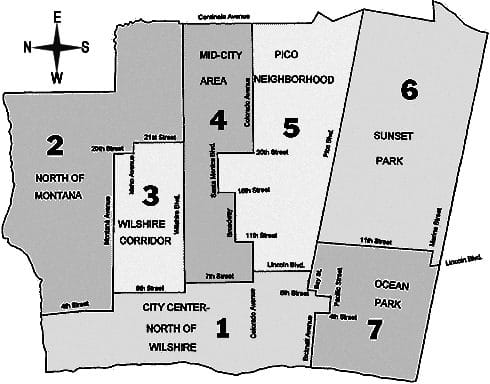
Representatives from the political group called, “Voters Election Reform Initiative for a True Accountability System,” also known as VERITAS, announced Monday that it has submitted nearly 13,000 signatures to the city clerk in an attempt to change the city’s election charter. The change would allow citizens to vote for their own mayor and one council member from their respective neighborhoods. The group surpassed the requirement by almost 4,000 signatures.
The current law allows only the seven city council members to elect the mayor. City council candidates run at-large throughout the eight square miles of Santa Monica’s city limits.
Paul DeSantis, who helped spearhead the VERITAS effort, believes Santa Monica’s election process makes it too costly for the average person to run. He also complains that Santa Monica does not have a representative government. Currently, it allows for slate-financed campaigns dominated by huge special interest money, he asserted. What’s more, voting for the mayor “politically legitimizes” the position, DeSantis said.
“It’s a disgrace,” he said. “In the last 20 years, no independent has been elected to city council. An independent, even one with exemplary qualifications and attractive ideas would need $200,000 to compete effectively... VER- ITAS ends this political stagnation with fresh blood, new ideas and true independents serving on the city council.
“I think the process is wrong,” he said. “We need people elected based on their ideas, not their money.”
The VERITAS initiative would give citizens a direct line to City Hall by electing one representative from each district, making their politicians accountable to those who elected them, supporters argue.
“The way VERITAS opens up the system is by breaking up the costly, city-wide contest into seven inexpensive, smaller contests in the neighborhood districts,” said Irene Zivi, a VERITAS supporter. “We don’t expect the slates to disappear. What VERITAS does is give a slingshot to every Santa Monica independent who can now challenge these Goliath slates with a good pair of walking shoes, interested neighbors and a few hundred dollars for photocopying.”
What VERITAS is introducing is nothing new to American politics, DeSantis said. Having a mayor represent the entire city with district representation on the council mirrors national electoral politics.
“We are not trying to be clever here,” he said. “We are just taking that American paradigm and bringing it to Santa Monica.”
But Santa Monica Mayor Mike Feinstein thinks the entire initiative is nothing more than a clever attempt to undermine the successful political culture here.
And as a result, the entire election process is in danger, he added. Feinstein argues the initiative, if passed, would decrease voter choice, decrease public officials’ accountability, and increase the amount of special interest money thrown at politicians.
Under the current system, each person can vote for all seven city council members but under the VERITAS initiative, voters would be restricted to choosing only one out of seven council members, Feinstein said. What’s more, council members would be accountable to only a single neighborhood, pitting one neighborhood against each other, especially on development issues, he suggested.
“I think that with the size of our city, every council member should be accountable to the community,” he said. “The form of government we have now is so much more appropriate for a city our size.”
Feinstein also fears that a voting mayor would attract enormous campaign funds to the race, corrupting the scale and cost of local elections, Feinstein said.
Feinstein attacked VERITAS for what he called deceptive practices by failing to tell petition-signers its full effect. For example, the mayor notes, the petition calls for term limits, but the “hired guns” VERITAS used to collect signatures outside local grocery stores and in residential neighborhoods didn’t disclose that. Instead, he said, they mentioned only that the mayor would be directly elected.
DeSantis hopes to bring the initiative to voters this spring, after a set of public hearings on the proposal.
However, Feinstein favors public debate before the proposal is brought to voters. He also noted there are a number of different ways that electoral overhaul could be done. One proposal would allow a vote for a district representative while voting for the other six council members at large.
“The overall problem is they did not stimulate a public process,” he said. “There are a lot of ways to do it and they didn’t allow the public to debate it.”
“The overall problem is they did not stimulate a public process. There are a lot of ways to do it and they didn’t allow the public to debate it.” — — MIKE FEINSTEIN Mayor of Santa Monica
Originally published in the Santa Monica Daily Press print edition on November 28, 2001. Read the original PDF.