

City to analyze the results of first test
SAN VICENTE BLVD. — In keeping with Santa Monica’s reputation for being ahead of the curve, city staff here Thursday tested a newly designed water collection and filtration system that should significantly lower levels of bacteria and other pollutants that spill into the bay.
The design uses a combination of methods, including a filter called a Smart Sponge, to remove oil, fecal coliform and other bacteria at the street level, as well as a collection system underground. The system helps store water so that it can seep naturally into the ground, where it will be filtered by the earth as it percolates into an aquifer below.
By using a combination of methods, less polluted water will reach the bay, and more clean water can be stored in the city’s aquifer, reducing dependence on imported water, officials said.
The system is part of an overall effort by City Hall to clean urban runoff before it reaches the bay.
Urban runoff is considered to be the No. 1 source of pollution to the bay, with an average of 500,000 gallons per day being generated in parts of the cities of Santa Monica and Los Angeles. Much of the runoff is treated by the city’s Urban Runoff Recycling Facility.
“We have enough of our own water to supply 80 percent of the city, but most of our wells have been shut down because of contamination,” said Neal Shapiro, senior environmental analyst for City Hall’s water resources management section of the environmental programs division. “This has made us dependent on outside sources for water, and that’s not good.”
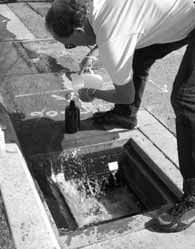
Shapiro and his colleagues on Thursday watched anxiously as more than 3,500 gallons of rainwater collected during recent storms rushed down a gutter along San Vicente Boulevard and into the Smart Sponge filter. It was the first test of the system, and city staff was unsure how it would perform.
The results seemed to be good, Shapiro said, as the system was able to store most of the 3,500 gallons of rain water. Much of it was filtered through the Smart Sponge and stored underground, allowing it to seep into the soil instead of rushing into the bay.
During severe storms, the Smart Sponge, which has shown to remove 85 to 99.9 percent of pollutants, could become overwhelmed because a collection pool adjacent to it is not deep enough to handle surging rain water, city staff said. If the pool drains too slowly, the Smart Sponge begins to float, meaning there is less gravity to pull the water through the sponge, allowing it to spill over and into the storm drain.
Those watching the demonstration said the collection pool could be dug deeper or a screen could be added to filter out more pollutants, as well as leaves and other debris.
The entire system cost a little more than $55,000, Shapiro said.
The Smart Sponge is made of synthetic polymers and can be recycled, said Duane Cook of Abtech Industries, which developed the sponges. Each sponge costs $990 retail. However, cities rarely pay retail.
The sponges can be cleaned regularly but need to be replaced periodically because they expand when interacting with hydrocarbons and therefore can’t absorb anymore water, Cook said.
City staff must now analyze data collected during the test and study water samples collected before and after filtration to get a better idea of how effective the system is. If it proves to offer substantial benefits, Shapiro said he will ask City Hall to invest more money into building these filtration and collection systems.
Originally published in the Santa Monica Daily Press print edition on March 31, 2006. Read the original PDF.