

But water quality is still one of the worst areas in California
Swimming and surfing in Santa Monica Bay is safer than it was a decade ago but it’s still one of the worst polluted beaches in the state, officials say.
Compared to other stretches of the state’s coastline, Santa Monica Bay is ranked one of the top 10 most polluted beaches in California, according to the Surfrider Foundation.
The Los Angeles Regional Water Quality Board, the local branch of a statewide agency that checks for water pollution, is credited with cracking down on polluters and writing strict rules restricting trash from entering the bay.
While the strict enforcement and increased vigilance has made the waters off Santa Monica cleaner, there is still a ways to go, officials said.
Scientists with Heal the Bay — a Santa Monica-based non-profit that helps to clean the bay — said urban runoff remains the No. 1 source of contamination for coastal ocean waters in Southern California.
When water from rain or lawn sprinklers runs into the street, it picks up fertilizers and pet waste, as well as heavy metals and oil residues from automobiles, as it flows into the region’s storm water collection system.
That water is then released, largely untreated, into the Pacific Ocean.
“Run-off contains the bacteria that makes people sick and also all the substances that harm marine life,” said Shelly Luce, a staff scientist with Heal the Bay. “It’s the absolute worst source of pollution.
“It’s really only after a rainstorm that bacteria levels get high enough to make people sick,” she added.
During the dry summer months officials say more than 90 percent of water samples meet or exceed quality levels for being a safe place to swim and surf, said Los Angeles County Department of Health officials.
“There is no time during the peak swimming season that bacteria exceeds health standards,” Luce said.
But even after a light rain, the Los Angeles County Department of Health routinely issues a “rain advisory” to beach-goers letting them know it would be wise to avoid going out in the water for 72 hours.
“Never swim near a discharging storm drain,” said Richard Kebabjian, director of Recreational Health with the L.A. County Department of Health. “It only takes a tenth of an inch of rain to start the drains flowing.”
Los Angeles was one of the first counties in the state to begin regularly testing the water along its 60 miles of coastline, and the standards it tests water quality by are still some of the strictest in the state, Kebabjian said.
“We get a lot of beach closures and beach warnings,” he said. “If you compare us to other parts of the state or parts of northern California it may seem high but that is because we are testing so much.”
County water inspectors take daily water samples at more than 30 different locations, many of which are near storm drains, piers, and where rivers and streams flow into the ocean.
After it rains, rivers and streams also carry contaminants into the ocean. In Malibu, faulty septic tanks leak into the Malibu Creek when it rains. Combined with the increased water flow, it washes away a man-made sand burm that is intended to keep the water from flowing directly into the ocean.
And when that happens, officials warn to stay out of the water.
Luce said she regularly surfs at Bay Street but rarely ventures to spots further north — rain or shine.
“You couldn’t pay me to surf at Malibu or Surfrider,” she said. “Surfrider is the worst, especially when the burm is washed out.”
“You couldn’t pay me to surf at Malibu or Surfrider.” — — SHELLY LUCE Heal the Bay staff scientist
Kebabjian said when he takes his family to the beach, he avoids locations within 100 feet of a pier.
Many times salt water from the ocean will rust away sewer pipes below the boards, allowing the sewage to leak into the ocean. Automobiles parked on the pier also can leak oil and other pollutants into the water below.
“And then there’s the birds,” he said. “Piers tend to attract birds, which then poop all over the place.”
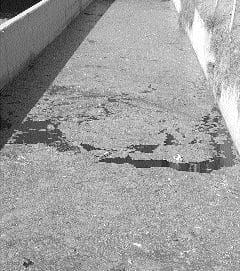
Paving is problematic Officials say because of the rapid paving of the Los Angeles basin during the past several decades, more run-off is being created than ever before.
“We have really damaged the natural ability of the watershed to clean up the water before it reaches the ocean,” said Craig Perkins, director of Santa Monica’s Environmental and Public Works Management. “It’s a whole lot of people living in the metropolitan area contributing to that.”
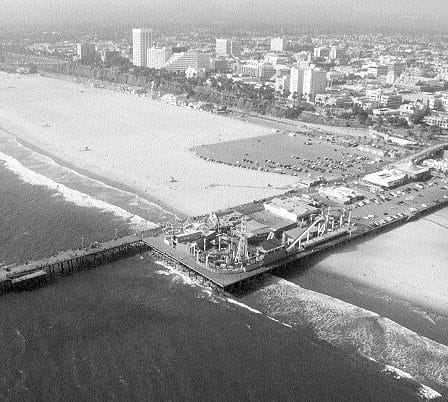
Santa Monica has built one of the few plants in Southern California that treats run-off along the coast and the Santa Monica Pier before it is discharged back into the ocean.
The plant — which is called the Santa Monica Urban Reclamation Facility, or SMURF — is located just north of the pier and has been operational for more than a year. But even during a slight rainfall, the treatment plant is over-run with the excess water, which is then released into the ocean untreated.
“The good news is that we’re in better shape than we have been in a long while,” Perkins said. “It’s cleaner now then it was 10 years ago, but we are no where near ready to declare victory yet.”
Victory would mean changing people’s behaviors when it comes to how they use chemicals on their lawns, how they dispose of used motor oil or even just remembering to pick up their pet’s waste, officials said.
“It’s not just the areas by the beach that need to be doing this stuff but it’s all the people living way upstream too,” Perkins said. “There are so many areas where we have to change people’s behaviors, and create an innovative system to catch pollutants before they reach the ocean.”
New laws may be solution The Los Angeles Regional Water Quality Board has been credited for reducing the number of sewage spills and the amount of trash that washes into Santa Monica Bay.
“The regional board is definitely looking closely at pollution sources in the bay,” Luce said. “They have been enforcing proper sewage maintenance and sewage remediation, which has drastically reduced the amount of sewage being released into the ocean.”
The City of Los Angeles has been fined millions of dollars in the past decade by the regional water quality board and the federal Environmental Protection Agency for releasing sewage when its facilities become over-run.
When sewage is released and beaches are closed, a notice is sent over the news wires and investigators from the regional water quality board are sent to investigate.
The state recently began requiring all counties in the state to take daily ocean water samples to test for bacteria levels. The state legislature also has begun writing rules to help restrict the amount of trash that makes it into the ocean.
Rotting garbage that washes into the ocean is a prime source of harmful bacteria that poses a risk to both swimmers and marine life.
The new laws would require communities throughout the county to put measures in place to prevent garbage from blowing into streams, rivers or directly into the ocean.
And cities would be responsible for sending municipal workers into the riverbeds to pick up trash before it washes any further downstream.
“Unfortunately those are being disputed by the city and county of Los Angeles,” Luce said. “They argue the costs are too high to keep trash out of our oceans.”
Both Kebabjian and Luce recommend reading the surf report card on either the county or Heal the Bay’s web sites before going out. Heal the Bay’s report card can be found at www.healthebay.org and the county’s can be found at www.lapub-lichealth.org.
Kebabjian said water samples are taken in ankle deep water, and the water further out can be safer.
“When you go out to chest deep water, counts dramatically drop,” he said.
Originally published in the Santa Monica Daily Press print edition on August 27, 2002. Read the original PDF.