

Some believe proposed laws are unconstitutional
Hundreds of homeless people protested on the steps of City Hall just before elected officials inside were expected to vote on two laws that could decide their fate.
The Santa Monica City Council, feeling pressure from the business community, was poised Tuesday evening to engage in a long and heated debate on whether it should pass two proposed ordinances that are designed to move the homeless out of downtown.
And the rationale for making a decision on the proposed laws in council chambers was as murky as the weather outside.
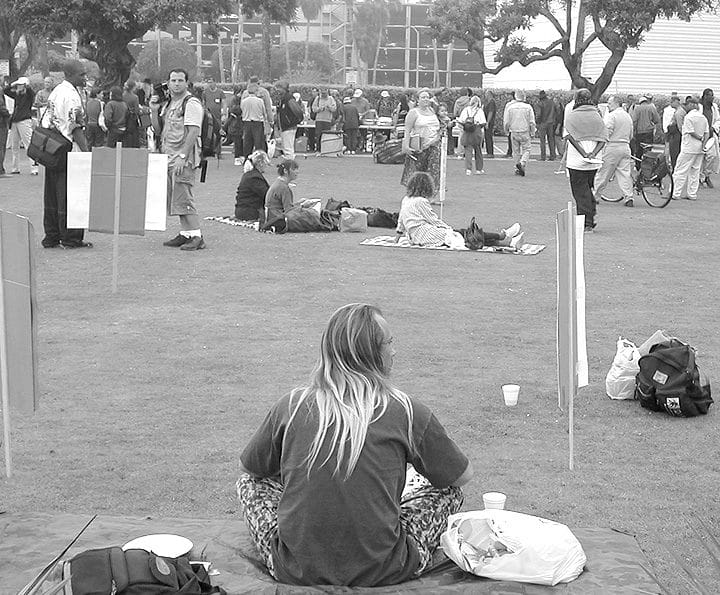
Thick fog descended upon the lawn of City Hall where the gathering looked more like a picnic than a protest. Council members walked through the maze of disheveled people on their way to council chambers where they were expected to hear hours of public input on both sides of the issue.
“We are people, we are all people,” said Mayor Pro Tem Kevin McKeown, who was expected to vote against the ordinances.
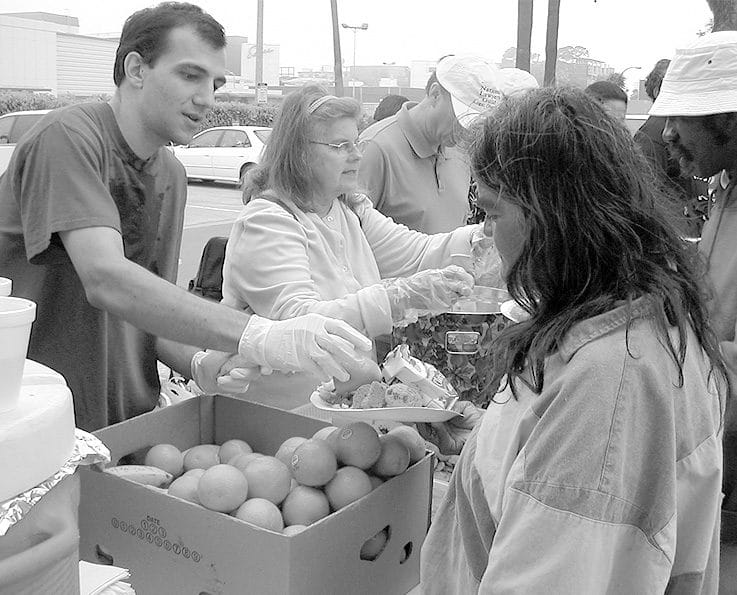
Those who showed up in front of City Hall, most of whom have no place to live, lined up in front of a food table where volunteers handed out lasagna, salad, bagels, muffins, cookies, chips, fruit and coffee. Several individuals carried around signs saying “save our food lines,” or “everyone has a right to eat.” But most of them sat down on the grass and enjoyed their meal.
Many of them said they wouldn’t be able to survive without groups like “Helping Other People Eat,” otherwise known as HOPE, which was the food provider Tuesday. HOPE distributes food each Wednesday and Thursday in Palisades Park at Arizona Avenue and Ocean Avenue.
“If I didn’t eat I would get really sick and I would end up in the hospital because I have diabetes,” said Denise Smale, a homeless resident who moved here in January from Santa Rosa. She said she moved here because of the temperate climate and the city’s beauty. When asked whether or not she thought food handouts should be attached to work, Smale agreed they should be.
“A lot of people get lazy and dependent and they get stuck,” she said. But if it wasn’t for people like Paul Grymkowski, who volunteers for HOPE, Smale said she thinks she might not be alive.
“He’s trying to feed the hungry,” she said. “He’s got a good heart and he’s doing the right thing.”
Not everyone agrees. Certainly not some members of the business community, residents and tourists who think the food giveaway programs, which occur between 20 and 30 times a week and feed up to 300 people at a time, attract transients. They claim the homeless’ antisocial behavior is ruining quality of life for residents and business downtown.
In response, the city council considered on Tuesday night a proposed ordinance that says any group that hands out food must have a permit issued by the Los Angeles County Health Department and be authorized by the city before organizing food lines.
The other proposed law would make it illegal for any person to sit or lie down in a building’s entrance between 11 p.m. and 7 a.m. The ordinance only covers buildings in the downtown, which means the area bounded by and including the east side of Ocean Avenue, the north side of Wilshire Boulevard, the east side of Lincoln Boulevard and the south side of Pico Boulevard.
The council had not made a decision by presstime.
But many people, including Mayor Mike Feinstein, think the ordinances are designed to oust the poor from the city and don’t consider human decency or basic constitutional rights.
Joseph Raimos, who has been homeless for eight months, agrees. He came to Santa Monica because he heard the weather was nice, it’s next to the beach and because of its liberal policies — a paradise for those down on their luck. Raimos has recently seen an influx of homeless people in Santa Monica and he said they have told him they came for the same reasons he did.
“But then they come here and it’s like one of those twilight zones,” he said. “It’s like the movie ‘Jaws’... no one tells you that there’s sharks swimming around.”
Attempting to deprive the needy for personal and monetary reasons is wrong, he said.
“How can you stop people from helping other people?” Raimos asked. “In a free country, how do you tell people you can’t help another person? Once you do that, you’ve got communism.”
“How can you stop people from helping other people? In a free country, how do you tell people you can’t help another person? Once you do that, you’ve got communism.” — — JOSEPH RAIMOS Homeless resident
Originally published in the Santa Monica Daily Press print edition on September 25, 2002. Read the original PDF.