

Message: Schools need a stable, predictable revenue stream
As the school district continues to grapple with multi-million dollar shortfalls, a powerful and influential group is working behind the scenes to ensure that education in Santa Monica remains at the top of its class.
What started as a few school supporters who gathered occasionally has graduated into a political action committee with several hundred members. And its clout — the group’s membership crosses nearly every political line in the city — can’t be under estimated, most agree. “Community for Excellent Public Schools,” also known as “CEPS,” is a group that seems to get more focused about its commitment as economic conditions get more dire for the local school district.
CEPS has brought forward a controversial charter amendment that would force City Hall to give the Santa Monica-Malibu Unified School District a minimum of $6 million each year. It’s a unique proposal never tried here before and would require voter approval in November.
CEPS’ steering committee met this week to strategize about how to get 15 percent of Santa Monica voters — about 9,000 people — to sign a petition by May in order to get the measure on the November ballot.
The group, comprised mostly of parents who have or had kids in the district, has been difficult to ignore over the past two years. They’ve thrown themselves behind school funding campaigns and rallied the community to march in front of City Hall.
City Council members and even John Deasy, the superintendent of schools, agree they’ve never seen anything quite like the movement CEPS has created.
544,“I like this group,” said Deasy, who has been in education for 19 years. “You meet special interest groups, but for the sole purpose of making schools excellent, I’ve never met a group like this.”
What makes CEPS unique is that the key people involved, some of whom participate heavily in local politics, tend to put their differences aside in order to try and achieve the common goal of supporting excellent education in the community.
When people like Denny Zane, who has been fundamental in the formation of Santa Monicans for Renters’ Rights — a liberal party that currently holds the majority on the City Council — and Chris Harding, a land use attorney who often is battling on behalf of the business community against SMRR, can put other differences aside and work together on the same campaign, then CEPS’ goal has already been achieved.
“It’s bipartisan. There is a sprinkling of everybody and, frankly, I’m not surprised,” Zane said. “I think most people participate because they all share the value of kids in this community and their education.”
Nat Trives, former mayor and chamber of commerce chairman, now sits on CEPS’ steering committee.
“Education is the core value of the organization and it’s part of our community as a whole,” he said. “The quality of education is key as much as the sales tax is to keep the engine running.”
Deasy, who not surprisingly thinks that CEPS’ momentum and influence is key right now — the district is facing multi-million dollar shortfalls in the coming years — said the district’s success in balancing its budget last year is largely because of the group’s dedication.
“It’s extremely gratifying that people are concerned enough to keep the effort going,” he said, adding he is only advised by a few members on what the group is doing. “I didn’t see the completed (charter amendment) language until it was filed (in City Hall).”
A ‘no brainer’
Linda Gross, one of the handful of founders of CEPS, never dreamed the group would reach the level it has. At the time, the group was just trying to help the district overcome a small shortfall. But that shortfall grew over the ensuing years — the district was forced to find $13 million to close its deficit last year.
“The deficit (remained at) a huge million and a half (dollars),” said Shari Davis, CEPS co-chair, who got involved in the organization in 1999. “We were frantic over what now seems like such a small amount. Everybody got mobilized at the perceived crisis at that time.”
Gross thought that because the City Council indicated its commitment to education was strong, the group would be able to lobby local politicians into giving some extra cash to the district and the problem would be solved.
As the district’s costs continued to increase and the state and federal government’s financial commitment to education has decreased, CEPS found itself going to the City Council every year for more and more money — and each year they’ve gotten it. For the past several years, the City Council has given millions to the district, and more recently, even more than what was budgeted.
“The City Council has been very generous, but we don’t want to come in front of them every year because it makes us feel like we are begging, and that doesn’t feel very good,” Gross said. “A group of us decided that what we needed was a reliable, steady source of funding.”
And while the charter amendment would do that, it was thought early on that all that would be needed was a parcel tax and the City Council’s contributions.
In 1999, the district’s solution to closing its $2 million deficit was to take in students from outside the district. But when the district’s enrollment reached its maximum a few years later, the financial problems were still there.
“There were empty seats and permitted students bring in state money,” said Ralph Mechur, one of the first CEPS members. “But when the number (of students) hit 12,000, enrollment was capped and we had increasing costs. We had to cut programs to meet the budget. That’s when we went to the city, but it was met with skepticism, like ‘what are you doing wrong that you need more money?’”
That’s when Gross and others recruited people in the community who knew elected officials or had backgrounds in municipal finance and political campaigns, in an effort to find more money for local schools.
A think tank
Most agree that the people behind CEPS are some of the brightest and committed community members in Santa Monica.
“(Linda Gross) was determined to bring people together that were on opposite sides of the political spectrum,” Davis said. “There is a lot of brain power sitting around the table.
“Our well is very deep with people with expertise.”
As CEPS was rallying the troops, Measure Y, a $100-per property parcel tax was passed in 2000, according to Davis. Shortly after, a new superintendent of schools — John Deasy — was hired and a new strategic plan for the district was created, providing a map of where the district should go.
And it’s going in the right direction, school supporters say. The district is closer to closing the achievement gap and test scores are up, Davis said.
“This district can improve and that’s what keeps me going,” said Davis, who has three children, two of whom are enrolled in the district. “Providing a stable source of municipal resources to the public school system will help all children achieve success in public schools.”
Measure EE, another parcel tax, failed at the polls in the fall of 2002, despite enormous campaigning by CEPS members, who also work closely with other school groups like the PTA and the teacher’s union.
“That was not a fun time. It was a time of stress,” Davis said. “That’s when we decided to become a political action committee.”
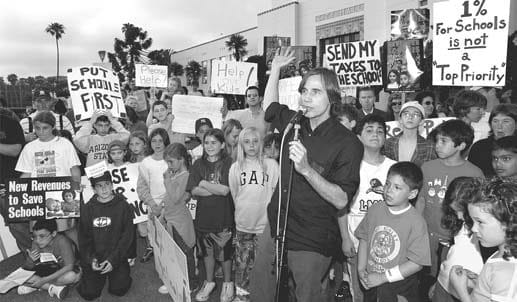
After the disappointing election results, CEPS really started gaining momentum. Its members and PTA supporters gathered the community and rallied in front of City Hall in January when the City Council first began considering its budget, which had to be passed in July. Then, in April, close to 1,000 people marched through Palisades Park, rallying to save teachers’ jobs as they were in jeopardy of being laid off. Two months later, about the same time as the parcel tax election, the group showed up again in front of City Hall, this time with legendary musician Jackson Browne, in an attempt to get extra money from the City Council. The group was successful both in terms of getting an extra $2.25 million on top of the annual $3 million contribution, and it also won the June election. CEPS had backed the school board’s decision to go for a special election and try to get voters to pass a revised parcel tax.
“The momentum we had as an educational-based organization and the political power allowed us to organize the community and achieve our mission to find strategic ways to increase financial resources for the district,” Davis said.
While Measure S was successful, CEPS members knew the $39 million it will bring in over the next six years still wouldn’t be enough.
Almost immediately after the June election, CEPS started strategizing other funding mechanisms for the district — the result being the charter amendment.
“We always knew parcel taxes are partial solutions because the need is so much greater than that,” Zane said. “The issue is to create a reliable and predictable source of funding.”

Originally published in the Santa Monica Daily Press print edition on January 23, 2004. Read the original PDF.