

Whale rescue team has secured spot for operations
A poisonous algae responsible for killing and harming hundreds of sea mammals last spring has cropped up again.
The algae, which is known as bridal plankton, begins to bloom in May and extends into June. The algae already this year has caused a large number of dazed and confused animals to wash ashore in Santa Monica and other Southern California beach communities in recent weeks.
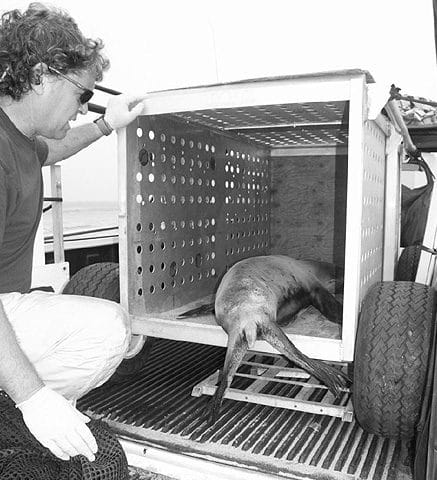
Peter Wallerstein, who runs the Whale Rescue Team, a non-profit group that patrols Los Angeles County beaches, transferred a sea lion to San Pedro Marine Animal Care Center on Tuesday. The sea lion had washed up on shore at Bay Street Beach and was having seizures.
Wallerstein noted last year’s situation was the worst he’d ever experienced. He received up to 50 calls a day for rescues last year.
When the algae blooms it releases a toxic substance called domoic acid, which is ingested by small fish like sardines. Larger animals then eat those fish and become sick.
The substance doesn’t appear to affect people because they do not swim far enough from the mainland to come into contact with it. But scientists warned that humans can become ill after eating fish poisoned by the algae.
The toxin affects the animals’ nervous systems and can cause disorientation, violent seizures, comas and death.
What Wallerstein is noticing this year is that there are a lot more sea lion pups that are either washing up on shore sick or dead.
“Their moms are so stressed out and trying to survive that they are dumping their pups,” he said.
Animals found in Los Angeles County are transported to the San Pedro Marine Animal Care Center where they are treated. They are given intravenous fluids and treated with heavy doses of antibiotics before being released.
Joe Cordoro, a wildlife biologist for the National Marine and Fisheries Services, said 12 live sea lions have been found on LA County beaches and 22 dead ones through May 20. He added that because June is the prime month for sea lions to give birth, rescuers are expecting to see increased numbers next month.
“We are only in the first month,” he said. “June will tell us a lot.”
Last year in LA County, 132 sea lions came in alive and 233 of them died, Cordoro said. Eight live dolphin were treated for domoic acid poisoning last year and 17 died, Cordoro said.
So far this year, one dolphin has been treated and eight have died.
Just like last year, because there are so many animals to be treated, the marine and fisheries service has issued a 48-hour watch on the ones found beached. If a sick mammal is found on the beach, they will be monitored for 48 hours before being transported.
“It’s like establishing a triage system,” Cordoro said, adding if a person finds a sick animal on the beach, report it immediately to the Santa Monica animal control office or the nearest authorities.
“If an animal is placed on watch, a sign is posted,” Cordoro said. “Don’t feed them, don’t throw water on them, just leave them alone.”
Wallerstein would prefer that all the animals receive treatment immediately.
“It just prolongs their suffering,” he said.
This year, Wallerstein at least has better response time when an animal is reported as sick. He used to work out of his home in Topanga Canyon, but the LA County Board of Supervisors recently authorized funding for the Whale Rescue Team to have a secured spot at Dockweiler State Beach, between Manhattan Beach and Marina Del Rey.
“We’ve got a RV spot and a 35-foot trailer,” Wallerstein said. “We are right in the center of the south and the north.”
Originally published in the Santa Monica Daily Press print edition on May 28, 2003. Read the original PDF.