

Community organization must answer to judge
The secret finances of a Santa Monica neighborhood group show several cash withdrawals, an examination of public records show.
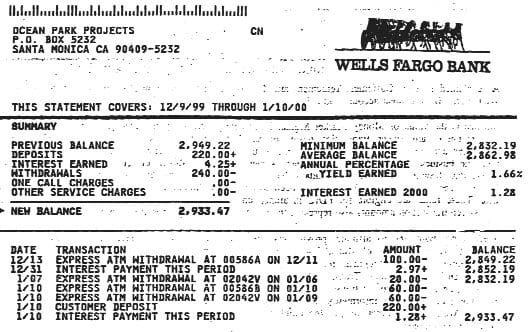
The disclosure of ATM transactions in the case of the Ocean Park Community Organization comes as its chairman, Rick Laudati, continues to ignore requests by its members to produce bank statements.
But Laudati’s actions in apparently avoiding service of a lawsuit against him faltered one week ago. In a Keystone Cops style episode, his pursuers stumbled upon him waiting in line at the DMV in Santa Monica — and subsequently served him by stuffing court papers under his windshield wiper as Laudati sped away.
Laudati is believed to be holding the financial records of the community organization, and could explain why for one month at least, all withdrawals from the group’s bank account were made in cash.
OPCO member Tom Fuller filed a complaint in Los Angeles Superior Court last September, which formally demands the release of the 2000 and 2001 financial records. But that complaint went unanswered. The inaction put OPCO in technical default, thus preventing the organization from defending itself.
But because of some legal technicalities, Fuller and his attorney, Gary Clouse, were asked by Superior Court Judge Allan J. Goodman in April to amend the complaint. The court required that Laudati be served again, which became a a painstaking process for Fuller.
Fuller and a private detective had been unsuccessful for two months in finding Laudati so they could serve him with court papers. That all changed on May 30 when Laudati was spotted standing in line at the DMV in Santa Monica by one of Fuller’s friends, community activist Chuck Allord.
Allord immediately called Fuller, who arrived with a fellow employee 15 minutes later at the DMV parking lot at Cloverfield and Colorado. They found Laudati sitting in his car.
The employee attempted to serve Laudati the paperwork through his car window, but Laudati rolled it up and the subpoena got caught. The papers then fell onto the ground. The employee picked up the paperwork and placed them under the windshield wiper of the car. Laudati drove off with the papers still on his windshield, Fuller said.
That same day, a hearing was scheduled in the case, for which Laudati didn’t show. Judge Goodman made it clear he was unhappy that Laudati hadn’t been served and gave Fuller until June 15 to serve the papers. Legal proceedings require that the party being sued be formally “served” — so the court knows the party has been put on notice.
Coincidentally, Fuller had been on the phone with Clouse pondering their next course of action when Allord called him from the DMV.
“It was very exciting. He finally surfaced,” Clouse said. “Laudati is legally obligated to answer the complaint and if he doesn’t then he and OPCO will face the consequences.”
“Laudati is legally obligated to answer the complaint and if he doesn’t then he and OPCO will face the consequences.” — — GARY CLOUSE Attorney
When Fuller goes to court in July, he doesn’t expect Laudati to be there despite having been served.
“My guess is that he will still try to avoid it,” Fuller said.
Laudati, as well as other board members, have repeatedly declined comment on where OPCO’s money is. Laudati didn’t return phone calls seeking comment.
The last bank statement that was made public sits in a file in City Hall. It details OPCO’s finances from December 1999 to January 2000. At that time, OPCO had $2,933 in a Wells Fargo Bank account. During that month, deposits totaling $220 were recorded and $240 worth of withdrawals were made — all of which were made from ATM machines, which dispense cash.
OPCO hasn’t requested funding from the city for the last three years, but it has in the past. Any neighborhood organization to which the city contributes is required to provide financial records and list its members.
It’s unclear how much money OPCO has collected from its members, how many members there are, and what the dues structure is. Some estimates put the organization’s membership between 150 and 500.
73F,OPCO was formed in 1978 as a community organization for the Ocean Park neighborhood as a nonprofit corporation. Under California law, it’s required to provide its membership with financial records, according to Fuller’s complaint.
One of OPCO’s functions is to review development projects and then recommend to the Planning Commission and City Council that they be approved or denied. Some OPCO board members who have recently resigned said they fear a lack of protection from liability should the organization’s legality be questioned.
Close to a dozen board members have resigned over OPCO’s inaction in the past several months. Board members Audrea Golding Bitler, Ted Winterer and Elan Glasser attempted to work out a resolution with the board to get the finances released last fall. But they resigned in November out of frustration that no progress had been made. In early 2002, Bob Loftus, Joe Pipersky and Bill Sunblad resigned over the financial questions.
When Fuller got involved in OPCO in early 2001, he asked to review the accounting books and finances, as well as a list of the organization’s current membership. His requests have been ignored.
In his written request to Laudati in June 2001, Fuller said he was concerned about an apparent discrepancy between the number of reported members compared to the small amount of membership fees collected.
Fuller attended the OPCO meeting in December to introduce himself to four new board members who had been recently appointed after others quit over the secrecy issue.
Fuller, who has spent $12,000 of his own money on the OPCO chase, plans to proceed with the complaint that formally asks that the 2000 and 2001 financial records be released. He also requested the 2002 documents be given to him on a monthly basis, which has not been done.
Originally published in the Santa Monica Daily Press print edition on June 7, 2003. Read the original PDF.