

Ports of call: City delivers on its promise for potties
11th Street — Hundreds of suspected illegal immigrants who loiter on the sidewalks waiting for work now have a place to squat.
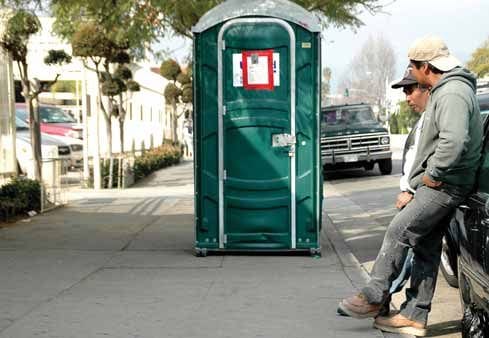
After years of discussion, City Hall delivered two port-a-potties to 11th Street on Jan. 17 as a means of helping residents and businesses deal with a day laborer situation many claim is out of control.
Those concerned about crime in their neighborhood — not to mention excrement on their sidewalks — asked City Hall in August to step in and help regulate the illegal immigrants who gather in this part of town while waiting for someone to drive by and offer to pay them under the table in exchange for labor.
The port-a-potties arrived after years of complaints by residents.
City Hall officials have budgeted for two port-a-potties in the area, but finding the right location for them has been difficult, said Elana Buegoff, a senior administrative analyst in City Hall’s economic development division. In October, city staff met with residents in the area to discuss the placement of the port-a-potties.
The site agreed on is the west side of 11th Street outside of Bourget Brothers building material and lumber store, where the port-a-potties are now located.
For decades, day laborers have loitered on the sidewalks near 11th Street and Olympic Boulevard, where they keep a watchful eye on traffic coming and going from the Salvation Army outlet, Bourget Brothers, the old Fisher Lumber site and other businesses from which they might be called upon to help with construction, landscaping, home improvement, moving and other fix-up jobs.
However, residents have grown weary of the blight created by the masses, which can number up to 175 people on a given day.
The two port-a-potties will cost the city $465 per month to be maintained three days a week, Buegoff said.
Recently, tensions were high on 11th Street as activists battled over whether or not undocumented immigrants have a right to work in the country.
Dozens of counter protesters in Santa Monica far outnumbered the three members demonstrating from the Minuteman Project on Saturday, Jan. 7, during that group’s “Stop the Invasion” National Protest Day. The Minutemen demonstration was meant to send symbolic messages that the group is opposed to illegal immigration and borders should be tightened.
Santa Monica City Councilman Richard Bloom has urged staff to contact officials in Pasadena, who he said seem to have a successful program for regulating day laborers.
Ann Erdman, a Pasadena spokeswoman, said the city passed an amendment in 2003 called the “No Vehicle Solicitation” ordinance.
It prohibits vehicles from stopping in posted areas along Villa Street, which has had a problem with day laborers congregating there at least since 2001, Erdman said. There also are large signs posted that say “no vehicle solicitations.”
Traffic safety problems were the main impetus for creating the ordinance, Erdman said. Other issues related to day laborers, such as littering, defecating, public urination and the rare fist fight, are being handled by a combination of the Pasadena Police Department, organized neighborhood associations and the code compliance office, Erdman said.
In addition, a nonprofit group called the Institituto de Educacion Popular del sur de California has established a day laborer center at 500 N. Lake Ave., just a few blocks from Villa Street. Erdman said the center serves as an organized way for day laborers to find work, and it’s very popular. To participate, day laborers must go through a registration process.
Erdman said the combination of law enforcement and providing the day laborers with employment options seems to be working well for Pasadena.
John Bourget, an owner of Bourget Brothers, said he would like to see an enforcement approach undertaken by City Hall, in addition to the placement of the port-a-potties.
Bourget suggests City Hall set up a program whereby the day laborers are welcomed between 7 a.m. and 1 p.m., for example. After lunch, Bourget said those who don’t find work likely won’t and should be required to leave for the day. If allowed to loiter after lunch, Bourget said the day laborers are likely to drink, gamble and get into other kinds of trouble, he said.
Originally published in the Santa Monica Daily Press print edition on January 28, 2006. Read the original PDF.