

Green Party enlists activists for city’s proposed ordinance
Green party activists from throughout the state met this past weekend to find ways to enact living wage ordinances in other California towns.
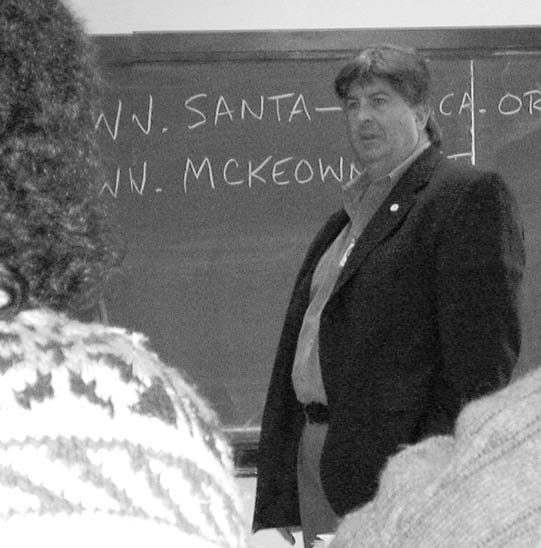
Santa Monica City Councilman Kevin McKeown, a featured speaker at the workshop, shared his experiences in creating the city’s proposed ordinance which will be decided on by voters this November.
Residents here could enact the strongest living wage law in the country. It would require private businesses located in the “Coastal Tourism Zone” that gross more than $5 million annually to pay their employees a higher wage and provide health insurance.
“If we shoot short, we will end up shooting ourselves in the foot,” said McKeown. “We don't need another minimum wage, we need to finally enact a true living wage.”
The Greens also enlisted the help of Vivian Rothstein, president of Santa Monicans for Responsible Tourism, and Madeline Janis- Aparicio of Los Angeles Alliance for a New Economy, who helped enact living wage ordinances in the city of Los Angeles and in Los Angeles County.
Opponents of the living wage ordinance say the measure jeopardizes the city’s annual $700 million hotel industry, and the $40 million in taxes the municipality receives from it.
Kathy Dodson, executive director of the Santa Monica Chamber of Commerce, has said before that mandating what businesses pay their employees is dangerous and will ultimately hurt them in the long run. Many restaurant owners already have said they will stop serving lunch to get under the $5 million revenue cap.
The Santa Monica Chamber of Commerce is leading the charge against the ordinance, calling it discriminatory and unfair.
“Here in Santa Monica businesses are always paying above the federal minimum wage rate because the market has already set a (higher) rate,” Dodson recently told the Daily Press. “In this instance they (the city) are targeting businesses geographically and financially, but they conveniently exclude unionized hotels and city employees.
Supporters of the living wage movement argue that the federal minimum wage is ineffective because it is set well below the poverty level, leaving many families on welfare, food stamps and without health benefits.
“Sure, we have brought in all these jobs but the workers who fill the ranks have to turn to government to pay the bills or buy groceries,” said Rothstein. “Basically, taxpayers are subsidizing the low wages corporations’ pay their employees.”
When Green party activists suggested organizing a boycott of hotels who are fighting the living wage ordinance, supporters said that would only hurt employees they are trying to help.
“We’re not calling to hurt the hotels with boycotts,” said Rothstein. “All we want to do is help the workers, but a boycott would only make their economic hardships worse.”
“We’re not calling to hurt the hotels with boycotts.” — — VIVIAN ROTHSTEIN Santa Monicans for Responsible Tourism
Activists also warned that in order to wage an effective living wage campaign, a solid legal team needs to be in place. McKeown said that even if voters enact the ordinance in November, legal challenges will likely delay the ordinance for years.
“They will sue the city after voters pass it in a last ditch effort to revoke it,” he said. “It’ll tie the city up in lawsuits but, hey, that's life in government.”
McKeown told activists that it’s not just his re-election and the fate of the living wage are at stake this year, but also a measure that would completely rewrite the local election process.
“It’s imperative that we win this year. We’re going to kick ass,” he said. “We’re going to do it in a nice way because we’re Greens, but we’re out to kick ass this year.”
The measure McKeown referred to — the Voters Election Reform Initiative for a True Accountability System, or VERITAS — would allow for the direct election of the mayor and divide the city into city council districts.
Incidentally, McKeown said the measure would leave him without a district to run from.
“But I'm sure that’s only a coincidence,” he joked.
McKeown said just before the council voted to enact the living wage ordinance, a group of hotel owners invited him to lunch and threatened to end his political career if he helped enact the measure.
“They said voting in favor of the living wage would be considered a scorched earth policy toward them,” he said. “And they will now come after me personally in this election.”
McKeown said this year’s election could be one of the costliest in city history because the hotel and restaurant industry is likely to pump millions into supporting the VERITAS referendum and defeating the living wage ordinance.
“They are working hard to defeat us in Santa Monica right now,” McKeown said. “If it works in Santa Monica, similar legislation could be enacted in other tourism heavy cities. And believe me, that scares them to no end.”

Originally published in the Santa Monica Daily Press print edition on January 21, 2002. Read the original PDF.