

SAR team moves 10,000-pound concrete slab
SANTA MONICA BOULEVARD — Though the earth was still, and the city’s structures still intact, Santa Monica’s first line of defense was at the ready on Thursday.
The handful of men and women who would be first on the scene in the event of a major earthquake gathered near an abandoned building to practice rescuing people buried beneath rubble.
More than a dozen members of the Santa Monica Fire Department — supported by a large fire engine, two specialty trucks and equipment — practiced urban search-and-rescue techniques on the corner of Santa Monica Boulevard and Berkeley Street, honing skills they’d use on victims in the event of earthquakes and other disasters.
“This is typically how we would handle a situation if a building collapsed,” said Santa Monica Fire Capt. Scott Ziegert. “Earthquakes would be the primary disaster these guys would be responding to.”
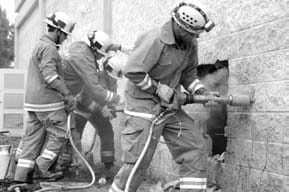
The firefighters, dressed in full-body yellow uniforms and hard-hats, worked together positioning a large drill against a wall for safe human passage. The drill is part of a diverse arsenal the men and women work with when calamity strikes, said firefighter Jimmy Scott, who’s been with the department for 30 years.
“We’re pretty much self-contained, and self-sufficient, to handle any kind of situation on site,” Scott said.
Santa Monica’s specially-trained Urban Search and Rescue team (SAR) consists of 18 fire-fighters, six of whom are available on any given shift, Scott said. They are part of truck company No. 1 and are housed at Fire Station No. 2 at 222 Hollister Ave. Members of the Urban Search and Rescue Team take four weeks of classes and conduct monthly routine drills, as well as take part in an annual regional drill, in order to stay abreast of their skills, according to Paul Weinberg, City Hall’s emergency services coordinator.
To aid in their efforts, the SAR team has a large fire engine, equipped with an 80-foot ladder, and two smaller trucks that contain drills, shoring supplies, oxygen tanks, airbags and other specialty equipment.
The large engine alone cost $900,000. It’s so large that the engine has a rear driver’s seat to direct the back wheels when the vehicle makes turns around corners, Scott said.
The two smaller trucks cost approximately $290,000 each. The SAR truck has $250,000 worth of equipment, and the other truck, which generally accompanies the larger engine, has approximately $100,000 worth of equipment, according to Ziegert.
When the SAR team responds to a disaster, the first course of action is for an appointed surveyor to scope the collapsed building and identify electric, gas and water lines, Scott said.
In the course of the inspection, the surveyor also is expected to identify potential entry points into the building.
To ascertain the whereabouts of victims who may be caught in the rubble, the SAR team may rely on witness testimony, Scott said. They also tap lines and debris in the hopes victims will respond in order to get a better sense of their location.
Another method is to use cameras the trucks come equipped with to insert into the building to try to locate survivors.
After locating them, the SAR team will meet and plan a course of action to gain entry into the structure. To do so, they have a variety of tools available, saws and drills, to cut through any debris. Once a hole is created, they will shore it up with metal pipes or pieces of wood. They will insert airbags that clear a path into the structure.
Then, members of the SAR team, traveling in pairs, will take turns entering the structure to locate the victims.
In the meantime, a coordinator outside the building keeps tabs on the team’s whereabouts through radio devices and other monitors.
The coordinator also watches the team’s oxygen level. As additional oxygen is needed, tanks are stitched out, and the team of two is replaced if they’re not having success finding the victim, Scott said.
While the work can be exhausting, no timetable is placed on how long it will take to complete the rescue operation. The SAR team must adapt to each situation and handle each emergency one case at a time.
In a recent drill, the SAR team moved a 10,000-pound concrete slab using hand-held, non-mechanical tools.
“It showed us that if everyone works as a team, you can move anything,” Scott said.
Originally published in the Santa Monica Daily Press print edition on October 28, 2005. Read the original PDF.