

(This is the fourth installment of an ongoing series about City Hall’s sign ordinance.)
An ongoing effort to remove illegal signs in front of businesses has merchants lashing out at local politicians, who are defending their position that it’s a top priority to clean up the Santa Monica.
For the past three months, compliance officers in City Hall’s building and safety department have been focusing on enforcing all of the city’s codes, which includes an 18-year-old law that governs signs.
As business owners realize that they must tear down their signs or faces tens of thousands of dollars in fines, they look to their elected officials wondering why other issues — like vagrancy — aren’t being dealt with. The perception from many merchants is that City Hall’s policies create an anti-business environment and the recent focus on the sign ordinance is just one example.
But officials say Santa Monica is not a perfect world and ridding the city of vagrants is a separate issue from code compliance.
“We can’t take on bigger issues without solving the smaller ones first,” said City Councilman Herb Katz, who helped draft the sign ordinance nearly two decades ago. “They are right, we have bigger issues and if they cooperated, we wouldn’t have these issues.”
Katz is referring to a web of intricate laws governing vagrancy and the public’s responsibility — specifically property owners — to report illegal loitering, camping and sleeping on sidewalks and in parks. Because of constitutional issues, the burden is on property owners and merchants to keep vagrants from sleeping in front of their doorways by following the city’s local laws. One of them requires businesses to post a sign that states it’s illegal to lie or sleep on private property. That sign must be recorded with City Hall and updated every 30 days.
“Signs don’t have constitutional rights, people do,” said City Councilman Kevin McKeown, adding that ensuring all signs in the city conform to standards will create uniformity. “An attractive, uncluttered environment is good for business... what happens is that people don’t comply with the (sign) law and it creates an unfair advantage for those that do.”
But City Councilman Bob Holbrook, who often is in the minority on the council, agrees with merchants when it comes to City Hall’s policies being misdirected.
“The council doesn’t care about the business community, it’s obvious,” he said. “There is no political will to do anything about the homeless in Santa Monica.
“The council doesn’t care about the business community, it’s obvious. There is no political will to do anything about the homeless in Santa Monica.” — — BOB HOLBROOK City Councilman
“It has to be dealt with at the polls,” he added. “This council isn’t going to do anything.”
Holbrook said he’s more tolerant than most about the signs in Santa Monica and doesn’t see a problem with many of them, including banners hung in front of churches promoting an event.
But the rest of his colleagues do, which is why the City Council directed the building and safety department to hire more officers and start enforcing the city’s numerous codes.
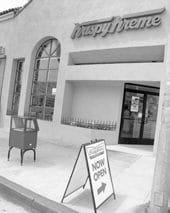
The sign code is based on a complex set of criteria that includes the amount of square footage in the storefront, and prohibits certain types of signs like those that hang from rooftops, those on free-standing poles and sandwich boards, among others.
The sign ordinance hasn’t been enforced for years. In 2000, the City Council directed staff to begin enforcing prohibited signs, but City Hall didn’t have enough staff to handle all of the cases. Businesses who don’t comply now have two options: Either remove the illegal signs, or get a permit and approval from City Hall and one of its commissions, the Architectural Review Board.
City Hall has beefed up its enforcement of illegal signs as part of an overall effort to have all of the city’s codes be complied with, including zoning issues and noise, McCormick said. Ten new code compliance officers have been hired and one is dedicated solely to sign enforcement.
With more than 6,000 businesses in Santa Monica, it’s certain that code compliance officers won’t catch every infraction. But officials hope that the ordinance will become self-enforcing when one business is forced to comply when it is threatened with fines.
“If you cite someone, then their neighbor notices it,” Katz said. “It’s being enforced as it’s seen.”
City Councilwoman Pam O’Connor, who said she’s not a big proponent of code enforcement, said who decides what signs are aesthetically pleasing is subjective, which is why standards were created.
She also added that state laws limit how much local municipalities can regulate vagrants.
“If there is a problem, we need to hear about it and the police need to know about it,” she said. “The state got into limitations on loitering and what is delegated to local authorities.
“Our hands are tied to what the state has preempted us from doing,” she added. “We have more control with laws like the signs.”
Santa Monica Police Department Lt. Frank Fabrega said there are a multitude of laws that overlap regulations related to vagrancy. But if there are issues on private property, the land owner must formally indicate to officers that he or she doesn’t want people sleeping in their doorways. In some cases, property owners don’t have a problem with it.
“It’s private property and we can’t discriminate against that,” Fabrega said. “Under the 14th Amendment, people have the right to equal protection under the law.”
City Councilman Ken Genser said business owners will rarely be fined, if they comply with the law.
“We give them plenty of warning so they don’t have to pay the fines,” he said. “A lot of business owners have complied voluntarily. And it’s not fair to allow their competitors to keep their signs up.”
Originally published in the Santa Monica Daily Press print edition on April 22, 2004. Read the original PDF.