

Santa Monica has plenty, but many are deemed illegal (This is the second installment of an ongoing series about City Hall’s sign ordinance).
(This is the second installment of an ongoing series about City Hall’s sign ordinance).
By Carolyn Sackariason
Daily Press Staff Writer
Business owners who have illegal signs in front of their stores can be fined by City Hall as much as $25,000 per day until they comply with the law.
If they refuse, businesses could face a maximum of $500,000 in fines. That is, of course, if owners think keeping their signs up with no permit is worth a half of a million dollars.
The head of City Hall’s building and safety department confirmed this week that his staff is cracking down on Santa Monica businesses that adorn the outside of their stores with illegal signs.
The concerted effort in enforcing the sign code, which was handed down by the Santa Monica City Council, has been occurring for the past three months. Businesses who don’t have City Hall’s stamp of approval were notified via letter in November of their non-compliance. Since then, a team of building inspectors has been roaming the streets of Santa Monica looking for violations.
They have found many. On Wilshire Boulevard alone, several businesses have been forced to remove their signs in the past few weeks.
One of them was Great Labels, a resale designer clothing shop for women at 1126 Wilshire Blvd. Owner Andrea Waters said she removed the signs two weeks ago after inspectors in March gave her one last chance to comply. However, on Monday, Waters received a hand-delivered letter from the City Attorney’s Office informing her that she is facing $20,000 in fines — $200 a day for 100 days of non-compliance. An administrative hearing is set for later this month.
While it’s unlikely Waters will have to pay a dime, City Hall’s mission is accomplished — the threat was enough to prompt the proprietor to take down her signs, signs which she says are crucial for advertising to the public what she is selling.
5B9,“Fines are that hefty to be a deterrent,” said Tim McCormick, the head of the building and safety department, adding about 85 percent of violators who have been notified end up complying before it gets to the administrative hearing phase. “They immediately comply usually if they know we are going to follow through. It becomes self-regulating.”
The signs at Great Labels were hung on a brick wall at the entrance of Waters’ shop. The number of signs and their sizes must conform to the code, which is based on a complex set of criteria that includes the amount of square footage in the storefront. Waters’ signs were found to be too large and too many in number based on her square footage.
“Everything has priorities.” — McCormick said
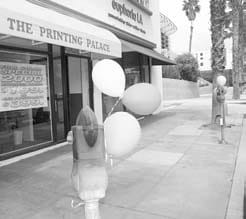
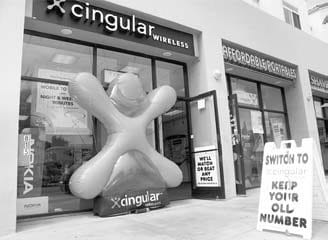
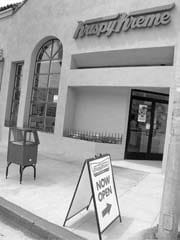
Other signs that are prohibited include rooftop, free-standing pole signs and sandwich boards, among others.
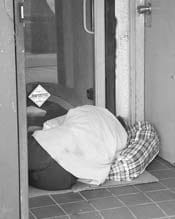
Waters, who is vacationing out of town this week, told the Daily Press on Friday that she feels City Hall’s priorities are misdirected. Not only does she feel that the law is arbitrarily enforced — there are numerous violators throughout the city, even right next door to her — but also that City Hall’s willingness to allow vagrants to sleep and defecate in front of her business is a far worse violation than signs promoting local businesses.
Waters isn’t alone. Many merchants — both those who have been targeted for their signs and those who have not — agree that City Hall’s focus on cleaning up Santa Monica through its sign ordinance is the wrong policy.
31A,“You pay rent, you try to do the right thing as a business and then they make it hard for you,” said one Wilshire Boulevard store manager, who didn’t want to be identified for fear of retaliation from City Hall. That particular business isn’t currently complying with the sign ordinance. “They are anti-business and they create this red tape to make more money.”
McCormick said his department’s code enforcement efforts actually cost City Hall money.
“It’s a quality of life issue, not a money-making issue,” he said, adding it costs between $700 and $800 just for an inspector to handle one case. Fines from code enforcement don’t even account for 10 percent of the revenues for the department, he said.
“We are losing money on code enforcement,” McCormick said. “It’s not about the money.”
“It’s not about the money.”
Until recently, the building and safety department didn’t have enough staff to adequately enforce not only the sign ordinance, but all codes within the city, McCormick said. While there were only four staffers dedicated to enforcement a few years ago, there are now 10 dedicated to illegal signs.
“The city wasn’t in a place to enforce it at the time,” said McCormick, adding that zoning officers also must enforce a host of other codes that regulate all types of issues from overgrown weeds to the noise ordinance. “Everything has priorities.”
With more than 6,000 businesses in the city to check, not everyone will be brought into compliance overnight.
“We try to make a concerted effort to not single anyone out,” McCormick said. “But we only have so many staff to handle it all... we are very conscious about being fair and even-handed.”
He wouldn’t specifically say where inspectors are focusing on, but Lincoln and Wilshire boulevards, as well as the southside of Santa Monica, have been recent targets. Inspections are based on complaints from the public and personal observations from building officials, as well as City Councilmembers.
“We try to concentrate in highly visible areas,” McCormick said, adding inspectors are taking one block at a time. “We are just starting and we are committed to doing it.”
Originally published in the Santa Monica Daily Press print edition on April 8, 2004. Read the original PDF.