

Same-sex union debate touching all churches
By KIM CALVERT Special to the Daily Press
It was a surreal moment for Andre and Lewis, something they never dreamed possible.
The couple, together for more than two decades, last fall pledged their love and fidelity for each other before God, family and friends in a wedding-like ceremony at Santa Monica’s Saint Augustine By-The-Sea Episcopal Church on Fourth Street.
“I never thought we’d be able to do this,” said Andre, 66, who grew up Catholic in New Orleans. “To be able to share with the people in our lives the love we have for each other — before God — it was just an incredible experience.”
Lewis, 64, who grew up Baptist in Salt Lake City, said he was deeply moved by the experience.
“My family, who are still Baptists, came to the ceremony and since that day, they’ve accepted Andre as a brother.”
The couple’s vows included an exchange of rings. A reception followed, complete with a wedding cake with two groom figurines and champagne toasts.
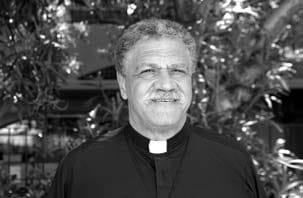
Lewis and Andre, who asked that their last names not be published, said the ceremony was the perfect way to honor their 20th anniversary as a couple. Rev. Hartshorn Murphy, 56, the rector of Saint Augustine’s, at 1227 Fourth St., conducted the couple’s same-sex covenant ceremony. It was the second time he officiated over a gay union at the church — the first time was for two women, one of them a deacon.
A CONTROVERSIAL ISSUE FOR ALL CHURCHES “Same-sex covenants are still very controversial in the Episcopal Church,” Murphy said. “Many priests won’t do it, either because it goes against their own conscience or because it would be unacceptable to their congregation.”
According to Murphy, all churches, regardless of their respective denominations, are debating the issue of homosexuality, but the Episcopal Church had moved to the frontlines of the controversy in August of 2003 when it voted to ordain Gene Robinson, an openly gay man living in a committed relationship, to the position of Bishop of New Hampshire. It was a move that shocked churches around the world.
“There’s still an international disagreement over the ordination of Robinson,” Murphy said. “It never would have happened 10 years ago.”
Murphy said the Episcopal Church did, however, recognize homosexuals as full and equal members of the body of Christ and beloved by God — but noted that, traditionally, the church did not endorse homosexuality as an acceptable means of human expression.
“There are dioceses, like in Los Angeles, where gay people are ordained and welcomed into the priesthood,” Murphy said. “And other places where they are not, and some places where they practice a ‘don’t ask, don’t tell policy.’
“I think one of the biggest struggles we have today is to move beyond the hypocrisy of that and be honest about it.”
Murphy doesn’t consider himself a maverick for performing same-sex unions.
“Saint Augustine’s has a long tradition of welcoming diversity in its membership,” Murphy said, regarding the 125-year-old parish. “This is not a ‘gay church,’ but we’ve had openly gay clergy since the ’70s, so the idea of performing same-sex unions isn’t such a tremendous stretch.”
Murphy said all churches should be motivated to perform same-sex unions because maintaining faithfulness to one person is difficult in any relationship — gay or straight — and by taking vows of fidelity before a church community, a couple increases their chances of success.
“It’s my hope that at some point, maybe in my grandchild’s lifetime, the majority of churches will see it that way,” Murphy said. “There’s great value in encouraging people to be in relationships of mutual fidelity — regardless of their sexual orientation — and to acknowledge God as a part of that.”
SAME-SEX UNIONS NOT ON MOST CHURCH CALENDARS Pastor Keith Magee, the senior pastor at Trinity Baptist Church, 1015 California Ave., said same-sex unions won’t take place at his church.
“I have a different perspective about what the Bible teaches,” Magee said. “We agree that we should love and care for people, but the Bible is very clear about no sex outside of marriage — and that goes for straight people, too.”
Magee said homosexuals are welcome as members of his church, but are asked to be celibate — as are unmarried heterosexuals.
“We’re not a judgmental church. We love people very much, but we hold on to what is written in the Bible, and the Bible is very clear that marriage is between a man and a woman, and sexual activity outside of marriage is a sin,” he said.
St. Monica’s Catholic Church, 725 California Ave., has a gay and lesbian support group, but according to Delis Alejandro, who coordinates the program, the Roman Catholic Church doesn’t perform same-sex unions.
“A priest who tried to perform such a ceremony would lose their position,” Alejandro said. “It would be considered a ‘point of censure.’”
Alejandro said St. Monica’s has a goal to include as many people as possible into its parish, but at the same time, people need to be aware of the church’s stance.
“There are basic church laws,” Alejandro said. “And those laws state that marriage is a sacrament that exists exclusively between a man and woman.”
FINDING ACCEPTANCE When Lewis and Andre first came to Saint Augustine’s more than 15 years ago they had been living together for several years. Although they attended other churches, they didn’t have a church to call home.
“We heard through the grapevine that Saint Augustine’s was accepting,” Andre said, referring to the church’s long-standing attitude of encouraging diversity in its congregation.
“Other churches only tolerated us,” Lewis added. “Saint Augustine’s accepted us.”
Andre said he was disturbed so many Christian churches refused to accept homosexuals as full members of their congregations.
“Over the years, I’ve been exposed to a lot of different churches and a lot of different interpretations of scriptures,” he said. “What I’ve found is that the greatest contributor to division is ignorance, and that ignorance comes out of fear.”
Andre likened it to racial discrimination.
“People used to think if a black family came to their church it would only be a matter of time before it became an all-black church,” he said. “A lot of people have the same idea about gay people.”
Rev. Murphy, who is African-American, can relate to the analogy.
“When I was married in 1973, my wife and I were living in Maryland,” he said. “We were the only interracial couple to be married in the county. People were staring at us like we were doing something immoral. It seems unthinkable today, but it wasn’t that long ago that marrying outside of your race was against the law.”
MAKING IT MORE LIKE MARRIAGE The same-sex unions Rev. Murphy performs at Saint Augustine’s By-The- Sea Episcopal Church are not binding by law, nor do they provide the civil responsibilities and rights granted in California’s domestic partnership agreements.
According to the Partners Task Force for Gay & Lesbian Couples, between 150 and 350 rights and responsibilities come with a legal marriage on a state level, and more than 1,000 rights are built into federal laws.
On March 14, San Francisco Superior Court Judge Richard Kramer ruled that California’s ban on same-sex marriage was unconstitutional. If upheld on appeal, California could follow Massachusetts in allowing same-sex couples to marry.
Judge Kramer’s decision follows a ruling by the California Supreme Court that halted a four-week rush of same-sex marriages resulting when San Francisco Mayor Gavin Newsom directed city officials to issue marriage licenses to same-sex couples, even though it was against state law.
While the debate rages on in the courts, Rev. Murphy said the purpose of the church ceremony is to address the spiritual element of marriage, while also providing same-sex partners an opportunity to consider the responsibilities inherent in marriage.
Gay couples go through the same six-month premarital preparation as straight couples, Murphy said. That includes premarital counseling sessions, and in the case of gay couples, negotiating documents with an attorney to reflect as nearly as possible the legal partnership that comes with marriage.
Murphy said although he may be one of the few clergy performing same-sex union ceremonies in the Episcopal Church, other clergy would be willing to do them if it wouldn’t cause a “hornet’s nest” in their congregations.
“In more conservative areas, I think you could find clergy that would perform same-sex ceremonies in homes or at the beach,” he said. “But they know if they crossed the threshold of their church, it would cause a huge problem.”
Murphy said he was grateful to be involved with a church that has been historically progressive on the issue of homosexuality.
“When people come here, they tell me they are looking for diversity,” Murphy said. “They want a congregation with kids, gay people, straight people, people from different economic backgrounds. They want to be part of a congregation that is reflective of the larger community.”
Murphy said he thinks it’s only a matter of time before same-sex union ceremonies become commonplace in churches.
“People who are trying to prevent gay marriage with a Constitutional amendment are trying to nail down today what will be inevitable in the future,” he said. “In 30 years, people will look back on this and wonder why we made such a big deal about it.”
Originally published in the Santa Monica Daily Press print edition on April 7, 2005. Read the original PDF.