

A direct and constant relationship with parole officers keeps would-be criminals at bay
By CAROLYN SACKARIASON AND JOHN WOOD Daily Press Staff Writers
The September arrest of a parolee in connection with Santa Monica’s only homicide this year is part of an ongoing extensive effort by local police who work with the Department of Corrections to reduce crime and keep criminals out of the community.
Santa Monica Police arrested 21-year-old Arthur Archuletta for second-degree murder three days after 19-year-old Jalonnie Carter was gunned down in an alley near 20th Street on Sept. 2. Archuletta also was picked up for violating his parole by either participating or associating with gang members, said Bill Sessa, spokesman for the state’s board of prison terms.
Archuletta has yet to be charged by the Los Angeles District Attorney’s Office because currently there is insufficient evidence to bring a conviction in court. Archuletta remained in jail for a few weeks after his arrest while the board of prison terms and his parole officer determined his fate. Because of a lack of evidence, he was released and was living with his family in Santa Monica.
That was until Nov. 22 when officers found a firearm in the car he was riding in. Archuletta, a convicted felon, was charged with being an ex-felon in possession of a firearm and a parole violation. He remains in jail, awaiting a hearing by the state board of prison terms, which is expected to occur this month. He could face up to a year in jail if a hearing officer decides to revoke his parole, Sessa said.
“The burden of proof is lower for a parole violation than it is to convict them of a new crime,” Sessa said.
Meanwhile, SMPD is waiting for results to come back from a crime lab to determine if the firearm found in the car Archuletta was riding in is related to any other shootings in the Los Angeles or Santa Monica areas.
Archuletta had been free for only for about two months before he became the focus of police. Archuletta, who was first convicted in Marin County in 2002 for attempting to smuggle a controlled substance into a jail, was paroled from a minimum security prison this past July, according to Russ Heimrich, spokesman for the Department of Corrections.
Heimrich pointed out that Archuletta may be in custody, but he hasn’t been convicted of anything and is innocent until proven guilty.
“He has the right to due process,” he said. “This is America.”
It was up to Archuletta’s parole agent, who works closely with the SMPD, to send him back to jail based on evidence provided by local police. It’s up to the board of prison terms to determine if it’s sufficient to send him to jail on a parole violation.
Because of the constant communication between detectives and parole and probation officers, it makes it more effective to track criminals in the community, or in this case the Pico neighborhood, where there is gang activity, officials said.
“We can give (local police) a lot of information before they make a roll on a call or conduct sweeps,” Heimrich said. “We work side by side with them.”
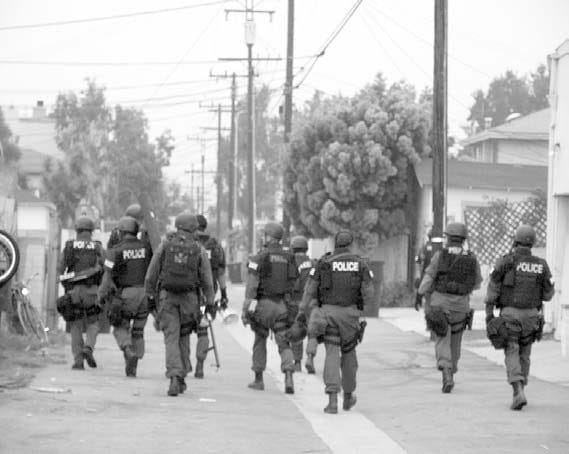
That’s what occurred this summer after shots were fired in five separate incidents within a month in the Pico neighborhood. Based on its own investigation and information provided by parole and probation officers, SMPD conducted several searches within the neighborhood that resulted in the arrests of six people for parole and probation violations. They were sent back into the prison system and in some of the searches, weapons were recovered.
While it’s unknown if any of the suspects were formally charged with the gunshots, they were taken out of the community and forced to answer to their parole and probation officers, as well as to the board of prison terms. It’s a tactic that the SMPD believes is effective and despite criticism from some in the community who say it’s unjust or unfair, police defend their policies.
“The net effect is the same, they are out of the community and we don’t consider that criminalizing anyone.” said SMPD Chief James T. Butts Jr.
The intent of working closely with the Department of Corrections is to target people involved in gang activity and to be punitive and rehabilitative in doing so, Chief Butts said.
Police recognize that a small sector of the Pico neighborhood is effectively terrorizing the community and holding the residents of the area hostage. And targeting those people suspected of engaging in acts of violence is guaranteed.
“If bad things happen, we expect them to stop,” Chief Butts said. “We want the foolishness to stop.”
More than a decade of community-based policing
Police working with parole and probation officers is just one facet of an aggressive, community-based policing effort employed by the SMPD for more than a decade.
The approach is predicated on a multi-pronged approach that ties together various components of the community with the ultimate goal of deterring crime in Santa Monica.
48A,“We are not, we the police, we’re not the people who determine what a city or a neighborhood will be or aspire to be,” Chief Butts said. “But we are facilitators of their aspirations and we are the protectors... We work for them.”
Probation and parole officers, prosecutors, community and religious groups, other City Hall leaders and police work together under the intertwined strategy, which has recently become more important due to a spate of gunshots in the Pico neighborhood.
Police said the blueprint for neighborhood-oriented policing, first introduced in 1990, was “tuned to an art form” in 1998, when two homicides took place in one day. One was a gang-related shooting in the Pico neighborhood. The other, unrelated homicide, was near the beach, when a tourist was fatally stabbed by two men trying to rob him.
SMPD officers met monthly with nearly 80 participants from a wide variety of law enforcement outfits, including the police departments in Los Angeles, Culver City, Inglewood, and Pasadena, the Los Angeles County Sheriff’s Department, national agencies like the FBI, INS and the Department of Justice, as well as dozens of other agencies.
“It brought a different dynamic here. To say that we pulled out all the stops is an understatement,” he said. “We weren’t going to stand for it.”
At the time, more than a dozen searches were conducted and 12 arrests — all gang related — occurred. Eight firearms were seized, four of which were assault rifles, Smiley said.
Increased police presence
To curb violence in the community, Chief Butts in 1990 expanded police presence in the Pico neighborhood by creating a substation at 20th Street and Pico Boulevard that has four full-time officers and a sergeant, all of whom are specially trained in gang culture, as well in prevention and enforcement.
In addition to the substation, regular patrols are done throughout the neighborhood by police. After violent crimes occur, those patrols are increased. In 1998, Chief Butts ordered police officers to work overtime to ensure around-the-clock enforcement of the neighborhood. SMPD obtained a grant from the Department of Corrections that was the equivalent to half the salary of a probation officer so a full-time person could be in the neighborhood specifically to target gang members.
Last year, the SMPD used a helicopter provided by the Hawthorne Police Department to patrol the neighborhood from the sky in response to increased violence.
But Chief Butts and Lt. Guido, who has spent most of his career in the Pico neighborhood, said it goes beyond just cracking down on crime.
47B,“Prevention and intervention are the main things we do when we look at our communities,” Chief Butts said.
That’s why the SMPD has three emissaries — Lt. Guido, Lt. Frank Fabrega and detective Ray Cooper — who are active in the Pico neighborhood and meet regularly with the families and the youths of the neighborhood. They attend community meetings and try to put a human face on the department.
Enforcement isn’t enough
While enforcement is part of the multi-pronged approach, so too is prevention. That’s why SMPD and City Hall have infused millions of dollars into the community — including the Virginia Avenue Park expansion and the Police Activities League. The PAL center, at 1401 Olympic Blvd., which helps hundreds of at-risk youth, operates during the day and night.
Youths are given access to computers, and help with their homework from assistants and experts at the drop-in center. Two full-time officers work out of the center, interacting with youth and acting as mentors. Kids can learn how to balance checkbooks to help their families with the finances, play basketball or just hang out with their peers in the recreation room.
The idea, Chief Butts said, is to give youth an alternative to joining gangs or getting in trouble on the streets.
“We are here as an intervention,” he said. “We focus on attempting to provide opportunities for those children.”
In addition to PAL and regular meetings with community and religious groups, the police department reaches out to members of the community through a variety of 12-week courses.
Probably the most popular of the programs is the Citizen Police Academy, which gives an opportunity for citizens to experience what it’s like to be on the force, how the SMPD operates and get a better understanding of what officers face each day.
As part of the program, participants are versed in almost every aspect of the job, including conducting their own mock arrests and doing a “ride-along” with police officers.
Because the program’s success, police extended it and created the Junior Police Academy, for youth, and the Spanish Citizen Academy, which is geared toward immigrants who might have a negative perception of, or a cultural bias, against police.
Once participants graduate, Lt. Guido said they are offered a slot on the Citizen Academy Alumni Association, which is where many of the police department’s volunteers come from. Volunteers assist with everything from clerical work to organizing large events.
As a result of the outreach efforts, Chief Butts said not only are crimes down — so are arrests. It’s a different model than employed by some police departments, which choose to scare residents into obeying the law by simply increasing patrols.
“That is suppression. That is intimidation. And that is needlessly impacting lives,” Chief Butts said.
Community feedback
Efforts by local police to protect residents and bring criminals to justice have not gone unnoticed by local community members.
Peter Tigler, a member and former board member of the Pico Neighborhood Association, and a former board member of the Virginia Avenue Park Advisory Board, said police should be commended.
“The SMPD are the ones who are really doing their jobs,” said Tigler, who has lived in the neighborhood 23 years and has a daughter who attends Santa Monica High School.
Tigler said to help quell the recent gun violence that has plagued his neighborhood, parents need to get in touch with their children and City Hall needs to re-examine its role in the neighborhood.
“My feeling is a lot of the Pico neighborhood are either asleep or very defensive,” Tigler said, adding, “I don’t blame the opportunities. If people want to work, there’s plenty of work out there. It’s not a matter of jobs — that’s empty rhetoric.”
Tigler said the Pico neighborhood shoulders an unfair amount of the low-income housing in Santa Monica and added that residents of those complexes should be subjected to background checks before they move in and should be evicted if they break the law.
146,“If it doesn’t work, use the ejection button,” Tigler added. “In the end, doesn’t it come down to personal responsibility? Society is not your mommy.”
Peter Tigler
Originally published in the Santa Monica Daily Press print edition on December 8, 2003. Read the original PDF.