

Yiddish revitalized on the big screen
By B Y C Y N T H I A C I T R O N NEWRELEASES
All those who know who Zypora Spaisman was, raise your hands. Hmmm, not many hands, I see.
Well, Spaisman was an actress/entrepreneur who devoted the last half of the 20th century to trying to keep Yiddish Theater alive in New York City. And now a beautiful documentary by Israeli director Dan Kotzir records that struggle; it’s called “Yiddish Theatre: A Love Story.”
As it happened, the waves of Jewish immigrants who arrived in America from Eastern Europe during the last years of the 19th century and the first couple of decades of the 20th brought with them a well-developed culture and a language that had been viable for more than a thousand years: Yiddish. Many didn’t venture too far from Ellis Island, settling into a new shtetl that evolved on the Lower East Side of Manhattan.
Speaking Yiddish, the language that united them, these newcomers established neighborhood theaters to perform plays based on folk tales they had brought with them from “the old country,” as well as translations and adaptations of the classic plays of major European playwrights. At its height, Yiddish theater in New York was presented in 12 venues strung out along 2nd Avenue. (And with more than 200 theaters and traveling groups around the country).
But as the Holocaust destroyed the Jews who had remained behind in Europe, their language also began to fade. It was perceived, as someone in the film points out, as “the language of the dead.” So as an extraordinary new generation of artists, the sons and daughters of the early immigrants, grew up in America to become actors, writers, musicians, comedians, and ultimately, filmmakers, they worked in English.
Hebrew became the official language of the Jews of Israel. Further, as the Jews of the Lower East Side became more prosperous and moved out of the area, other ethnicities moved in. What used to be almost entirely Jewish is now a part of Chinatown.
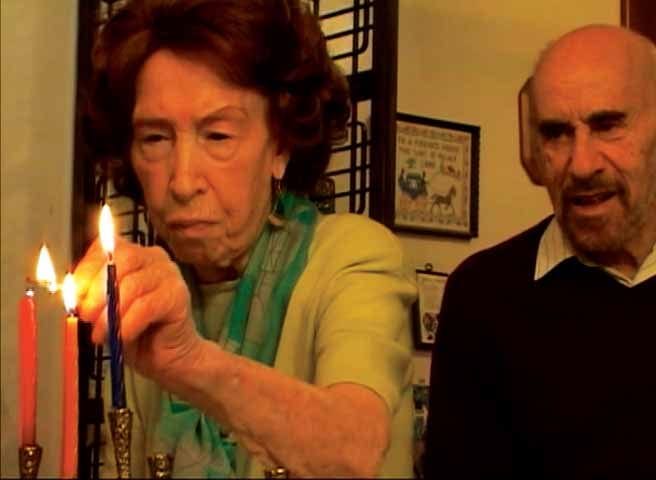
In 1954, however, a 38-year old human dynamo named Spaisman appeared on the scene. She had been a midwife back in Poland, but when she arrived in America she decided to become an actress. She was a natural at it and soon became a fixture of the Folksbiene, the Yiddish Theatre group that was founded in the early years of the last century. (This group is the last one still viable, and it operates as the National Yiddish Theater- Folksbiene.) Spaisman made it her mission to keep Yiddish Theater alive, and “Yiddish Theater: A Love Story” documents her struggle. The film follows her in real time through the eight days of Hanukah, as each Hanukah candle illuminates the way to the end: The closing of her theater, the Mazar. This 199-seat house, which presented plays in Yiddish with English translations on a banner screen above the stage (as is common in opera performances today), had dwindled to performing for as few as eight people. Eight OLD people, since few young people speak or understand Yiddish these days.
The film records her slogging around Manhattan in 2002, during the most severe snowstorm in decades, visiting philanthropists that she hoped would support her theater. In this she was joined by a handsome, eternally cheerful friend named David Romero. (It is Romero who, after an unsuccessful phone call to a Jewish potential benefactor, reports with a rueful smile that the man had turned him down because “he says he supports the Chinese theater.”) In addition to Romero, there are visits and interviews with stalwarts of the Yiddish stage, many of whom reveal the quintessential sense of humor unique to the Jewish people.
There is also beautiful footage of what can only be described as “Woody Allen’s Manhattan” in sunshine and in snow. It is a surprisingly well made, fascinating film. Even more amazing when you learn that it had a budget of only $100,000.
In the end, however, after all her hopes and prayers, Spaisman, who was still acting at 85, had to close her theater. She died shortly afterwards, at the age of 86.
“Yiddish Theater: A Love Story” has been making the rounds (and winning prizes) at various film festivals, and was premiered in Israel. It is currently playing in New York and has been brought to Los Angeles by Laemmle Theaters. The producers are hoping for backing that will allow them to open the film around the country, and for word of mouth that will persuade the Laemmles that there is an appreciative audience for this wonderful documentary.
“Yiddish Theater: A Love Story” is currently playing at Laemmle’s Monica located at 1332 Second St. in Santa Monica. For information, call (310) 394-9741.
Originally published in the Santa Monica Daily Press print edition on December 22, 2007. Read the original PDF.